Legal Spend Analytics: What Your E-Billing Tool Isn't Telling You
6 min read



Do you know what your legal department spent last quarter?
Most in-house legal teams can answer that in minutes. The invoices are in, the spreadsheet is updated, and the total sits in a slide deck somewhere waiting for the next board review.
What you probably don't know is whether that number was right or what next quarter should look like based on the pipeline your team is already managing. That gap between knowing what you spent and knowing what you should spend is where most in-house legal teams have been stuck for years, and it is the gap that legal spend analytics exists to close.
Legal spend analytics is the practice of turning accumulated matter data into cost, duration, and outcome forecasts, so a legal department can predict spending by matter type, evaluate outside counsel on evidence rather than relationships, and walk into a budget conversation with a defensible projection instead of a backward-looking number.
Legal spend analytics is the practice of using accumulated case, invoice, and data to understand not just how much a legal department spent, but why it spent and what comparable work should cost in the future. It goes well beyond the invoice dashboards that most e-billing platforms provide, because it connects financial data to the matter lifecycle that produced it.
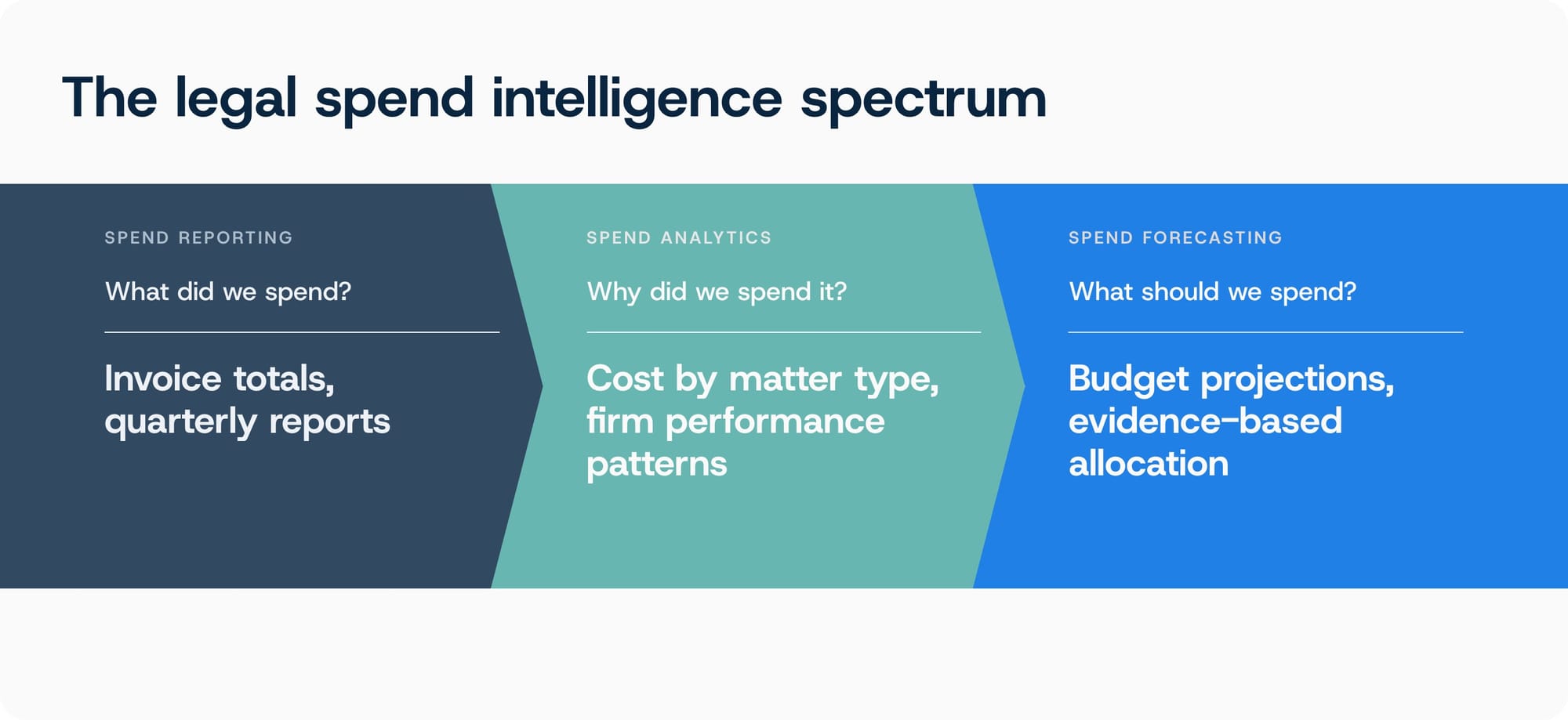
The distinction matters because many legal departments think they already do spend analytics when they do spend reporting. Reporting tells you what you spent; analytics tells you why litigation costs more per case, and that one of your panel firms consistently resolves those matters faster at a lower total cost.
According to CLOC's 2026 State of the Industry Report: only 37% of legal departments now expect a rise in outside counsel spend, and only 32% expect attorney headcount growth. Meanwhile, regulatory compliance at 63% and cybersecurity at 58% continue pushing workload upward.
As we explored in Provakil's analysis of generative AI in legal operations, the technology and the data often already exist within the organization, but the analytical layer that connects spending to outcomes is missing.
If legal spend analytics were simply about better dashboards, most departments would already have it. The real barrier is structural: genuine analytics require four foundations working together, and most platforms deliver only one or two.
The first is structured, categorized case data: matter types, practice areas, jurisdictions, and outcomes tagged consistently across the portfolio, not just matter names and open-or-closed status. This is the raw material every analytical layer depends on.
The second is historical cost and duration patterns by matter type. What does a commercial dispute in a specific region typically cost over its lifecycle? How long does a regulatory investigation run from intake to resolution? These baselines form only when matter data is structured and retained across years of work, not a single budget cycle.
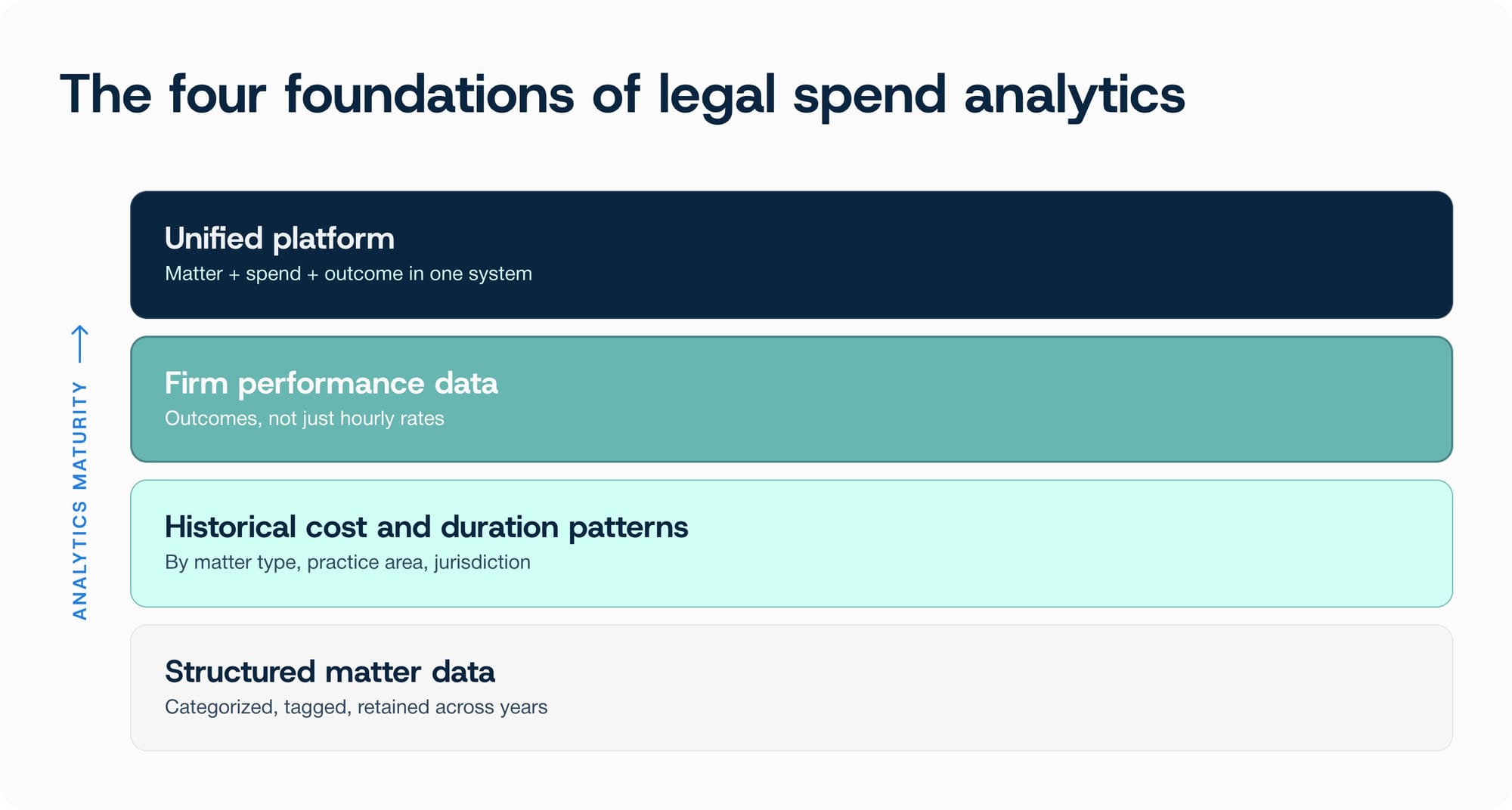
The third is panel-firm performance data tied to outcomes, not billing rates alone. Knowing a firm charges ₹35,000 per hour tells you what they cost; knowing they resolve disputes 40% faster than your next option at comparable total cost tells you something far more useful when allocating the next similar matter.
The fourth is a platform where litigation management, spend data, and outcome data live in one system. When these sit in different tools, the analytics require a data-engineering project before they produce a single insight, and that project rarely survives the budget conversation it was supposed to inform.
Provakil's Enterprise Legal Management platform was built on the premise that matter management, legal spend tracking, and outside counsel oversight belong in one system, because separating them is exactly what prevents analytics from working.
The litigation management module tracks cases across 19,000+ Indian courts and forums, feeding structured, categorized data into the platform with each hearing update, order, and outcome. That data connects to MIS dashboards and TAT analytics that surface patterns across the portfolio.
Legal spend tracking ties every outside counsel invoice, budget, and accrual to the matter record it belongs to, rather than leaving it as a standalone line item in a billing system disconnected from outcomes. External counsel management adds firm-level performance visibility: which firms handle which matter types, how their cost and duration compare, and where outcome-to-cost trends point over time.
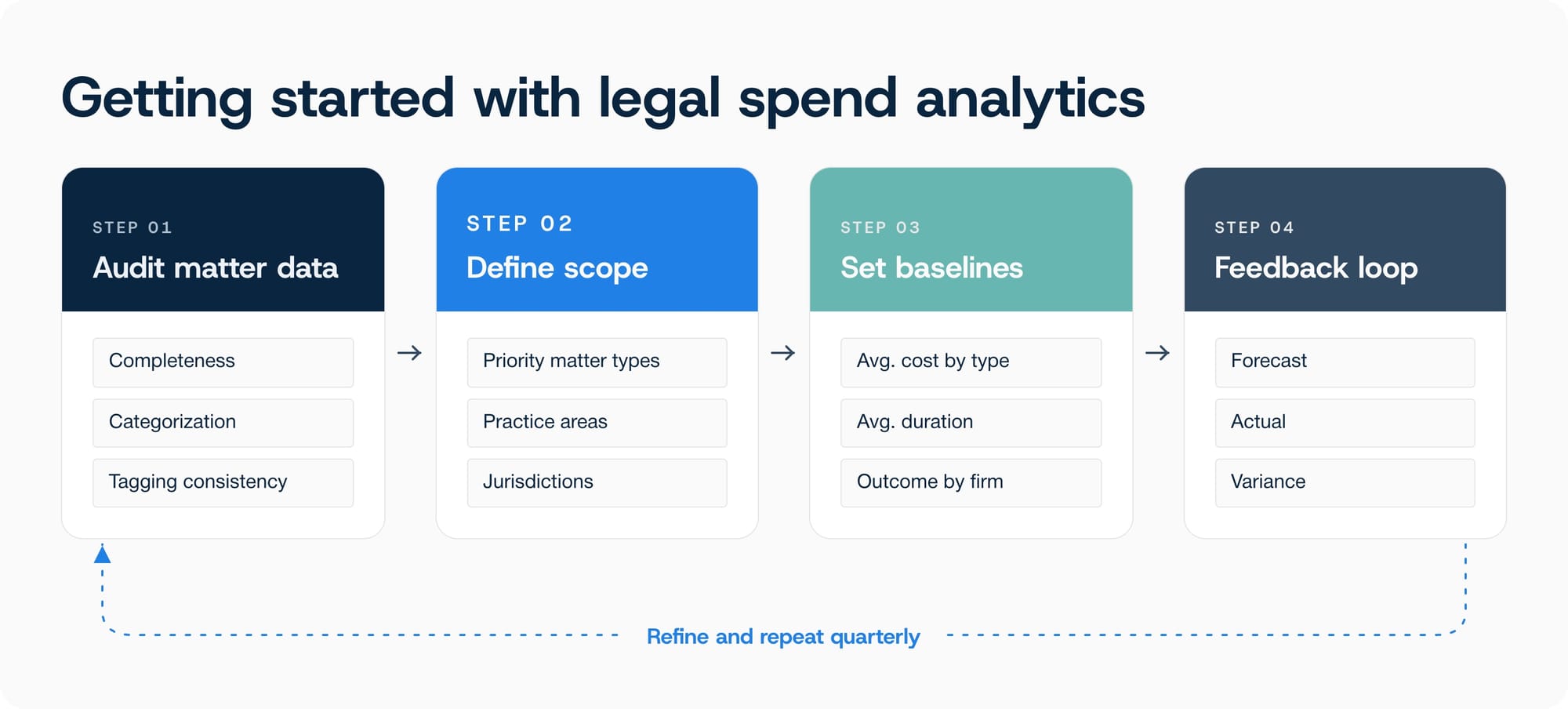
When these layers live in one platform, forecasting emerges from the data your team already produces through everyday legal operations. You do not need a separate BI tool or a data-warehouse integration project. The analytics run on the work your department is already doing, and the path from reporting to forecasting is shorter than most teams assume.

The next time someone in finance asks what legal should budget for next quarter, the answer does not have to be "roughly what we spent last year, plus a buffer." That answer has kept legal departments in the reporting seat for a long time, and it quietly reinforces the perception that legal is a cost center rather than a function that manages risk and outcomes with the same rigor finance applies to its own books.
Legal spend analytics changes what you bring to that conversation. Instead of a backward-looking total and a qualitative estimate, you bring a projection built on matter-type patterns, firm performance data, and a pipeline of work your system already tracks. The conversation shifts from "here is what we spent" to "here is what we expect, here is why, and here is where we can optimize."

Not necessarily. If your ELM platform connects matter data to spend data natively, the analytics layer runs on workflows your team already follows. A dedicated hire helps at scale, but the prerequisite is the platform, not the headcount.
Yes, as long as you track matters and outside counsel costs in a structured system. Smaller teams often see results faster because their matter taxonomy is simpler and pattern recognition requires fewer data points to become meaningful.
Most ELM platforms that support spend analytics offer API-based or flat-file integrations with enterprise ERPs. The key requirement is bidirectional data flow so legal budgets and accruals sync with the financial ledger without manual reconciliation.
Transparency tends to improve relationships rather than damage them. Firms that perform well on outcomes welcome evidence-based evaluation because it differentiates them from competitors who compete only on rates.
It depends on the maturity of your matter data. Departments with two or more years of categorized matter records typically generate directional forecasts within the first quarter of implementation. Newer datasets take longer.

Dive deep into Provakil's numerous blog posts & discover how legal tech can streamline your litigation, contracts, IP, and notice management processes.