Predictive Obligation Management: How AI Finds the Landmines Hiding in Your Signed Contracts
5 min read



Every signed contract carries obligations that extend months or years after you sign. Renewal windows, pricing adjustments tied to index movements, data-deletion requirements on termination, and insurance thresholds that reset annually. Predictive obligation management uses AI to continuously extract, classify, and monitor these commitments so your team catches risks before they become losses.
According to World Commerce & Contracting benchmark research, ineffective contract management costs companies an average of 9.2% of their annual revenue, with laggards losing 15–20%. Most of that value leaks not during negotiation, but during the months a contract sits signed and half-forgotten.
A renewal reminder 90 days before expiry is one notification about one date on one contract. Real obligation management tracks everything a contract requires of both parties across its lifecycle: performance benchmarks, compliance certifications, SLA thresholds, price-escalation triggers, and audit cooperation clauses.
A mid-size enterprise with 5,000 active contracts easily carries 30,000 to 50,000 individual obligations. Many are conditional ("if revenue exceeds X," "upon a change of control," "within 30 days of a data breach"). Some sit buried in schedules and exhibits that nobody reviewed after the deal closed. Calendar tools track dates. They do not track conditions, dependencies, or cascading risk across a portfolio.
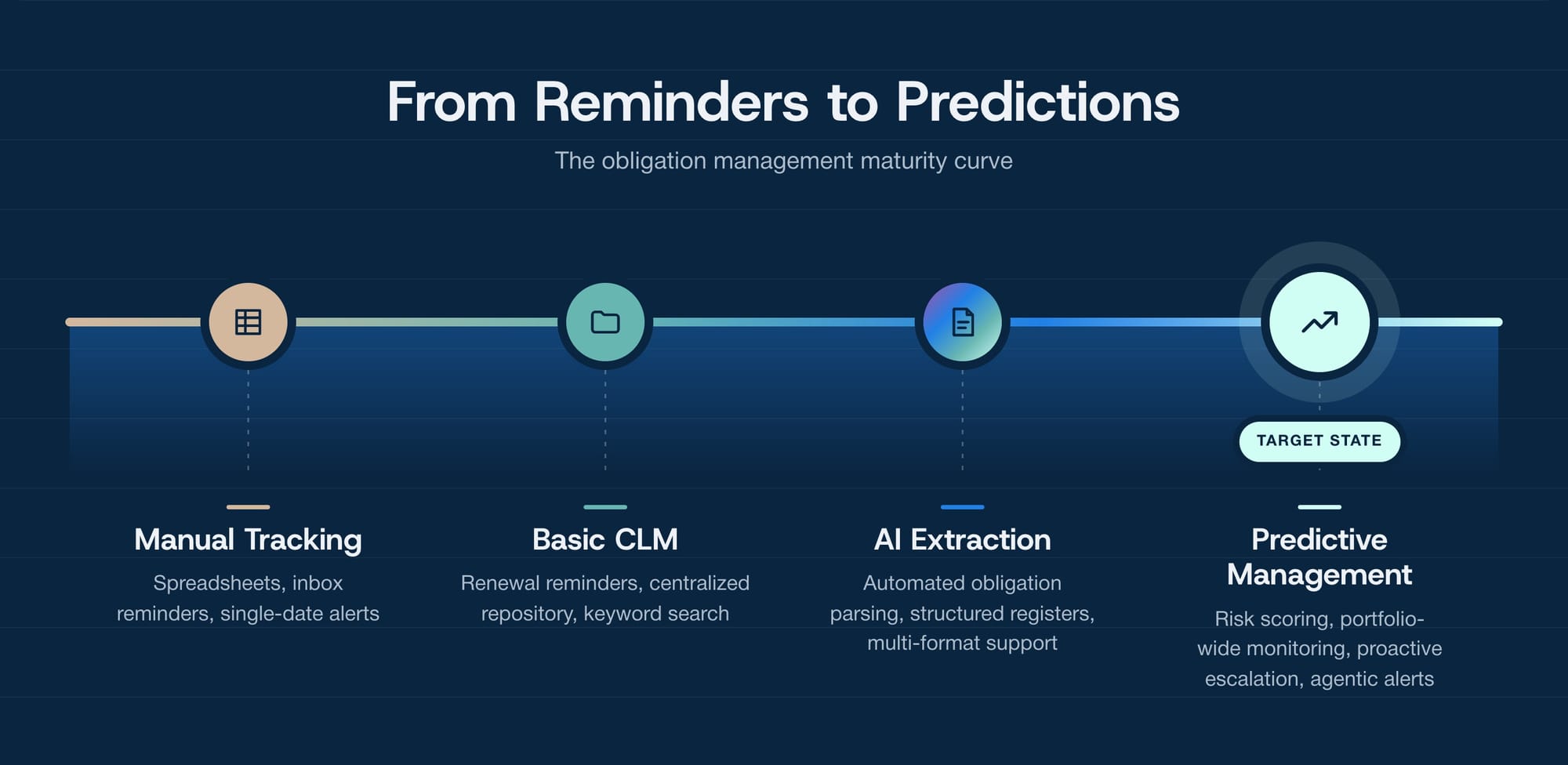
Predictive obligation management combines three capabilities that shift contract oversight from reactive to anticipatory.
Modern AI reads signed contracts, including third-party paper your team didn't draft, and extracts every obligation, milestone, condition, and deadline. This is the data-foundation step. Without structured obligation data, there is nothing to predict against.
The Thomson Reuters Institute's 2026 AI in Professional Services Report notes that enterprise-wide AI adoption in legal rose from 14% to 43% between early 2024 and early 2026, driven largely by extraction use cases reaching maturity.
Once obligations are structured, AI scores each one for risk based on deadline proximity, whether the obligation is conditional on an external trigger, how many parties are involved, and whether similar obligations have been missed before. A clause requiring annual certification renewal is lower risk than a clause that auto-renews a multi-year commitment at escalated pricing unless written notice is delivered within a 15-day window.
The system monitors conditions continuously and escalates when risk factors converge: an approaching deadline, an internal owner who hasn't acknowledged the obligation, and a contract value above a defined threshold. The alert goes to the right person with the right context, not a generic email to a shared inbox.
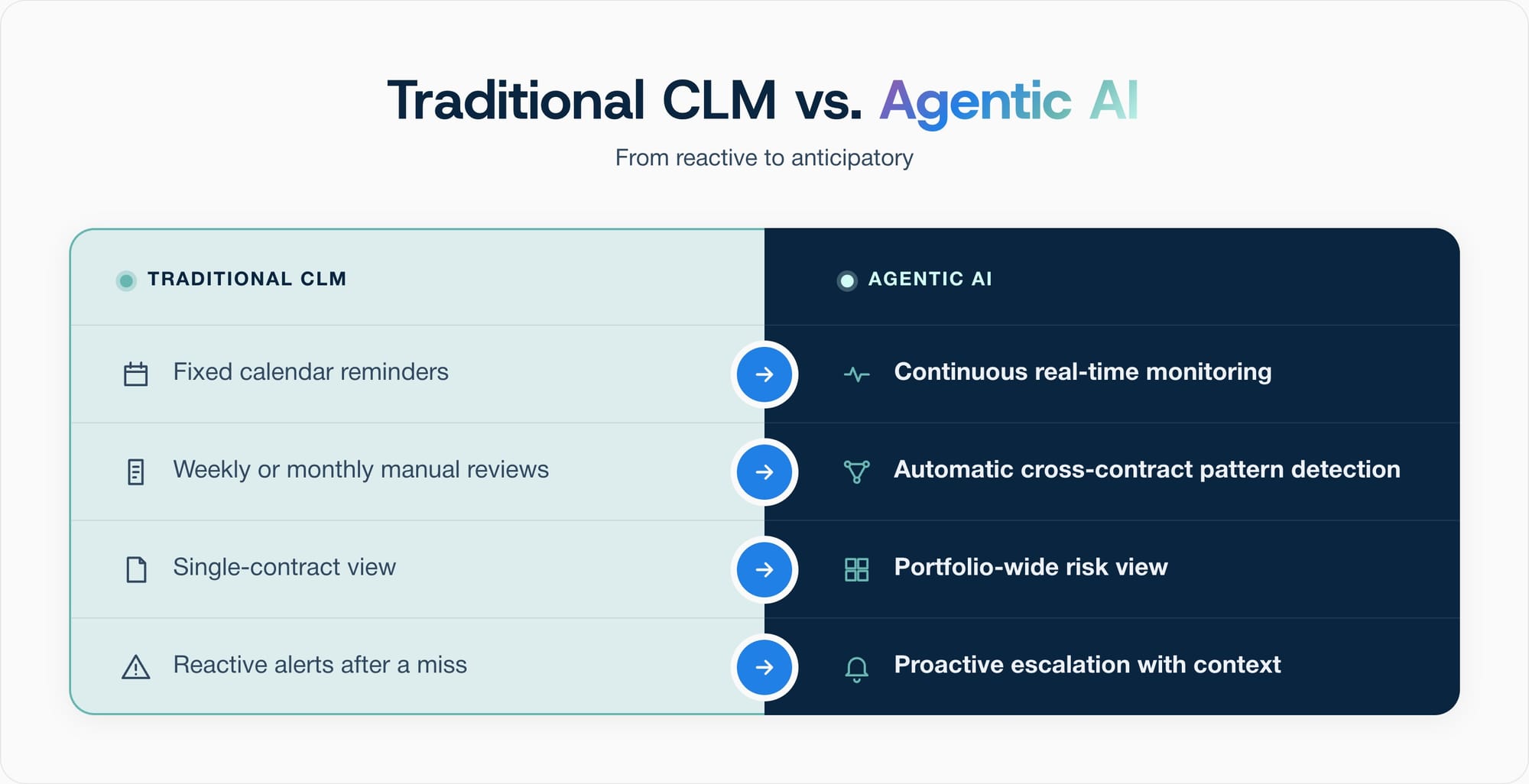
The Thomson Reuters Institute's 2026 report found that while only 15% of organizations currently use agentic AI, 53% are planning or considering it, and 77% expect it to be central to their workflow by 2030.
For obligation management, this means continuous monitoring replaces scheduled checks. An agentic system can identify that 40 of your vendor contracts contain similar data-deletion clauses, that 12 terminated last quarter, and that your team confirmed deletion compliance for only 3 of those 12. That portfolio-wide pattern recognition is beyond what calendar-based tools deliver.
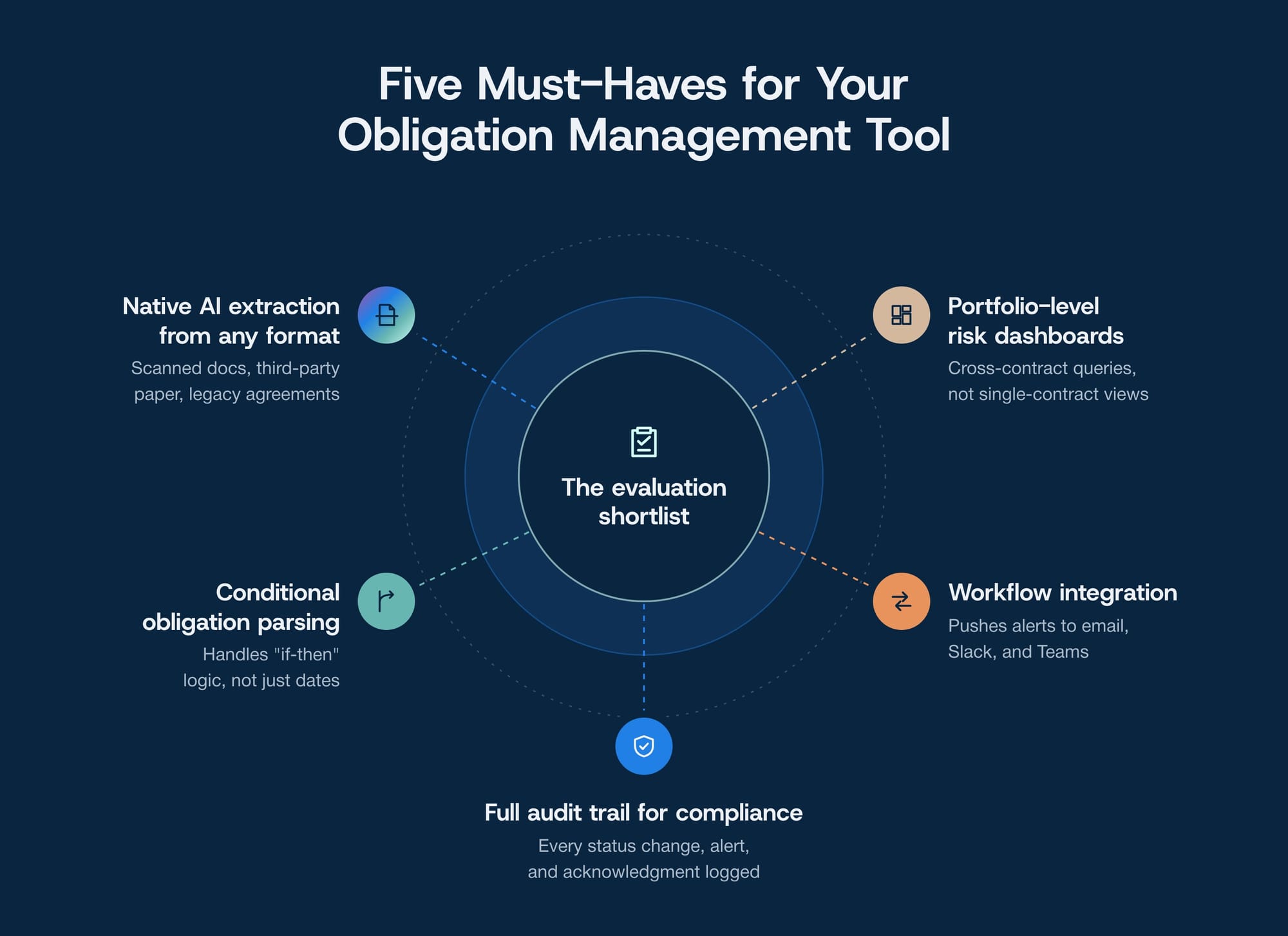
Not every CLM that claims obligation tracking delivers the full predictive capability. These are the distinctions that matter.
If your team has to manually tag every obligation, you will never reach full coverage. The system needs to extract automatically from any format, including scanned documents and legacy agreements.
Many obligations are not simple deadlines. "If Party A fails to deliver by Date X, then Party B may terminate with 30 days' notice." A system that only tracks dates misses the conditional trigger entirely.
Legal-ops leaders need dashboards that answer: "How many contracts have auto-renewal opt-outs in the next 90 days?" If your CLM cannot answer that across the full contract base, it is a repository, not a management system.
Obligation alerts need to push into email, Slack, or Teams. Log every status change, every alert, and every acknowledgement for compliance.

The contracts your team signed last quarter are creating obligations today. Some are straightforward deadlines. Others are conditional triggers buried in schedules that nobody has opened since the deal closed. The gap between signing a contract and actively managing what it requires is where revenue leaks, compliance risks compound, and audit failures begin. Predictive obligation management closes that gap by making every commitment visible, scored, and monitored before it becomes a problem.

Most implementations run four to eight weeks, depending on contract volume and how many legacy agreements need ingestion. Teams with a centralized repository start faster than those migrating from scattered drives and inboxes.
Yes. Modern AI extraction works on any contract format, including counterparty templates, scanned PDFs, and legacy agreements with inconsistent clause structures, without requiring your team to tag obligations manually.
No. It surfaces risks and patterns the team would otherwise miss at scale. Lawyers still decide how to act on an escalation; the system ensures nothing reaches that decision point too late.
Track missed-deadline reduction, auto-renewal savings from timely opt-outs, audit response time, and the number of obligations flagged before breach. Most teams see measurable improvement within the first renewal cycle.

Dive deep into Provakil's numerous blog posts & discover how legal tech can streamline your litigation, contracts, IP, and notice management processes.