NJDG-Connected Case Management Software: Turning Court Data into Operational Intelligence
8 min read



Somewhere in your legal department right now, a litigation coordinator is toggling between browser tabs on the eCourts website, punching in case numbers one after the other, copying next-date entries into a spreadsheet that three other people also maintain in slightly different formats.
Modern NJDG-connected case management is the practice of replacing that ritual entirely by feeding data from the National Judicial Data Grid, which holds status records for more than 23.81 crore cases and over 23.02 crore orders and judgments across district courts, High Courts, and the Supreme Court, directly into a litigation-management platform so that hearing dates, order uploads, and status changes reach your team without anyone checking a government portal every morning.
For enterprises running hundreds of active matters across jurisdictions, the difference between that automated flow and the manual alternative isn't incremental; it is the difference between operating litigation as a managed function and hoping nothing slips through.
When the National Judicial Data Grid first appeared under the eCourts Mission Mode Project, with Phase II launching for district courts on 19 September 2015, its purpose was squarely statistical, a tool for policymakers to study pendency, disposal rates, and infrastructure gaps across the Indian judiciary. That changed in stages, and the pace has picked up noticeably since 2023, when Supreme Court data entered the grid and the system began exposing an Open API for authorized entities alongside SMS and email alerts on case events.
The eCourts Phase III program, approved by the Union Cabinet as a Central Sector Scheme for 2023–2027 at a fund outlay of ₹7,210 crore, is accelerating the shift through several concurrent investments:
As of April 2026, ₹2,740.86 crore had already been released to High Courts and implementing agencies (IMPRI), and the practical consequence is that NJDG data has crossed the threshold where automated, platform-level case management on top of it is not a speculative feature but an expected capability that your competitors are probably already evaluating.
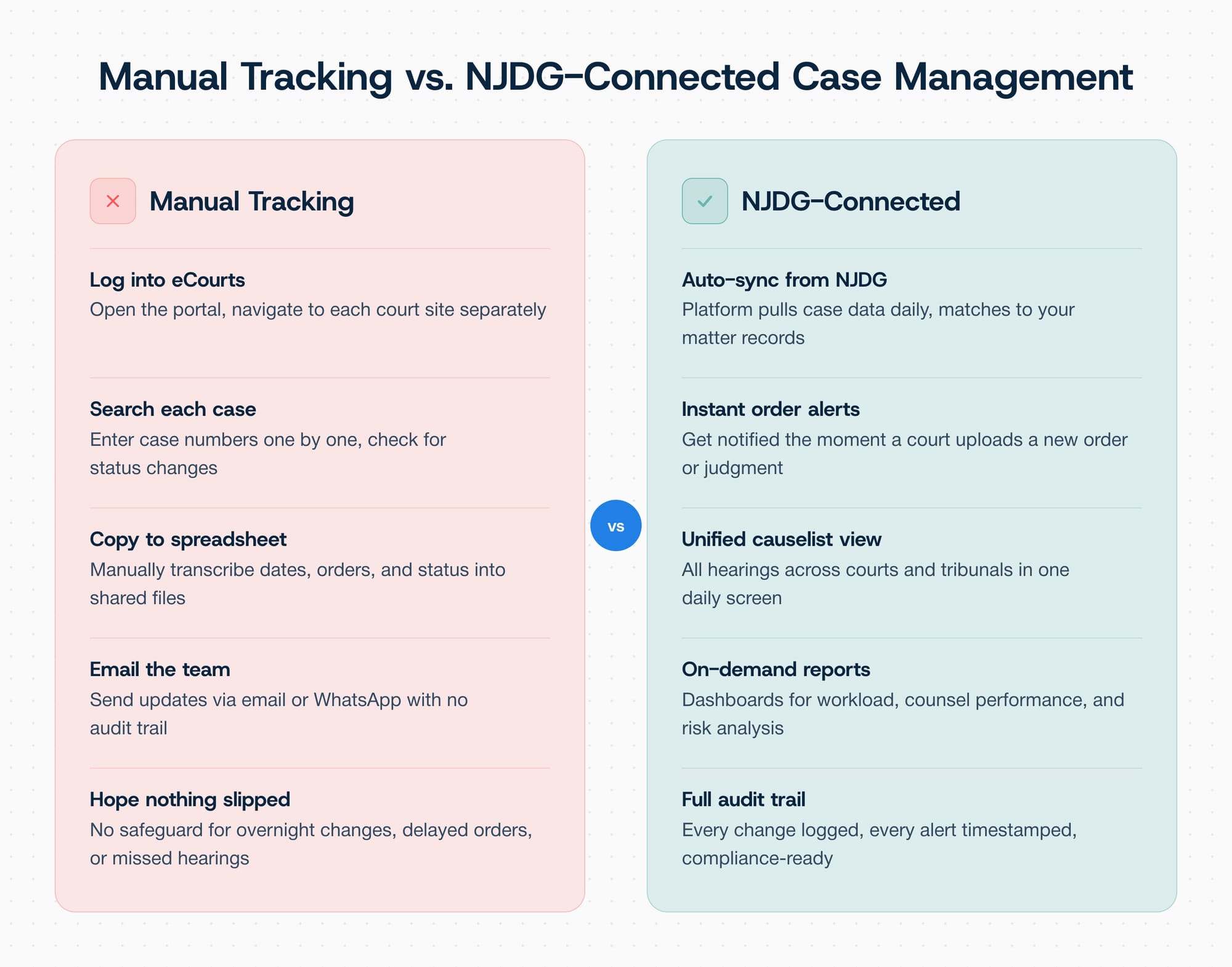
The workflow everyone recognizes, the one where someone logs into eCourts each morning, searches for each matter by its case number, notes any date changes or fresh orders, and distributes the findings over email or WhatsApp, has a deceptive quality: it looks like it works right up until the moment it doesn't [internal link: Provakil litigation management]. The failures are routine rather than exceptional, and they compound quietly across a large portfolio:
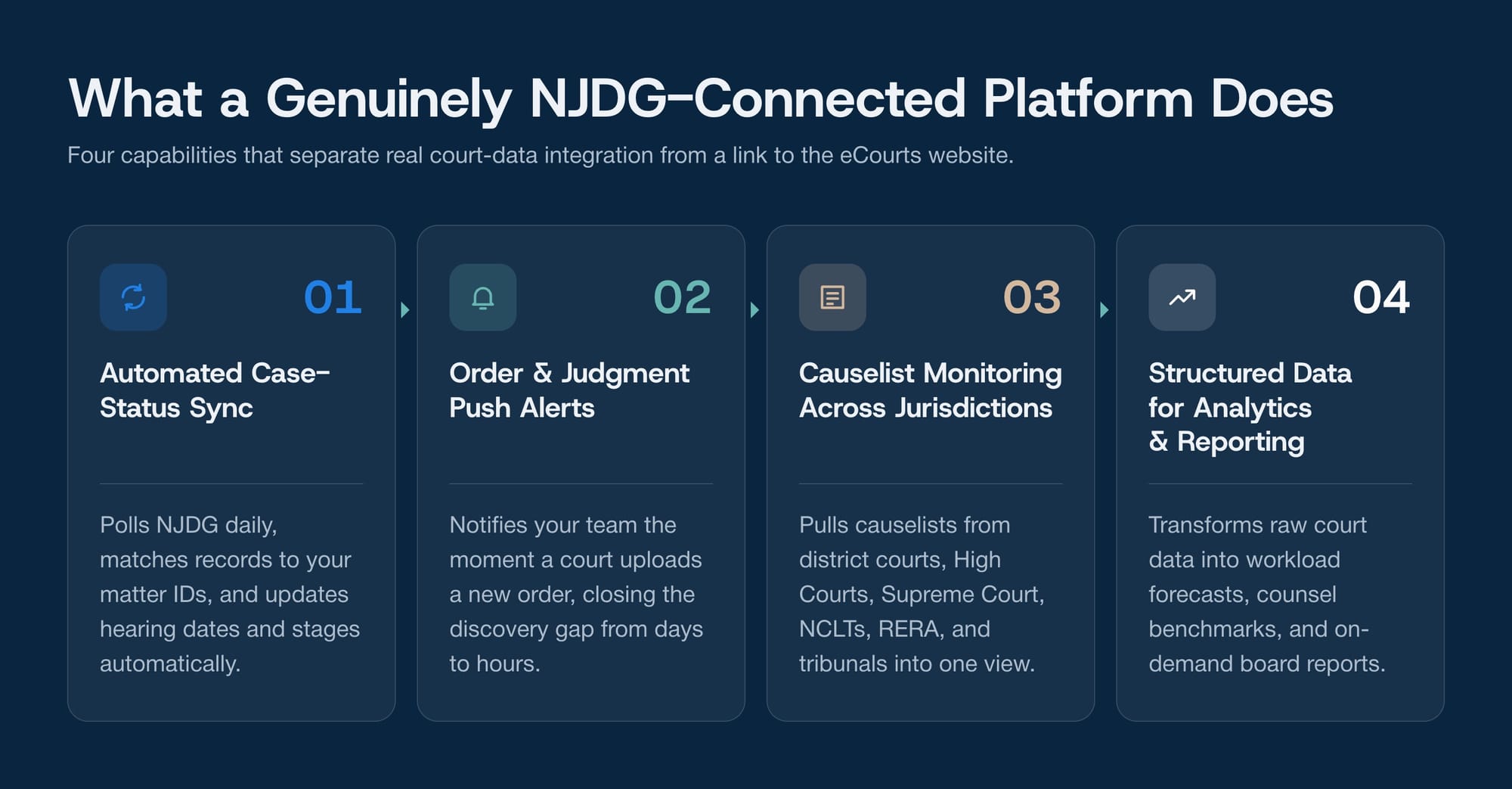
Vendors use the phrase loosely, and the gap between linking to the eCourts website and pulling structured data from NJDG's Open API into mapped matter records is enormous in terms of what your team can actually do with the information. A platform that genuinely connects to NJDG handles several things simultaneously:
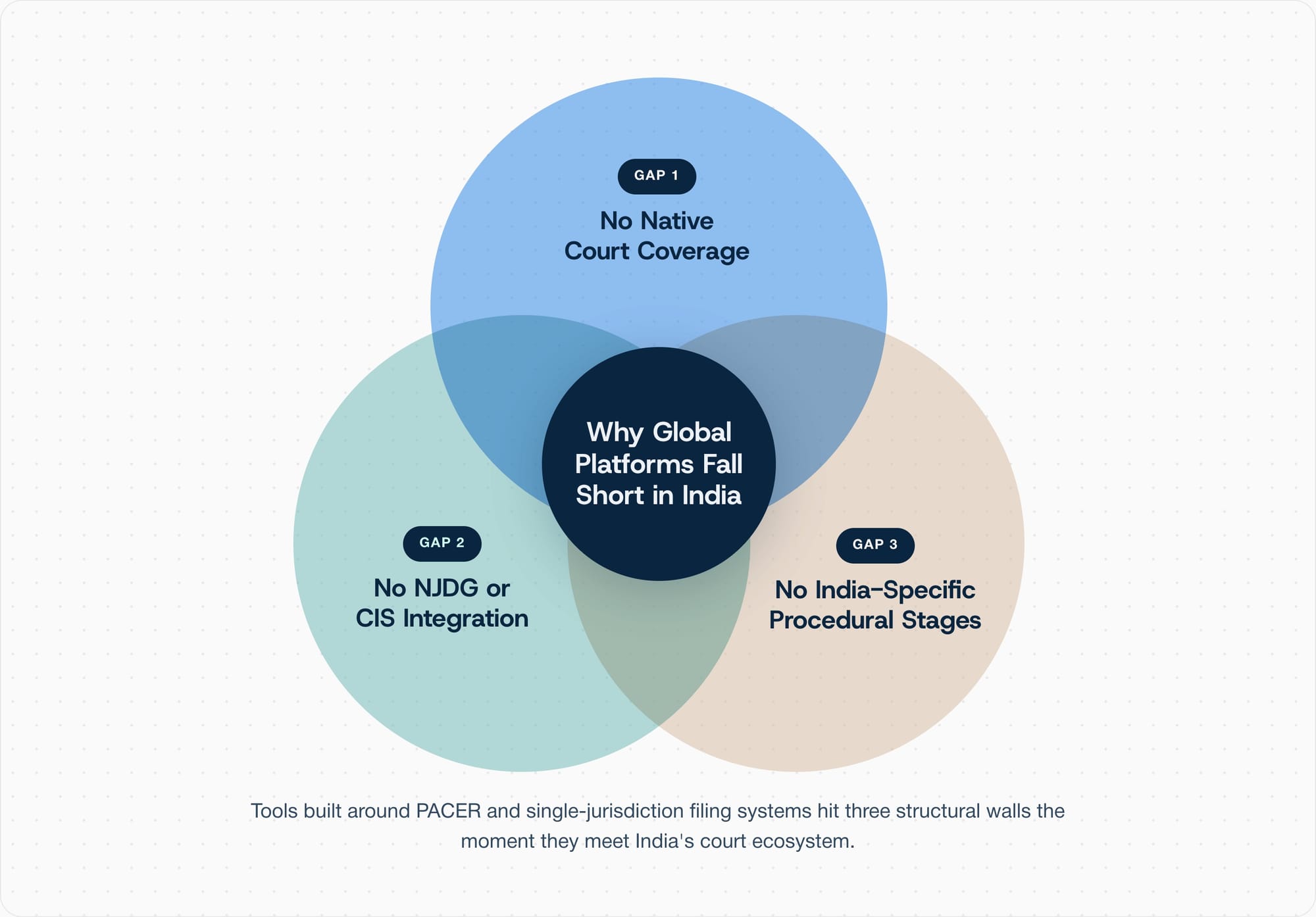
Most litigation-management tools sold internationally are built around PACER for US federal filings, state court e-filing portals, and a case-numbering system that assumes a single-jurisdiction model, which means they do not integrate with NJDG, the CIS, or the dozens of tribunal-specific portals that Indian litigation demands.
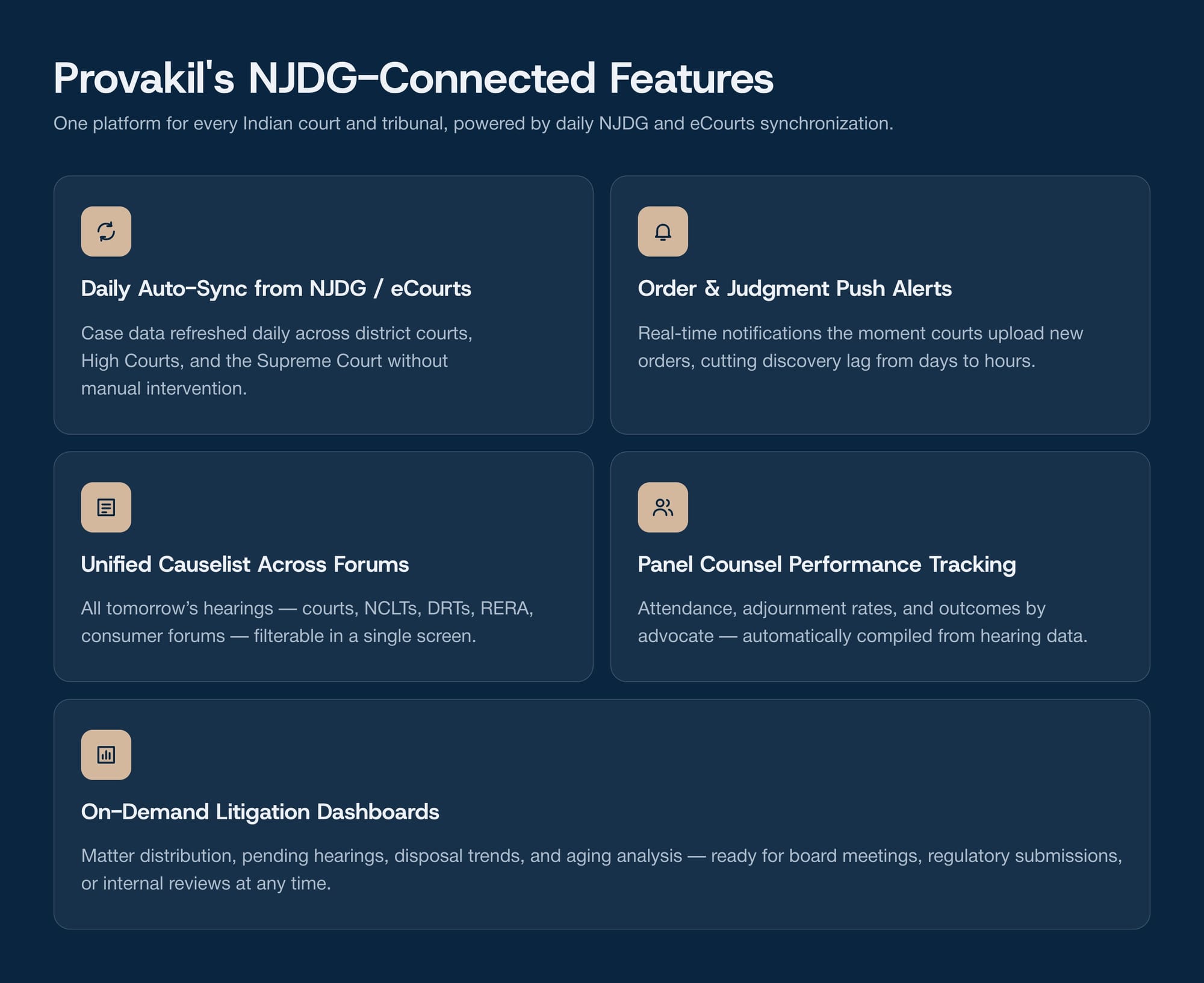
Provakil's case-management platform integrates with NJDG and eCourt Services to synchronize case data daily across courts, forums and key tribunals, so your litigation team operates from a single, current view of every matter without logging into multiple court portals. Here is what that translates to operationally:

The gap between what NJDG makes available and what most legal departments actually do with that data is, frankly, wider than it should be at this point, especially given that the infrastructure, the API access, the daily CIS synchronization, and the eCourts Phase III investments are already in place and improving quarter over quarter.
The organizations that will come out ahead are the ones that stop treating court data as something a junior associate checks manually each morning and start treating it as a live operational feed that drives scheduling, staffing, risk management, and board reporting the same way financial data already does in every other function. That shift is not theoretical anymore, and the tools to make it happen, Provakil's among them, are production-ready for the scale and jurisdictional complexity that Indian litigation demands.

Most enterprises with a structured matter list can go live within weeks, not months. The heavier lift is usually cleaning up legacy case data and standardizing matter IDs internally rather than the platform integration itself.
Not quite. NJDG synchronizes with the Case Information System at regular intervals, typically daily. A connected platform polls that data on the same cycle, so updates usually reflect within a day of appearing on the CIS.
Yes, provided the court has backfilled older case records into its CIS. Most courts connected under eCourts Phase II migrated historical data, though completeness varies by district and state.
It usually sits with the litigation operations head or the legal-technology lead. BFSI institutions often run it through the collections or recovery team, since they manage the highest case volumes and feel the tracking gaps most directly.

Dive deep into Provakil's numerous blog posts & discover how legal tech can streamline your litigation, contracts, IP, and notice management processes.