Legal Ops Software vs. Gen-AI: A Practical Comparison
7 min read



In October 2025, the Bombay High Court quashed a Rs 27.91 crore faceless tax assessment after discovering it relied on three non-existent precedents. The citations were traced to ChatGPT. Two months earlier, the Bengaluru ITAT recalled its own order in a Rs 669 crore dispute for the same reason.
By July 2, 2026, India's Supreme Court had seen enough: in Pooja Ramesh Singh v. Jammu and Kashmir Bank Ltd., the bench declared that any decision resting on AI-hallucinated citations is "no decision in the eyes of the law" and called for zero tolerance.
These are not hypothetical risks. US courts imposed over $145,000 in AI-filing penalties in Q1 2026 alone. Damien Charlotin's AI Hallucination Cases Database at HEC Paris held 1,668 documented cases as of July 2026, up from 719 six months prior.
The question legal ops teams should be asking is not whether generative AI is useful. It is whether gen-AI platforms like Claude, ChatGPT, Gemini, and more are the same thing as legal ops software. They are not, and the difference has consequences measured in quashed orders, sanctions, and suspended licenses.
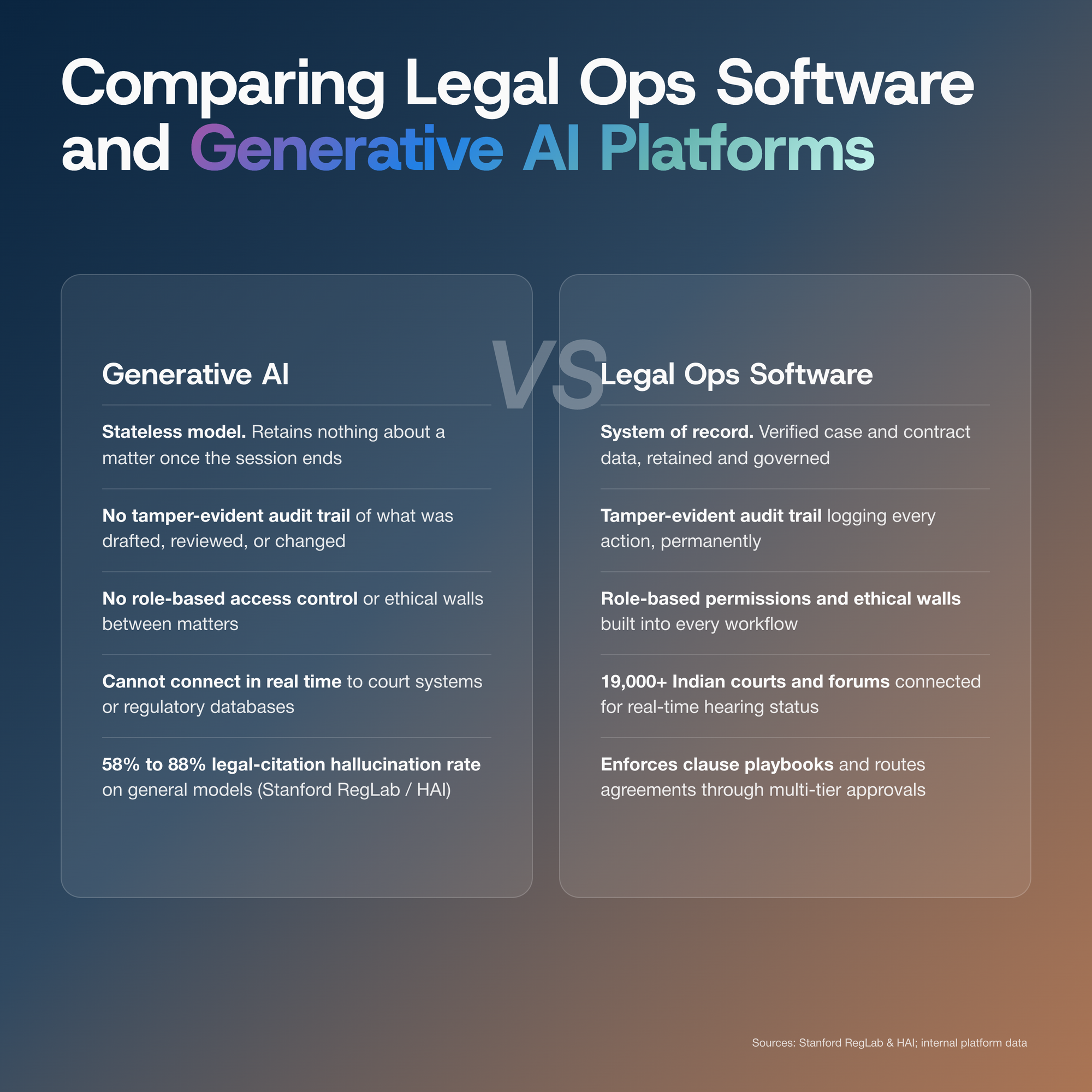
Legal ops software and GenAI are entirely different categories of tool, because legal tech software is a system of record that stores verified case and contract data, enforces the workflows your team depends on, governs who may see each matter, and preserves an audit trail of every action.
Whereas generative AI predicts plausible language on demand and retains nothing about your matters once the session closes. One was built to run your legal function, and the other only to help you draft more quickly inside it.
The divide shows itself once the text appears on screen, because a general-purpose model can hand you a polished paragraph yet cannot route it through an approval chain, measure it against your clause playbook, track the obligation it creates, or file it anywhere that counts. Legal tech software was built to do all of that, keeping the work somewhere permanent and governed rather than letting it vanish when a session closes.
Enterprise tiers from OpenAI and Anthropic offer workspace privacy and contractual no-training guarantees at roughly $25 per user per month, which makes them accessible for routine drafting and analysis tasks.
The problems are structural, not cosmetic. A large language model (LLM) is a stateless text-prediction engine. It holds no persistent case data, maintains no audit trail, enforces no role-based access controls, and cannot connect in real time to court systems or regulatory databases.
Stanford's RegLab and HAI research, testing more than 800,000 verifiable legal questions against GPT-3.5, Llama 2, and PaLM 2, found legal-citation hallucination rates between 58% and 88% across those models.
A follow-up study testing dedicated legal AI tools found fabrication rates of 17% to 43%, depending on the platform. These are not rounding errors. They are systemic properties of how language models generate text.
OpenAI CEO Sam Altman acknowledged in July 2025 that ChatGPT conversations carry no legal privilege. His words were direct: If a lawsuit arises, OpenAI could be compelled to produce those conversations. Pasting client facts, matter details, or privileged strategy into a consumer chatbot, even an enterprise-tier chatbot, can constitute disclosure to an unprivileged third party.
The principle now running through bar guidance and regulation is that the duty to verify AI output stays with the human who signs the filing and never passes to the machine.
A stance embodied in the American Bar Association's (ABA) Formal Opinion 512 and reinforced by regimes such as India's DPDP Act, the EU's GDPR, and the EU AI Act, which treats AI used in the administration of justice as high-risk and pushes firms toward data residency, consent, audit logging, and genuine human oversight.
Provakil occupies the category a standalone model cannot reach, working as an AI layer on top of structured, verified legal data and enforced workflows, with human oversight built into the process rather than bolted on afterward.
It enforces workflows rather than suggesting them. It logs every action in a tamper-evident audit trail. It restricts access through role-based permissions and ethical walls, and it integrates with the enterprise systems (SAP, Oracle, Salesforce, Microsoft 365) that legal departments actually operate within.
Provakil's platform architecture illustrates this difference concretely. Its AI-Powered CLM Software extracts 30+ structured data points from contracts, tracks obligations to renewal, flags clause deviations against a defined playbook, and routes agreements through conditional multi-tier approval workflows with a full audit trail.
The Legal Management module connects to over 19,000 Indian courts and forums for automated case updates, daily causelists, and real-time hearing status.
The Legal Collections module generates and tracks legal notices at scale across digital and physical channels with proof of delivery. None of this is something a language model can replicate, because none of it is a text-generation problem.

The real question facing legal teams was never whether to use AI, since that decision has already been made by the people pasting matters into a chatbot, but whether the AI they lean on sits inside a system that can be trusted and defended when it counts.
As courts sharpen their line on hallucinated citations and data rules tighten across jurisdictions, the gap between a general-purpose model and a purpose-built legal platform will only widen, and the teams that come out ahead will be those who treated every model output as unverified draft material while keeping a genuine system of record underneath the work.
Generative AI will keep getting faster and more fluent with each release, yet fluency was never the quality that made legal work hold up under scrutiny, because a confident paragraph that no one can trace or audit is a liability dressed as productivity.
Legal ops software is what turns that speed into something you can stand behind, pairing a model's drafting power with the verified data, enforced workflow, and audit trail a legal function needs to prove it did the work properly.

No. GenAI tools cannot maintain structured case or contract databases, connect to court systems for real-time updates, enforce role-based access or ethical walls, or run multi-tier approval workflows. It is useful for first-draft language and summarization, but it does not meet the compliance requirements that govern enterprise legal work.
Consumer tiers are generally not safe for it, because they can retain your inputs, offer no data processing agreement, and provide no legal privilege, which means pasting client facts into one can risk waiving privilege, whereas purpose-built legal ops software adds data isolation, role-based access, and audit trails designed to keep confidential information governed.
Use enterprise-tier AI with contractual no-training and zero-data-retention guarantees for non-privileged drafting tasks only. Route all privileged work, including client data, matter strategy, and filings, through a governed legal ops platform with role-based access, ethical walls, and data residency controls. ABA Formal Opinion 512 makes the duty to protect privilege when using AI explicit and non-delegable.
It refers to the way a model can produce a confident but wholly fictional output, such as a case that does not exist anywhere in the reports, and in legal work that is dangerous because a fabricated precedent can slip unnoticed into a filing, which is exactly why human verification of every citation has become non-negotiable.
Integration with Indian court systems (eCourts, NJDG, tribunals), DPDP Act compliance with data residency and consent management, ISO 27001 and SOC 2 Type II certification, support for e-stamping and Aadhaar eSign, and a tamper-evident audit trail. Global platforms that lack Indian court connectivity leave a critical operational gap.

Dive deep into Provakil's numerous blog posts & discover how legal tech can streamline your litigation, contracts, IP, and notice management processes.