The Insourcing Shift: Why India's GCCs Are Pulling Legal Ops In-House?
8 min read



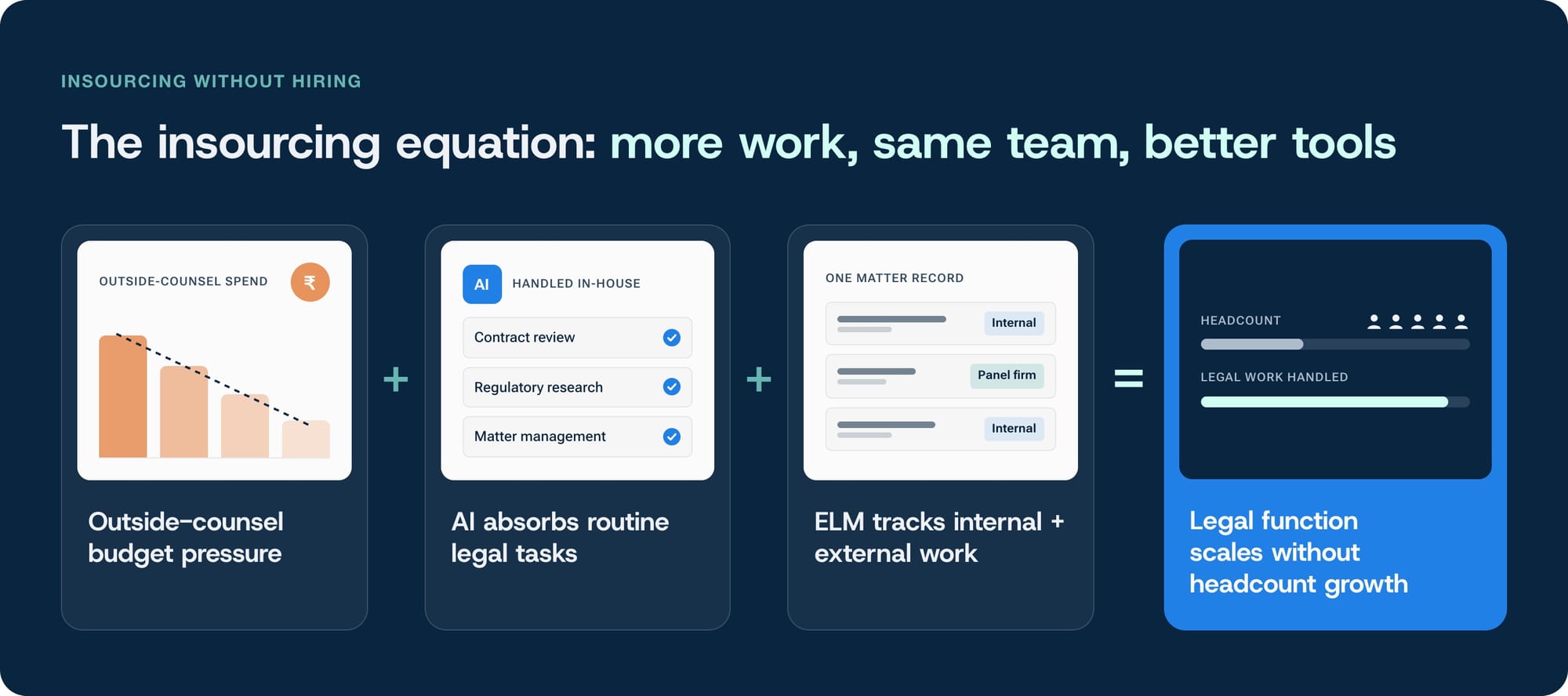
India is now home to more than 1,700 Global Capability Centers (GCCs), and more of them are pulling legal operations back in-house. GCC legal operations insourcing isn't about hiring more lawyers; it's about using AI-powered enterprise legal management to absorb contract review, regulatory research, and matter management that once went to outside counsel, without expanding headcount.
According to RSGI's 2026 research, 36% of in-house teams are already insourcing work previously sent to external firms, while the ACC/Everlaw survey found 64% of in-house departments expect to depend less on outside counsel because of AI.
That shift has consequences for every GCC running a legal function out of India. When work moves inside, but the systems don't keep up, you trade one problem (outside-counsel cost) for another (operational chaos). Enterprise legal management is the discipline that keeps the transition from breaking.
Legal-spend pressure is no longer cyclical. CLOC's 2026 State of the Industry Report found that only 37% of legal departments expect outside-counsel spend to increase, down sharply from 58% the prior year. Expectations for inside legal-spend increases dropped from 65% to 47%, and only 32% expect attorney headcount growth. For GCCs, which were built to centralize and optimize enterprise functions, these numbers are a mandate. The parent organization wants more output from the same budget, and the legal function is no longer exempt.
The window for being an AI early adopter has closed. Thomson Reuters' 2026 AI in Professional Services Report found enterprise-wide GenAI adoption rose from 14% at the start of 2024 to 43% two years later, with large firms and legal departments approaching near-universal adoption.
What does that mean in practice? RSGI's June 2026 report found that power users at law firms save an average of 11 hours per week (up from 8.5 hours six months earlier), and in-house power users save 28.3 hours per month.
That recovered capacity is exactly what funds insourcing. You don't need to hire five more associates if your existing team can absorb the equivalent of five more associates' output through better tooling.
GCCs operating in India face a regulatory environment that global outside counsel rarely understand operationally. The Digital Personal Data Protection Rules 2025 (notified November 2025) are phasing in over 18 months, with Consent Manager provisions arriving by November 2026 and substantive fiduciary obligations by May 2027. Add eCourts Phase III digitization, RERA compliance for real-estate portfolios, and sector-specific mandates from SEBI, IRDAI, and the RBI, and you have a compliance workload that favors teams sitting close to the action.
CLOC's 2026 report quantified the load: regulatory compliance (63%) and cybersecurity (58%) are the top drivers of rising legal workload, even as budgets flatten. That gap between rising demand and constrained resources is what the industry calls the "structural productivity gap," and it is widest in jurisdictions with dense, evolving regulatory frameworks.
Insourcing is not a switch. It is a gradual rebalancing that changes the shape of the legal function in at least four ways GCC leaders need to plan for.
When outside counsel handled most contract review, due diligence, and routine regulatory filings, the in-house team coordinated. Once that work comes inside, the team becomes the execution layer. Matter volumes go up while matter complexity stays mixed. Your Litigation Management System needs to track not just the high-value disputes you always managed internally but also the hundreds of mid-tier tasks that used to sit on a law firm's docket.
In a "send-it-out" model, legal spend is mostly outside-counsel invoices. In an insourced model, spend shifts toward technology licenses, internal headcount allocation, and harder-to-measure process costs. The ELM taxonomy that tracked invoice line items and billing-guideline violations needs to expand into internal cost allocation, capacity planning, and time-to-resolution metrics.
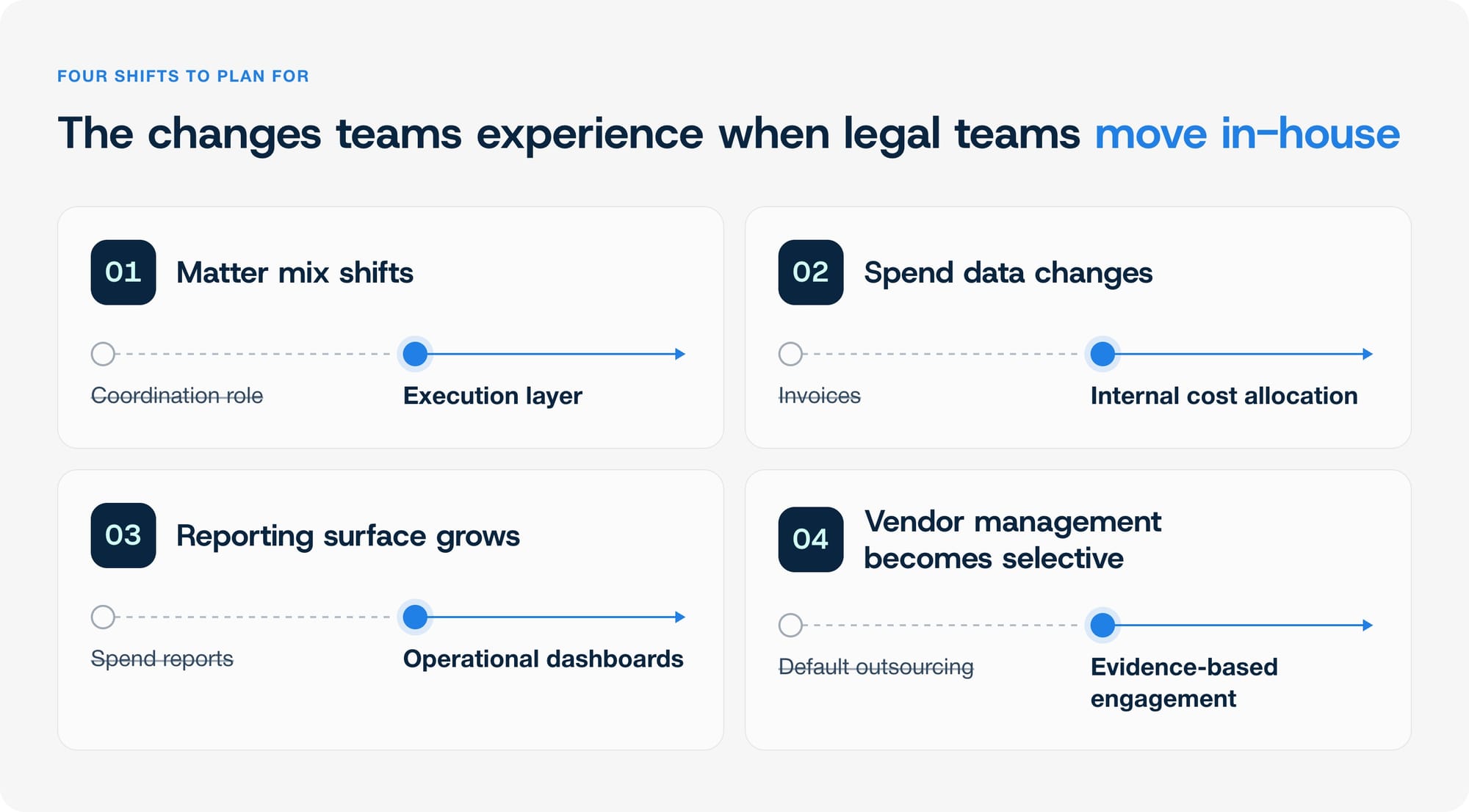
GCC leadership teams report upward to global headquarters. When legal ops was outsourced, the report was simple: here is what we spent on law firms this quarter. Insourced legal ops demands richer reporting.
Without an legal mamagement platform that captures this data natively, the legal function cannot answer these questions, and it cannot justify the insourcing investment to the CFO.
Insourcing reduces outside-counsel dependence; it does not eliminate it. Complex litigation, cross-border transactions, and specialized regulatory matters still go external. The difference is that vendor management becomes selective rather than default. Panel-firm performance needs to be tracked against the work the in-house team handles, not just against billing guidelines. This is where predictive matter budgeting (forecasting cost, duration, and outcome from accumulated data) becomes a real capability, not theoretical.
Litigation management is the operating system for a legal department that runs work internally. Without it, insourcing produces fragmented spreadsheets, ungoverned AI usage, and a legal team that cannot prove its own ROI.
For GCCs in India, the platform also needs to support Indian jurisdictions rather than being retrofitted from a US or UK billing model. Provakil covers the full spectrum, from the Supreme Court and High Courts to NCLTs, DRTs, consumer forums, and 19000+ more, with matter tracking that understands Indian procedural stages and hearing-date alerts connected to court data.
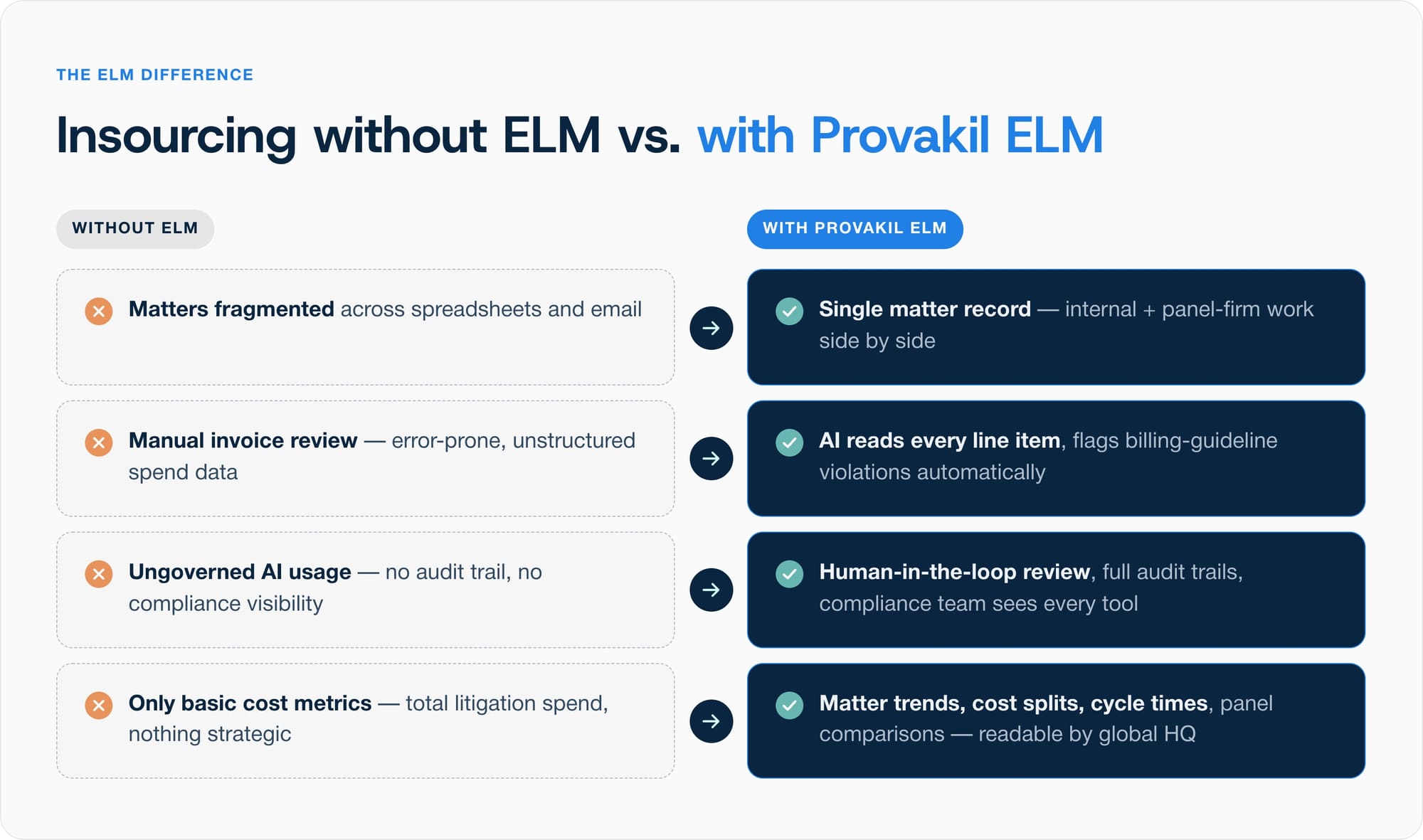
Every piece of legal work, whether handled by the in-house team, sent to a panel firm, or managed through a hybrid model, needs to live in one system. Matter intake, assignment, status tracking, document management, and resolution data all belong in the same place. When a GC asks "how many employment disputes are open across our three India offices," the answer should take seconds, not a week of emails to outside counsel. Provakil's AI-powered litigation management software is built for this hybrid reality, tracking internal execution and panel-firm work side by side so the GCC always has a single source of truth.
Even as insourcing grows, outside-counsel spend does not vanish. AI invoice review reads every line item, classifies the work, checks it against billing guidelines, and flags violations. For a GCC managing a panel of Indian law firms across multiple High Courts and tribunals, automated invoice review turns a manual, error-prone task into structured spend data.
For GCCs operating under global compliance frameworks and local regulatory mandates simultaneously, AI governance is not optional. Provakil enforces human-in-the-loop review for high-stakes tasks, maintains audit trails for every AI-assisted decision, and gives the compliance team visibility into which tools the legal team uses.
The ACC/Everlaw survey found that 96% of CLOs believe GenAI can help demonstrate the legal team's value, but most still track only basic cost metrics like total litigation spend rather than strategic outcomes relative to cost. That is the "metrics gap."
For a GCC legal team making the case for continued insourcing, closing that gap is existential. Provakil's dashboards show matter volume trends, internal vs. external cost splits, time-to-resolution benchmarks, and panel-firm performance comparisons, all in reporting that a Singapore or New York headquarters can read without needing a translator for Indian legal terminology.

Over a third of in-house teams are already insourcing legal work, and nearly two-thirds expect their dependence on outside counsel to keep falling. The GCCs that build the right infrastructure now will set the benchmarks their peers eventually have to match. Those that wait will face the same budget pressure with fewer options.
The question for your GCC is not whether the legal function will absorb more work. It is whether you will have the systems to run that work well when it arrives, to measure what it costs, and to prove to headquarters that insourcing was the right call.

Provakil is built for deployment in weeks, not the multi-quarter timelines typical of legacy enterprise ELM platforms. Contract abstraction, data migration support, and pre-configured Indian-jurisdiction workflows significantly compress onboarding.
Yes. Data can be hosted locally in India, the UAE, KSA, and Malaysia. Provakil also offers on-premises deployment for GCCs operating under strict data-sovereignty policies or government compliance mandates.
For GCCs whose needs span litigation, CLM, IP, and legal collections alongside matter management, Provakil replaces multiple point tools with one platform. It covers capabilities global ELMs typically require separate purchases for.
Over 300 enterprises, including Landmark Group, Marico, Bata, Britannia, ABB, and Flyadeal, plus 50+ government entities and PSUs. More than 25,000 practicing lawyers are onboarded to the platform.
Yes. Provakil serves legal teams across India, the GCC region, and Southeast Asia with local data residency, locally compliant e-signatures, and multi-jurisdiction compliance workflows from a single platform.

Dive deep into Provakil's numerous blog posts & discover how legal tech can streamline your litigation, contracts, IP, and notice management processes.