The Legal Recovery Infrastructure Gap: Why Indian Lenders Can't Scale Collections Without Legal-Tech Integration
7 min read



Indian banks have spent the better part of a decade digitizing loan origination. A borrower can get a personal loan approved on a phone in under ten minutes. But when that borrower defaults and the account moves to legal recovery, the process often falls back on spreadsheets, WhatsApp groups, and manual follow-ups with empanelled advocates. The gap between digitized lending and manual legal recovery is where lenders lose time, money, and audit defensibility.
Legal collections management software is the technology layer that connects a lender's collections operation to the statutory frameworks it must run through. Without it, recovery stays slow, expensive, and difficult to audit, even as loan volumes grow and regulators tighten documentation requirements.
Loan origination technology attracted billions in venture funding because it sat at the revenue end of the lending cycle. Recovery technology sits at the loss-mitigation end, competing for budget against write-offs and provision coverage rather than against growth targets. As a result, most Indian lenders now run a modern loan-management system that hands off delinquent accounts to a recovery process driven by email, phone calls, and manually drafted legal notices.
The overall recovery rate across all channels stood at 18.0% in FY25, according to the RBI's Report on Trend and Progress of Banking in India 2024–25 (released December 29, 2025).
SARFAESI recovered 31.5% of referred amounts (up from 25.4% the prior year), and IBC proceedings recovered roughly 37%. Those are the two most effective legal channels, and both depend on tight process execution, statutory timelines, and documented evidence trails.
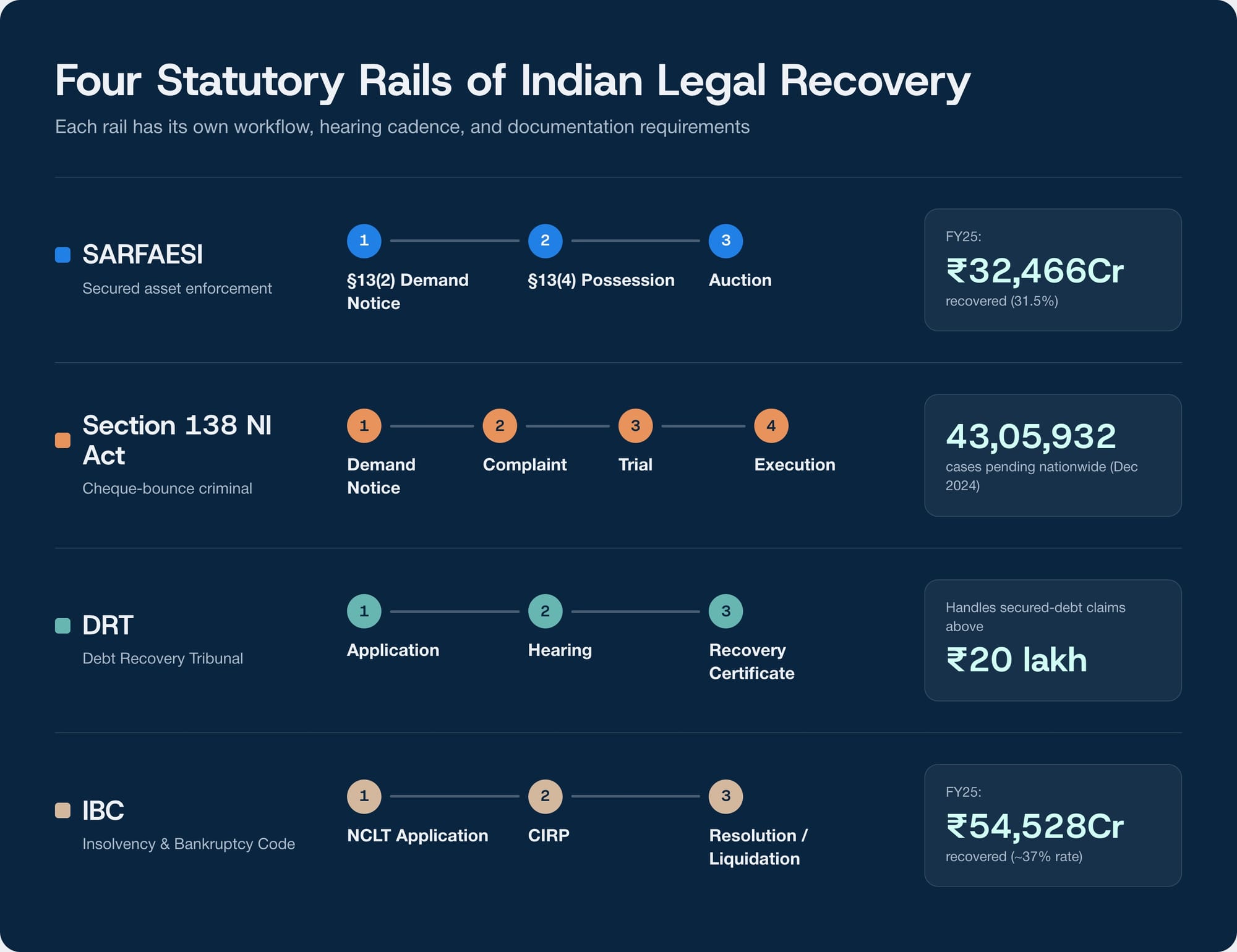
Legal recovery runs on four distinct statutory rails, each with its own workflow, hearing cadence, and documentation requirements.
SARFAESI gives secured creditors the power to enforce security interests without court intervention, but only if they follow the procedural steps precisely. The lifecycle runs from the Section 13(2) demand notice through Section 13(4) possession to auction. In FY25, SARFAESI referrals reached 2,15,709 cases. A missed notice deadline or an improperly documented possession can void an entire enforcement action.
Section 138 NI Act criminal litigation is among the highest-volume legal workloads in Indian courts. As of December 2024, 43,05,932 cheque-bounce cases were pending nationwide (Ministry of Law and Justice, Lok Sabha reply). Delhi district courts alone had 6,50,283 pending as of September 2025 (NJDG data). Tracking hearing dates, filing deadlines, and case status across thousands of matters is operationally impossible without technology.
DRT proceedings handle secured-debt claims above ₹20 lakh. IBC referrals, with structured timelines and NCLT oversight, have become the dominant channel for large-value recoveries, returning approximately ₹54,528 crore in FY25 at a recovery rate of roughly 37% (RBI data).
The typical Indian lender's legal recovery setup involves a legal team tracking matters in Excel, communicating with advocates through WhatsApp or email, generating notices through Word templates, and reporting to the credit committee through manually assembled MIS decks.
When SARFAESI matters live in one tracker, Section 138 cases in another, and DRT proceedings in a third, nobody has a complete view of the legal recovery portfolio. The collections head sees recovery numbers. The legal head sees case status. The credit committee gets a stitched-together report that is already outdated by the time it lands.
Most lenders empanel hundreds of advocates across jurisdictions. Without a system that tracks case allocation, hearing attendance, outcome rates, and billing by stage, there is no way to evaluate whether the right advocate is handling the right case.
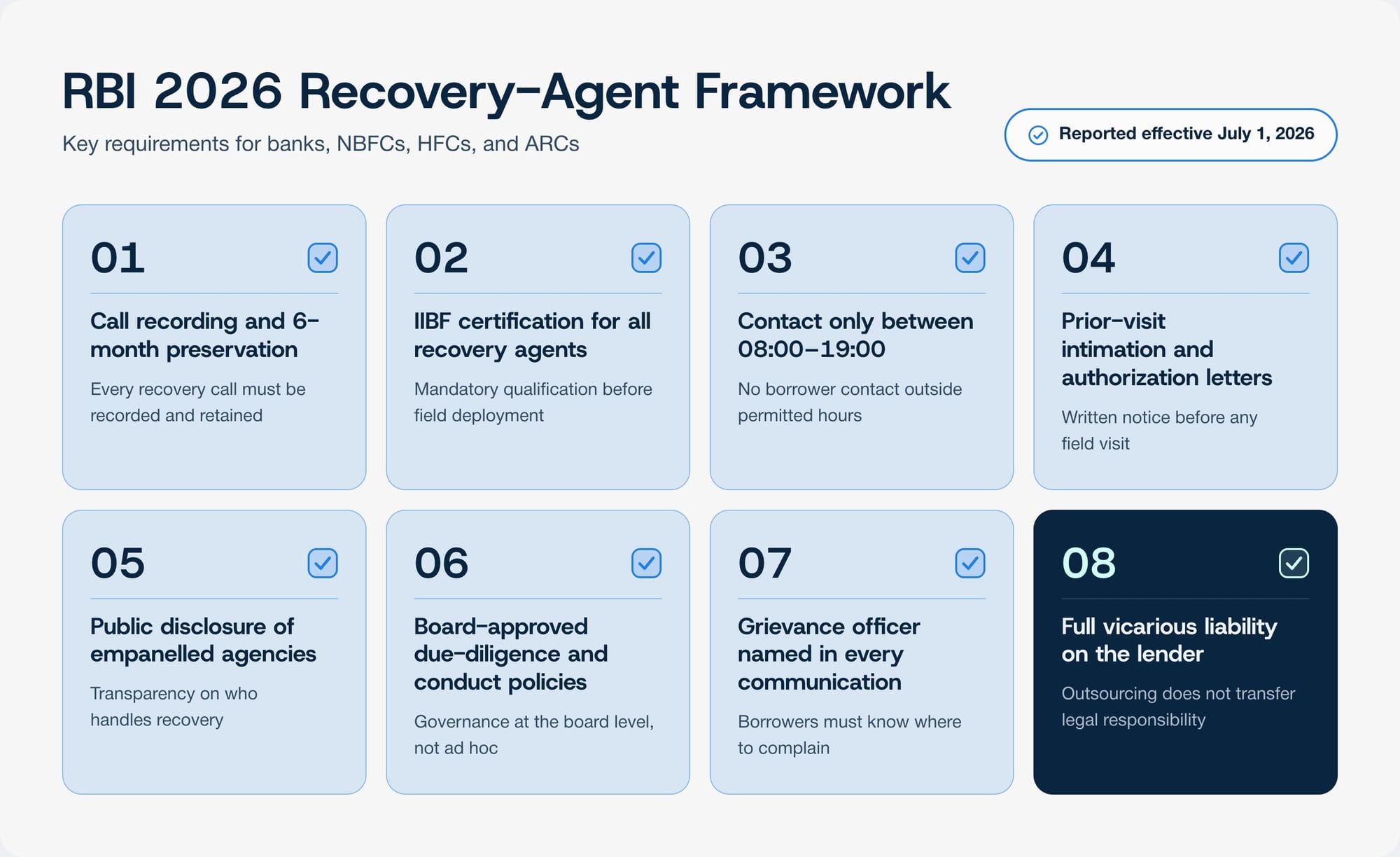
The Supreme Court has strongly condemned banks' use of aggressive recovery agents and held that outsourcing does not remove bank liability (reported in LawRato and Lead India digests). If the notice-to-case chain is scattered across email inboxes and personal devices, the lender's defense in a borrower challenge or regulatory inspection rests on evidence it cannot reliably produce.
Provakil brings SARFAESI, Section 138, DRT, arbitration, and repossession workflows into a single system. Legal notices, both digital and physical, are generated, dispatched, and tracked with India Post proof of delivery from one interface.
Case status across 19,000+ courts and forums updates automatically. Hearing dates, filing deadlines, and statutory timelines trigger alerts, reducing reliance on manual diary checks.
The platform auto-allocates cases to empanelled advocates based on expertise, geography, and workload. Every hearing, filing, and outcome is recorded against the matter, giving legal-ops leaders real data on advocate performance rather than anecdotal impressions. Stage-based billing and court-fee auto-calculation bring legal spend under the same governance as every other cost center.
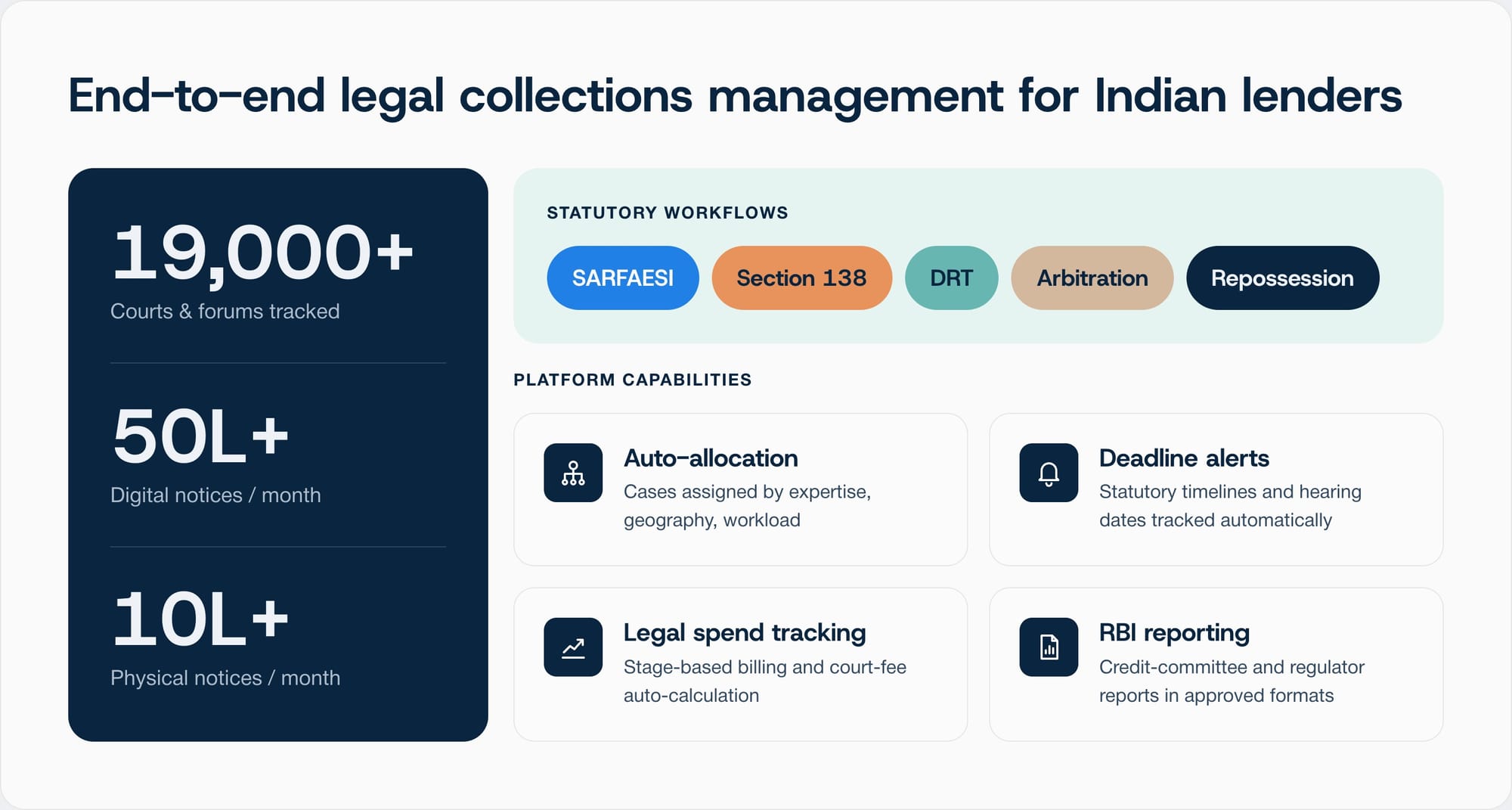
RBI and credit-committee reports generate automatically in regulator-approved formats. When the audit comes, the data is already structured, time-stamped, and traceable to source documents.
Legal recovery data includes borrower identity documents, financial records, and privileged communications. Provakil holds ISO/IEC 27001:2013, AICPA SOC 2, and GDPR certifications, with an on-premise deployment option for lenders with data-residency requirements.

The direction is clear. RBI's recovery-agent framework, borrower-rights jurisprudence, and the broader push toward regulated, evidence-intensive recovery all point the same way. Documentation is no longer optional, and the bar for what counts as documentation is rising.
The lender that invests in an auditable legal system today avoids the scramble, penalties, and reputational damage that follow when a regulator or court asks for records that don't exist in any structured form.
The infrastructure gap between digitized lending and manual legal recovery has persisted because recovery sat at the budget margins. That calculus is changing. Recovery rates remain low, regulatory requirements are tightening, and the volume of matters flowing into legal channels continues to grow.
Lenders that close this gap with purpose-built legal technology will recover more, spend less on outside counsel, and face audits with confidence. The ones that don't will keep learning about their documentation gaps from regulators and courts.

Legal recovery infrastructure is the technology layer that connects a lender's collections operation to statutory recovery frameworks like SARFAESI, DRT, Section 138 NI Act, and IBC. Indian lenders need it because loan volumes have grown faster than legal-team capacity, and regulators now require auditable evidence trails for every recovery interaction.
SARFAESI enforcement follows a strict statutory lifecycle from Section 13(2) demand notice through Section 13(4) possession and auction. Each stage has mandatory timelines and documentation requirements. Legal-tech integration automates notice generation with proof of delivery, tracks statutory deadlines, and maintains the full evidence chain in one system.
Provakil integrates with over 19,000 Indian courts and forums, including the Supreme Court, all 25 High Courts, district and subordinate courts, NCLT, RERA authorities, DRTs, consumer commissions, and other tribunals.
RBI's draft harmonized framework (reported effective July 1, 2026) requires mandatory call recording and preservation, IIBF certification for recovery agents, prior-visit intimation, authorization letters, and public disclosure of empanelled agencies. Lenders bear full vicarious liability for agents' conduct. Document, store, and make every recovery interaction producible on request.
Yes. Provakil's Legal Collections module includes dedicated workflow engines for Section 138 NI Act cases, full SARFAESI 13(2) through 13(4) and auction lifecycles, DRT proceedings, arbitration, and vehicle repossession.

Dive deep into Provakil's numerous blog posts & discover how legal tech can streamline your litigation, contracts, IP, and notice management processes.