AI-Powered Legal Tech Software vs. Claude: Why the Smartest AI Still Isn't Legal Software
8 min read



If you are evaluating AI legal tech software for an enterprise legal team in 2026, Claude is probably on your list. Claude Fable 5 leads Vals AI's LegalBench at 88.56% accuracy, the highest score any model has posted on a dedicated legal reasoning benchmark, ahead of Gemini 3.1 Pro Preview at 87.40% and GPT-5.5 at 86.52%.
In May 2026, Anthropic launched Claude for Legal with 20+ MCP connectors, 12 practice-area plugins, and integrations with Thomson Reuters, Westlaw, Everlaw, and iManage. By every visible measure, Claude has staked its claim as the most capable legal reasoning AI on the market. And in the same twelve months where that claim took shape, federal courts in Texas, New York, and Louisiana fined attorneys for filing Claude-generated briefs containing fabricated citations.
A federal judge ruled that Claude conversations carry no attorney-client privilege, establishing a nationwide first-impression precedent, and Anthropic's own defense firm admitted to a magistrate judge that Claude hallucinated a citation in a filing made on Anthropic's behalf.
That contradiction is the one legal operations teams need to sit with. These are not gaps that a future Claude release will close; they are architectural, which is exactly why AI-powered legal ops software exists separately.
This is the third piece in Provakil's comparison series, after the broader legal ops software vs. generative AI comparison and the ChatGPT-specific evaluation.
Claude is genuinely strong on legal reasoning, and dismissing it as "just another chatbot" would be dishonest. The LegalBench and Legal Research Bench numbers cited above reflect real improvement in the model's ability to parse statutes, distinguish holdings from dicta, and reason through multi-step legal questions.
But reasoning and reliability are entirely different problems. On Harvey's agentic Legal Agent Benchmark, which measures whether a model can complete a full legal task end-to-end rather than answer a question about one, the best public score is just 11.25%. Stanford's "Large Legal Fictions" study found general-purpose LLMs hallucinate on 58% to 88% of specific legal queries, though Claude was not among the four models directly tested in that study.
The gap between "reasons well about law" and "does legal work reliably" remains enormous. That gap is exactly where the documented courtroom failures live.
Gauthier v. Goodyear (E.D. Tex., November 2024) was the first US sanctions case to name Claude explicitly, after plaintiff's counsel used it to draft a summary-judgment response citing two nonexistent Fifth Circuit cases and fabricating quotations from six real ones, drawing a $2,000 penalty and mandatory CLE while opposing counsel reported spending over $7,500 responding to phantom authorities.
In Kaur v. Desso (N.D.N.Y., July 2025), an immigration attorney working under a deadline and with a respiratory infection used Claude Sonnet 4 to draft an emergency habeas corpus brief containing fabricated quotations, and was fined $1,000 after the court found he "was aware that artificial intelligence tools are known to hallucinate."
Brooks v. Lowe's (W.D. La., May 2026) exposed the most dangerous pattern. A law clerk caught hallucinated quotations in a Claude-generated brief before filing, and the attorney then asked Claude to correct the identified errors rather than verifying them against a legal database. Judge Jerry Edwards Jr. wrote in his order that "Claude just made up more stuff," fined the attorney $1,000, and stated that "ignorance of the risks of AI usage is no longer an excuse." Asking the same model to verify or fix its own hallucinations is now a documented path to federal sanctions.
In Concord Music v. Anthropic (N.D. Cal., May 2025), a Latham & Watkins associate asked Claude.ai to format a citation for a real article published in The American Statistician and filed the result in a declaration on Anthropic's behalf. Claude returned an inaccurate title and incorrect authors, and Magistrate Judge Susan van Keulen distinguished it from a routine citation error, calling it "a hallucination generated by AI" before striking the citation from the record.
If Claude fabricated citation details in a filing made by the law firm defending its own maker, the verification gap is not a user-competence problem; it is architectural.
Claude for Legal, launched on May 12, 2026, added 20+ MCP connectors linking Claude to Thomson Reuters, Westlaw, Everlaw, iManage, and DocuSign. When Anthropic released its open-source legal plugins in January 2026, Bloomberg reported a $285 billion stock rout across legal tech, financial services, and asset management companies.
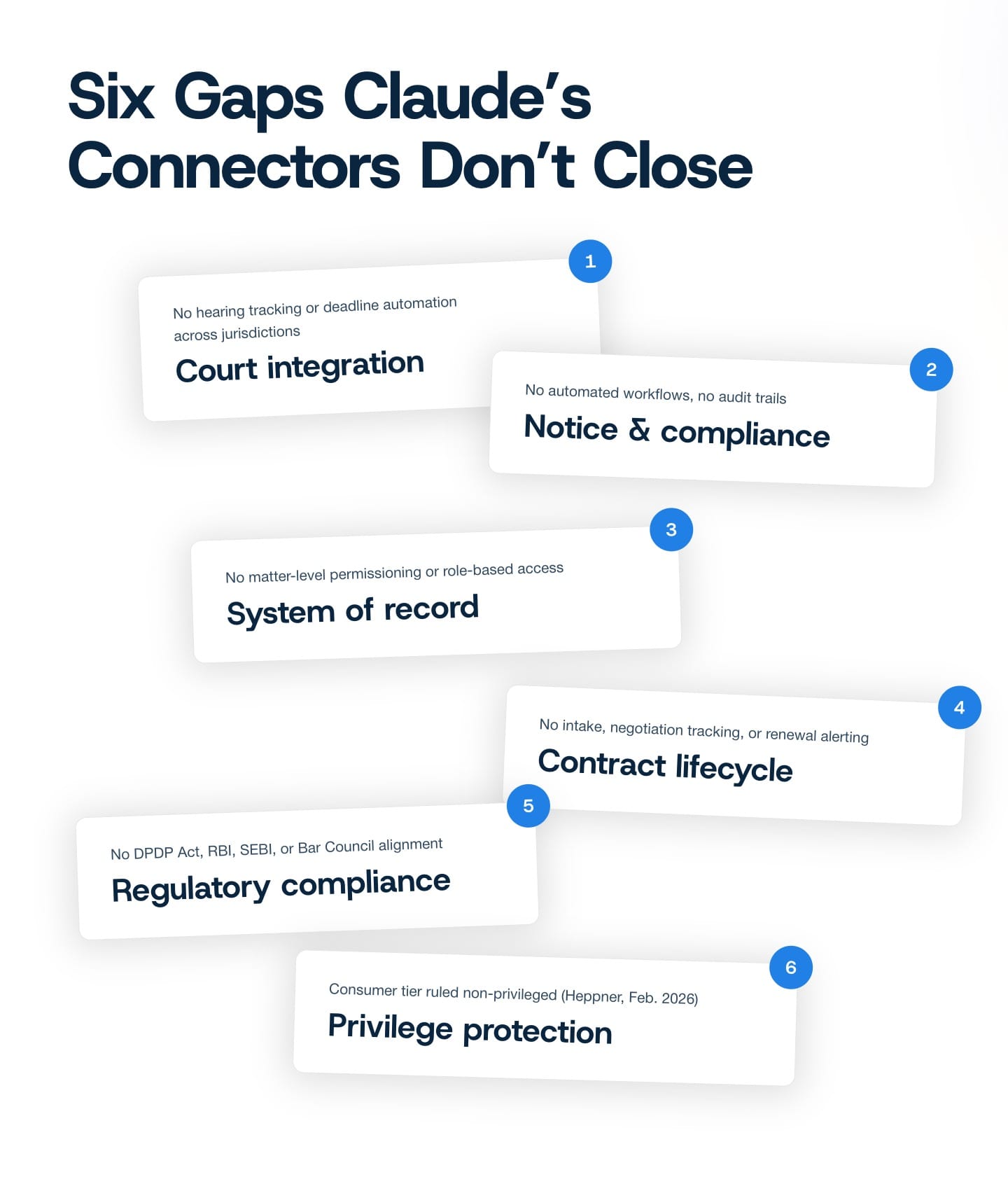
Connectors, however, wire a reasoning engine to external databases and document systems; they do not convert it into a legal operations platform.
What Claude structurally lacks, even with those connectors:
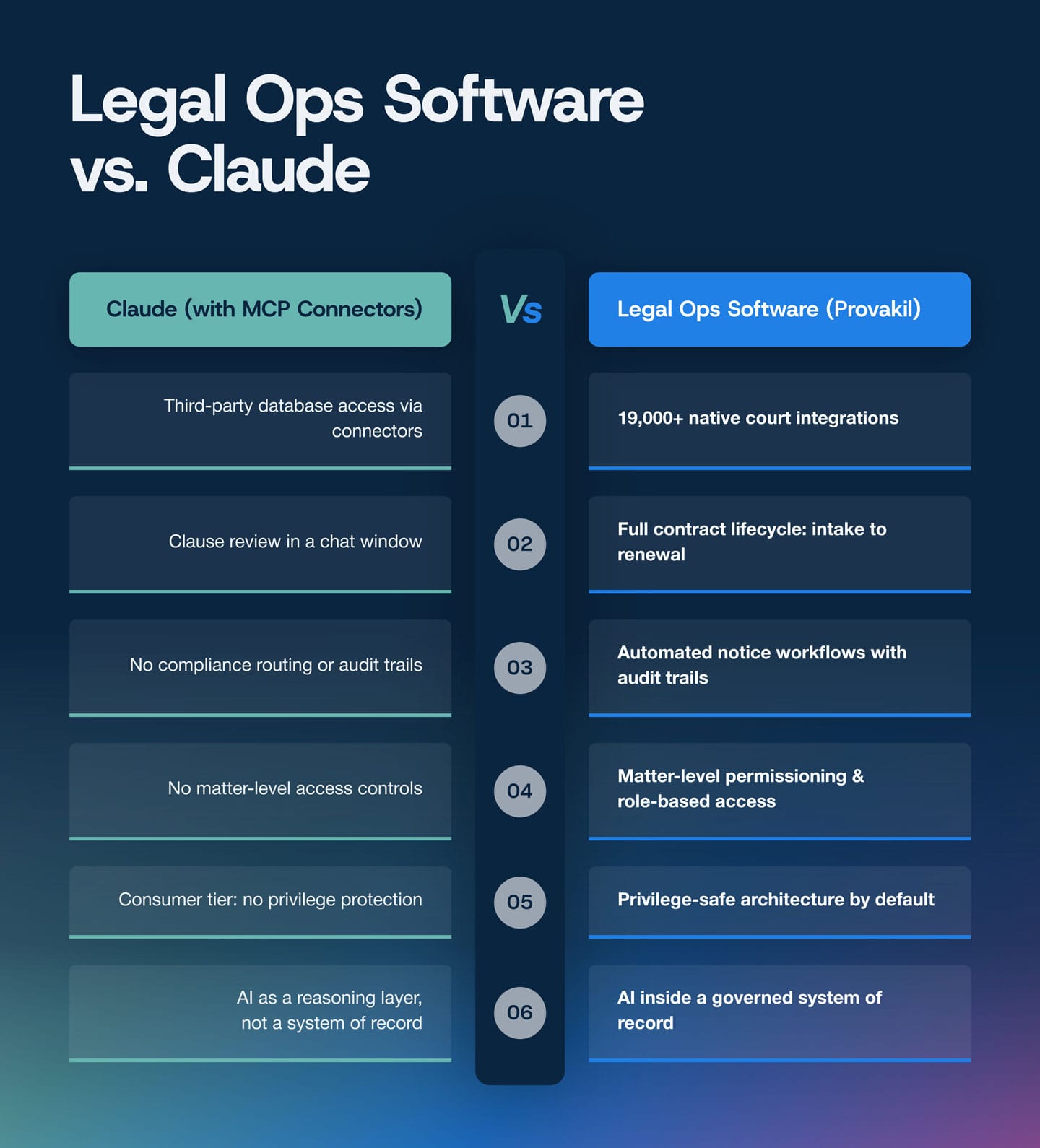
The difference is not intelligence. Claude and the AI models inside Provakil draw on the same generation of large language models. The difference is what the AI stands on.
Provakil, an AI-powered legal tech software, starts from the legal workflow: the court feed, the litigation repository, the deadline tracker, the role-based access layer. AI is then layered on top of that governed infrastructure, so every model output is grounded in verified data and logged in a traceable system.
A general-purpose chatbot starts from the language model and tries to bolt legal infrastructure on afterward, which is the design choice that produced every failure mode documented in this piece.
Provakil's platform shows what that foundation looks like in daily use. Real-time integration with courts and forums across jurisdictions means the data the AI reasons over is current and source-verified, not reconstructed from training text. Automated deadline tracking and causelist monitoring close the operational gaps that no chatbot addresses.
AI Contract intelligence extracts obligations, renewal dates, and risk clauses from your actual repository. Role-based access and full audit trails log every AI-assisted output and restrict it to authorized users, which is exactly the provenance documentation courts are beginning to demand.
India's regulatory posture makes these safeguards especially urgent. The Supreme Court of India has classified AI-generated fake case law as professional misconduct, exposing lawyers to Bar Council discipline, up to removal from the roll. The Bombay High Court imposed ₹50,000 in costs for fabricated AI case law. For legal teams operating across Indian jurisdictions, the compliance floor is rising, and a general-purpose chatbot cannot meet it.

Claude's trajectory on legal benchmarks points in one direction: the models will keep getting smarter, and fast. But the courtroom record over the past two years tells a different story. Every sanctioned lawyer used Claude as a standalone research tool and filed the output without verification against a primary legal source. Every privilege failure traced back to a platform that was never architected to protect confidential data in a legal context.
The structural gaps- no audit trail, no deadline tracking, no court-system integration, no role-based access- persist regardless of how well the model scores on a reasoning test.
The question for legal teams evaluating AI tools is not "how smart is the model" but "what is the model standing on." AI-powered legal tech software gives the model a foundation: a verified legal database, a governed workflow, a privilege-safe architecture, and an audit trail that holds up when a court asks how a citation got into a brief.

No. Claude excels at legal reasoning, drafting, and document analysis, but it lacks native court integrations, automated deadline tracking, notice management workflows, audit trails, and system-of-record architecture. Enterprise legal operations require a platform that owns the workflow end to end, not a reasoning engine that connects to external tools through intermediary layers.
On consumer tiers, the risk is documented. In United States v. Heppner (S.D.N.Y., February 2026), Judge Rakoff ruled that exchanges with consumer Claude are neither privileged nor work-product protected, citing Anthropic's data-collection policies and the absence of counsel direction. Enterprise tiers with contractual confidentiality offer a stronger posture, though no court has definitively ruled on that configuration.
Claude Fable 5 leads Vals AI's LegalBench at 88.56% on legal reasoning tasks, but on Harvey's Legal Agent Benchmark, which tests whether a model completes full multi-step legal tasks, the best public score is 11.25%. The gap confirms that Claude understands legal concepts at a high level but cannot reliably execute the complete, document-heavy work that legal operations teams run daily.
Claude can review and summarize contract clauses when you provide the document in a chat session. AI-powered legal ops software manages the entire contract lifecycle, from intake and authoring through negotiation, approval, obligation tracking, and renewal alerts, with clause libraries, template governance, and structured risk flagging built into the platform. Provakil's AI CLM Handbook covers the full scope of that workflow.

Dive deep into Provakil's numerous blog posts & discover how legal tech can streamline your litigation, contracts, IP, and notice management processes.