AI Legal Invoice Review: The ₹2 Crore Leak in Your Outside Counsel Spend
7 min read



If your legal department spends ₹50 crore a year on outside counsel, somewhere between ₹2.5 crore and ₹5 crore of that is walking out the door in billing violations that nobody on your team has the bandwidth to catch. That is not a worst-case estimate or a number pulled from a vendor pitch deck; it is what the industry data consistently shows when enterprises actually audit their panel firm invoices against their own billing guidelines.
Block billing that bundles five tasks into one line entry, associates billing at partner rates, administrative work dressed up as professional fees, eight hours of research on a provision that any competent practitioner should already know — these are not edge cases; they are patterns that show up in 5% to 15% of every invoice, every quarter, across the board.
The reason most legal departments never see these numbers is simple: nobody has time to look. AI legal invoice review changes that equation by reading every line item on every invoice, checking it against your billing guidelines, and flagging violations before you approve payment; documented outcomes across deployments show a 10% to 20% reduction in outside-counsel spend that shows up in your next quarterly report.
This blog breaks down what that math looks like at Indian enterprise spend levels, what AI invoice review actually catches that your team is missing, and why the ROI case here is the most straightforward one in legal technology.
Most in-house legal teams have billing guidelines for their panel firms. The problem is enforcement. When your legal department manages 200+ matters across High Courts, the NCLT, RERA authorities, District Courts, and various tribunals — with 15 to 30 panel firms billing you every month — the invoices pile up fast
A department at that scale processes 500 to 1,000 invoices per quarter. Each invoice has dozens of line items describing work performed, hours billed, and expenses claimed. Reviewing one complex invoice against your billing guidelines takes 20 to 45 minutes. Do the math: that is a full-time job, and no legal ops team in India has someone whose only role is reading invoices.
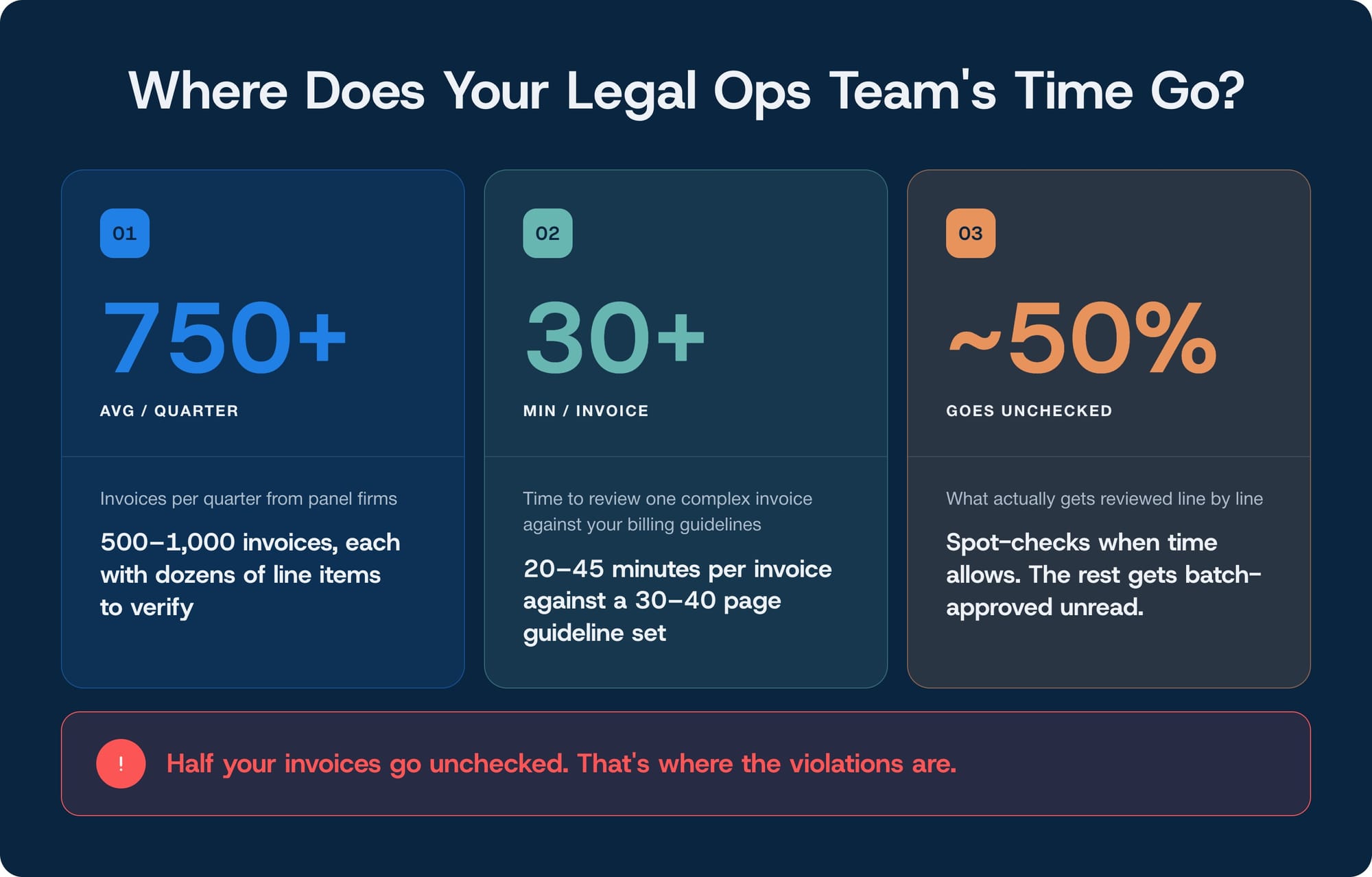
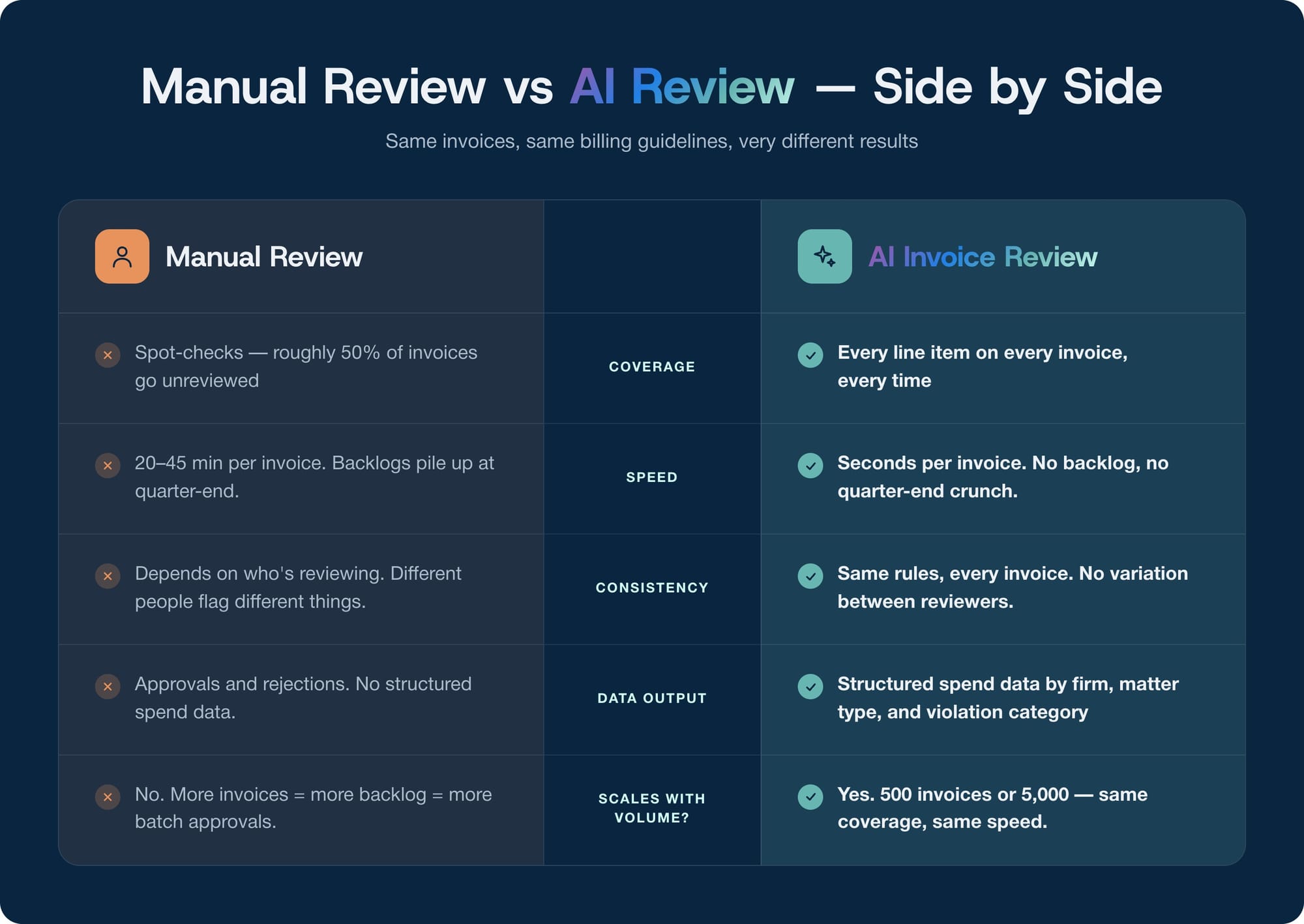
So what happens in practice? A legal ops coordinator or company secretary spot-checks a handful of invoices each month, approves the rest in batches, and occasionally catches a duplicate charge or an unauthorized expense. The invoices that slip through unchecked are exactly where the billing violations live — block billing that hides inflated hours, associates billing at senior rates, administrative work dressed up as professional fees, and vague entries like "perusal of documents" with no way to evaluate the time.
On ₹10 crore in annual outside-counsel spend, an 8% violation rate means ₹80 lakh in overpayments every year. Spot-checking catches roughly half. The remaining ₹40 lakh gets paid without anyone noticing. At ₹50 crore in spend — typical for a large BFSI institution or a conglomerate managing litigation across multiple jurisdictions — that unrecovered amount crosses ₹2 crore annually.
AI invoice review is not a keyword filter. It reads the natural-language description of each line item, classifies the work performed against standard task codes, and evaluates it against your specific billing guidelines.
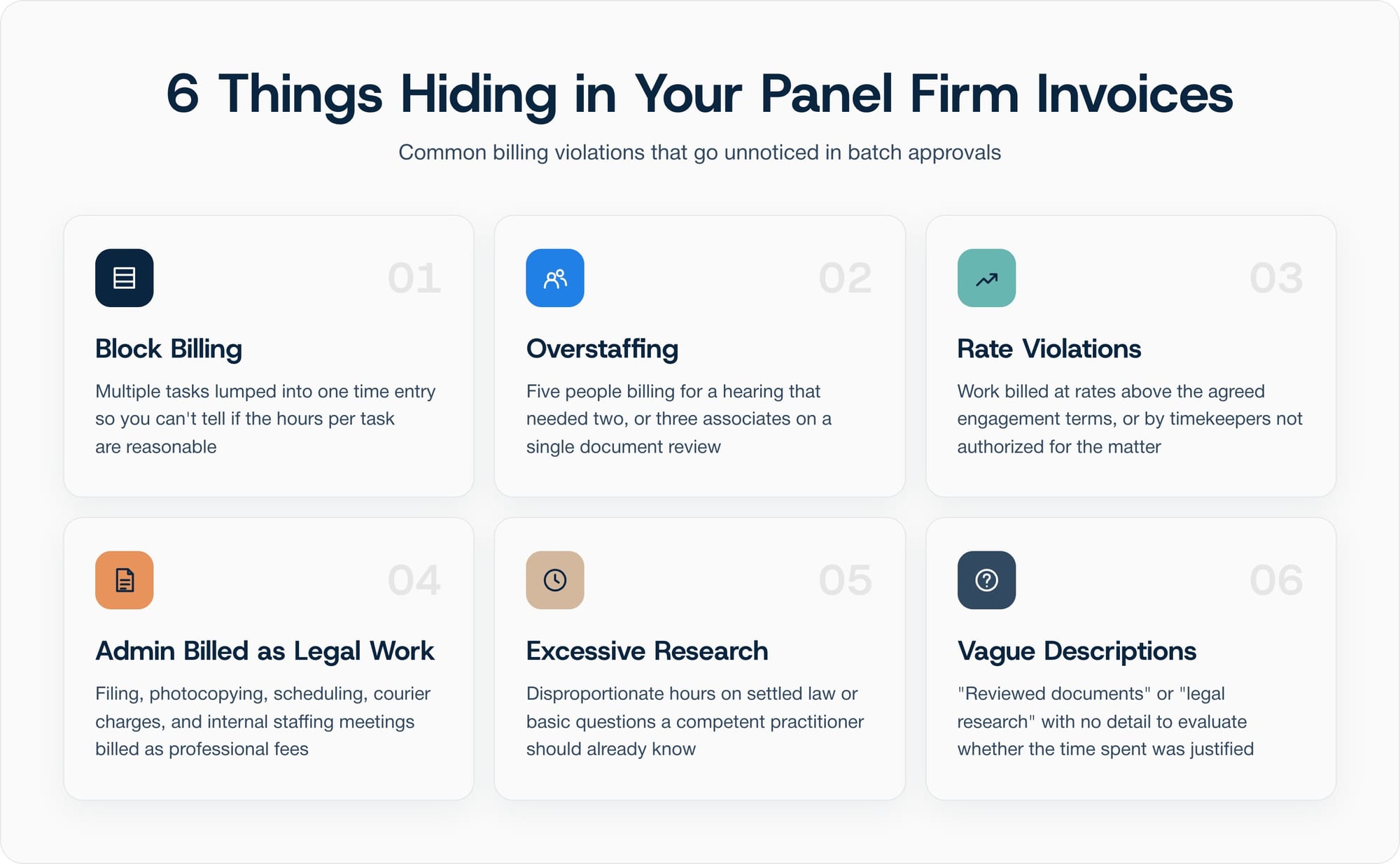
The real difference is context. When an entry says "Attended hearing at NCLT Mumbai, reviewed order, coordinated with client on next steps," AI identifies three distinct activities in a single entry, flags it as potential block billing, and checks whether the combined hours are reasonable for what was done.
And every invoice reviewed produces structured data. After 12 to 18 months, you know which panel firms overbill, which associates over-research, and which practices run lean. That data becomes your strongest card at every rate negotiation and panel review.
Legal departments across India are under pressure from both sides. Workloads are increasing — regulatory compliance, data protection under the DPDP Act, cybersecurity incidents, ESG reporting — while budgets are flattening. Boards and CFOs are asking legal teams to do more with less, and "we are improving our processes" is not a number anyone can report to the audit committee.
"We reduced outside-counsel spend by 12% through AI-powered invoice review" is a number the audit committee understands. It shows up in payment data, it is verifiable, and it compounds every year. For a GC defending the legal budget in an annual planning cycle, that is the strongest answer available.
Standalone spend-management tools review invoices in isolation. Provakil's ELM platform connects invoice review to everything around it.
When an invoice arrives for a matter tracked in Provakil, the system already knows the court, forum, procedural stage, and hearing history across 19,000+ Indian courts and tribunals. That context makes the AI's evaluation of billing reasonableness sharper than any system reviewing the invoice without knowing what the matter actually involves.
AI invoice review, matter management, CLM, litigation tracking, and legal spend analytics all run on the same system. One data layer, one set of reports. Your CFO gets dashboards they can read without a translator from legal ops.
Cloud and on-premises deployment with local data residency across India, the UAE, Saudi Arabia, and Southeast Asia. For banks under RBI data-localization norms or GCC entities with sovereign data mandates, this is not a feature — it is a prerequisite for even starting the conversation.

Legal departments spend heavily on outside counsel and have limited visibility into whether they are getting what they pay for. Every other function in the enterprise — procurement, finance, operations — has automated controls that catch overcharges before payment goes out. Legal is the exception, but it doesn't have to be.
AI invoice review closes that gap. It is not a moonshot AI project that takes two years to show results. It is a straightforward intervention: invoices come in, the system checks them against your rules, violations get flagged before you pay, and the savings show up in your next quarterly spend report.
The question is not whether AI invoice review works. The math on that is settled. The question is how long you keep paying for violations that a system could have caught before the invoice was approved.

Some initially do. But most firms adapt quickly once they see that the rules are applied consistently across every firm. It actually levels the playing field and reduces disputes because the flagging criteria are transparent and documented.
Not necessarily. Most ELM platforms can work from your existing guideline documents and configure rules from them during onboarding. You do not need a fully coded rule set on day one — the system builds it with you.
Yes. Advanced platforms extract and structure data from PDFs, Excel sheets, and manually submitted invoices — not just LEDES-formatted ones. This matters in India, where many panel firms still submit invoices in non-standard formats.
Most modern ELM platforms connect with SAP, Oracle, Tally, and other accounting systems for payment processing and financial reporting. The invoice review output feeds directly into your existing approval and payment workflows.
Flagged entries go to your legal ops team for review, not straight to rejection. Your team makes the final call on every flagged item. Over time, the system learns from these decisions and its accuracy improves with each billing cycle.

Dive deep into Provakil's numerous blog posts & discover how legal tech can streamline your litigation, contracts, IP, and notice management processes.