ChatGPT vs. Provakil, an AI-Powered Legal Ops Software
6 min read



In June 2023, a New York attorney filed six entirely fabricated case citations sourced from ChatGPT and was fined $5,000. By May 2026, that figure had climbed to $109,700 in a single Oregon matter, and US courts had imposed over $145,000 in AI-filing penalties in Q1 2026 alone.
Globally, Damien Charlotin's AI Hallucination Cases Database tracked 1,668 court decisions involving AI-fabricated material as of July 2026, with 653 of those involving practicing lawyers rather than pro se litigants.
In Ontario, a sole practitioner was suspended for six months after submitting ChatGPT-drafted family law filings with four fake citations and then denying she had used AI at all. In Australia, a solicitor caught filing AI-generated fabrications was placed under supervised practice for two years.
The pattern is consistent across jurisdictions: a lawyer trusts ChatGPT's confident output, skips verification, and faces consequences that have escalated from reprimands to career-altering sanctions in under three years. And hallucination is only one axis of risk.
In February 2026, a US federal court ruled in US v. Heppner that ChatGPT conversations are not protected by attorney-client privilege, confirming what OpenAI's own CEO had admitted months earlier: that the company could be compelled to produce user conversations in litigation.
AI-powered legal ops software exists precisely because these gaps are structural in ChatGPT, not bugs that a future update will fix. This is the second piece in Provakil's comparison series, following the broader legal ops software-versus-generative AI comparison.
ChatGPT can produce a usable first draft of a contract clause, translate dense regulatory language into plain English, brainstorm memo arguments, and summarize long documents faster than most associates.
Enterprise tiers ($25 per user per month) offer contractual no-training guarantees and workspace privacy, making it a reasonable tool for internal ideation and non-privileged drafting. What it is not, and what three years of court records confirm, is a legal operations platform.
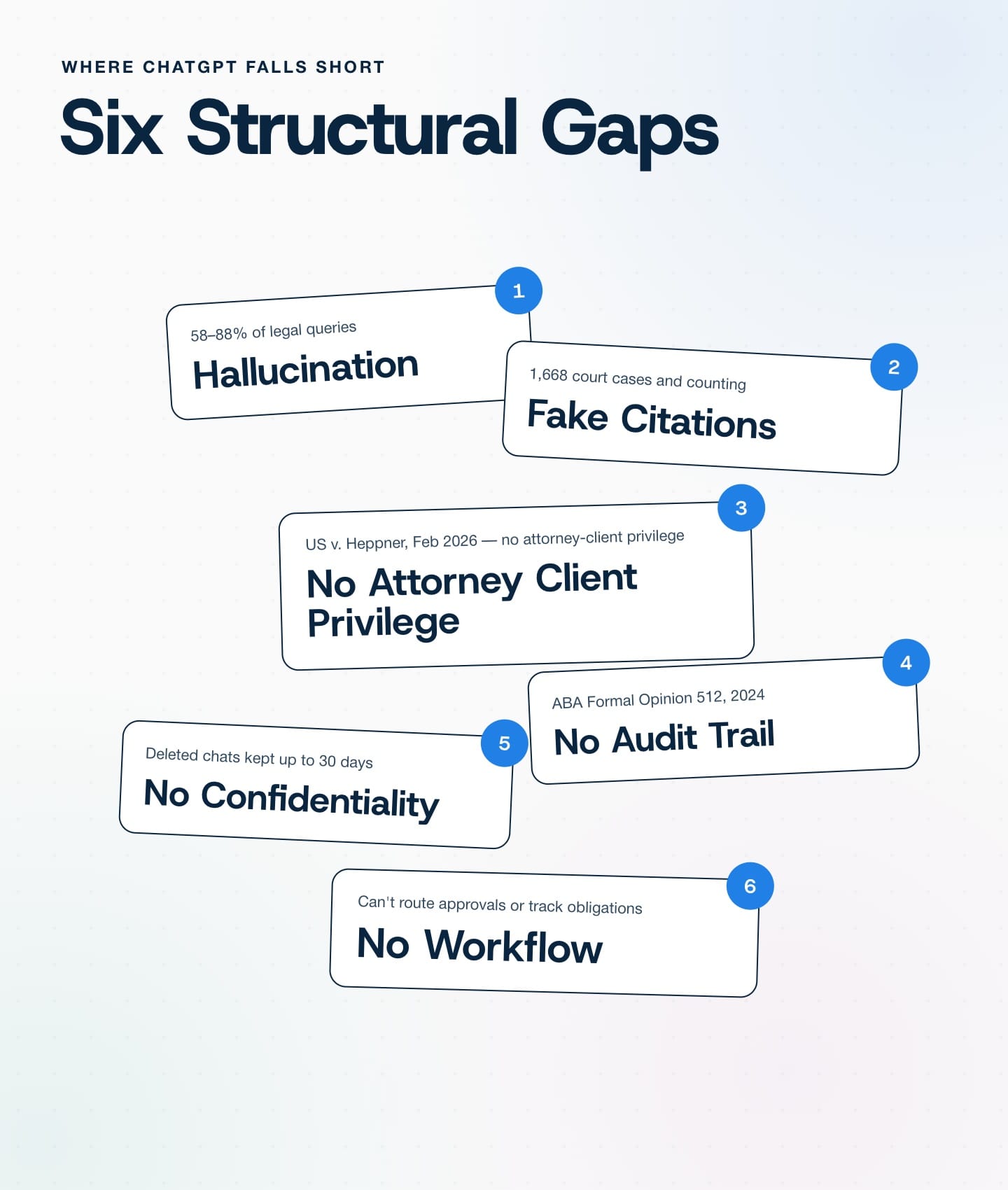
The sanctions above are symptoms. The cause is structural: ChatGPT predicts statistically probable text; it does not retrieve from a verified legal database. The Stanford RegLab/HAI study ran 800,000+ legal queries and found hallucination rates of 58 to 88 percent across models.
A May 2024 follow-up found that even purpose-built legal AI tools with curated databases (Lexis+ AI, Westlaw AI-Assisted Research) still hallucinate on 17 to 33 percent of queries. If grounded, RAG-based tools fabricate at those rates; an ungrounded general chatbot is structurally unsuitable for any work product that gets filed, cited, or relied upon.
In India, the Supreme Court's July 2026 ruling in Pooja Ramesh Singh v. J&K Bank declared the advocate's misconduct for using unverified AI citations and directed the Bar Council to frame disciplinary norms. The Bombay High Court and the Bengaluru ITAT had already quashed orders based on fabricated AI precedents in matters involving Rs 27.91 crore and Rs 669 crore, respectively.
The Heppner ruling and Altman's admission (covered above) established the legal position. The operational detail compounds it. On consumer tiers, ChatGPT trains on conversations by default; the opt-out is not retroactive, and deleted chats are retained for up to 30 days.
A court order in NYT v. OpenAI required the retention of even deleted conversations. Enterprise tiers offer contractual zero-retention, but data still transits OpenAI infrastructure. For a corporate legal team handling privileged strategy or client-facing analysis, every interaction is a potential disclosure to an unprivileged third party.
ChatGPT produces text. It cannot route contracts through multi-tier approvals, maintain an audit trail, enforce clause playbooks, track obligations to renewal dates, or integrate with enterprise ERP and CRM systems.
ABA Formal Opinion 512 (July 2024) sets explicit duties of competence, supervision, and confidentiality for lawyers using AI, duties that require logged, reviewable records a stateless chatbot does not produce. A drafting assistant and a system of record are not the same category of tool.
Each failure above is architectural in ChatGPT. Each one is architecturally solved on a governed platform like Provakil.
On hallucination: Provakil's AI layer operates on top of structured, verified legal data; automated case updates from 19,000+ Indian courts and forums; contract metadata extraction of 30+ data points; and clause detection grounded in playbook-defined rules, with human review built into every workflow.
On privilege and data security: ISO 27001 certified, SOC 2 Type II compliant, per-tenant data isolation, role-based access controls, ethical walls, matter-level permissions, and on-premises deployment so client data never leaves the organization's servers. DPDP Act-, GDPR-, and DIFC-compliant.
On workflow: Multi-tier conditional approval workflows, obligation tracking with proactive alerts, a collaborative editor with in-document audit trails, e-signing integrations, and enterprise connectors to SAP, Oracle, Salesforce, and Microsoft 365.
The dividing test is simple: does the output touch privileged data, need to be filed, or need to be audited? If the answer to any of those is yes, the work belongs in a governed platform, not a chatbot.
ChatGPT is a reasonable tool for non-privileged first drafts, internal brainstorming, plain-language summaries of public regulatory text, and ideation where no client data is involved. It is the wrong tool for anything that touches privilege, anything submitted to a court or regulator, anything requiring an audit trail, or anything with compliance deadlines.

The line between these two tools is only going to matter more. Courts are moving from surprise to sanction, regulators are writing AI use into professional duties, and the volume of AI-tainted filings is climbing quarter over quarter rather than leveling off.
The teams that stay out of trouble will not be the ones that banned ChatGPT, nor will they be the ones that trusted it with everything. They will be the ones that drew the dividing line early and built their real work on verified data with a human in the loop.
Start by mapping your own workflows against that single question: privileged, filed, or audited, then move everything that answers yes onto AI-powered legal ops software before a filing deadline forces the decision for you.

No. ChatGPT can draft contract language, but it cannot extract structured metadata, track obligations, enforce clause playbooks, route contracts through multi-tier approvals, or maintain an audit trail. Contract management requires a persistent system of record with workflow enforcement.
On consumer tiers, ChatGPT trains on conversations by default, and deleted chats are retained for up to 30 days. A February 2026 US federal court ruling held that AI-generated documents are not protected by attorney-client privilege. Entering privileged information into ChatGPT risks waiving privilege and breaching confidentiality obligations.
India's Supreme Court ruled in July 2026 that citing AI-hallucinated precedents constitutes advocate misconduct and that any decision based on such material is void. The Bombay High Court and Bengaluru ITAT have separately quashed orders built on fabricated AI citations.
Purpose-built platforms like Provakil ground their AI in verified, structured data (court records, contract repositories, compliance databases) and add workflow enforcement, role-based access, audit trails, and enterprise integrations.

Dive deep into Provakil's numerous blog posts & discover how legal tech can streamline your litigation, contracts, IP, and notice management processes.