Legal Intake Management: The In-House Guide to Building a Legal Front Door
7 min read



Legal intake management is the structured process by which a corporate legal department captures, triages, prioritizes, routes, tracks, and reports on every request the business sends it. For in-house teams, it is demand management: a governed channel that replaces scattered emails, hallway conversations, and shared inboxes with a system that gives legal the data to measure workload, set service levels, and demonstrate value to the business.
Most legal departments operate without one, and the numbers explain why that is becoming untenable. The EY 2021 Law Survey, conducted with the Harvard Law School Center on the Legal Profession across 2,000 interviews in 22 countries, put a finer point on the problem: 87% of law department leaders say their teams spend too much time on low-value work, and roughly one in five in-house counsel hours goes to routine, repetitive tasks.
More demand, fewer people, and no system to manage the gap. Legal intake management is what fills it.
Legal intake management covers how a legal department receives requests for help, what information it collects upfront, how it categorizes and prioritizes those requests, who it routes them to, and how it tracks the entire flow from submission to resolution. It is the operating system for incoming legal demand.
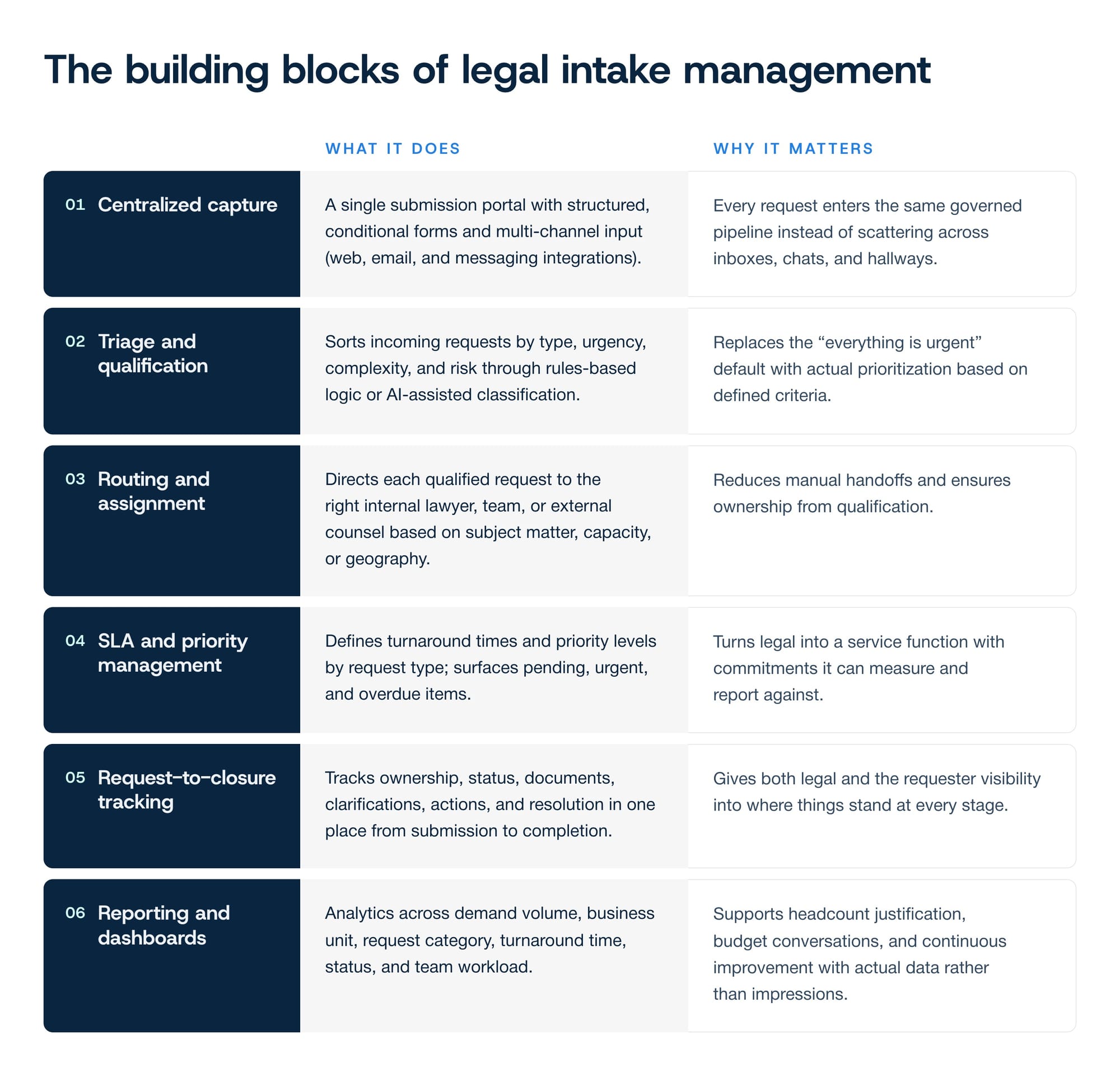
For in-house corporate legal teams, intake is internal demand management. A business stakeholder raises a request for legal help, whether that is a contract review, a regulatory query, a marketing clearance, or an employment advisory. The legal team evaluates its priority, complexity, and resource requirements, then assigns it and tracks it through to resolution.
This guide is written for the in-house side. If you need client intake at a law firm, the evaluation criteria and tools differ enough to warrant separate treatment.
Intake is upstream of everything else in the legal operations stack. It precedes litigation management, contract lifecycle management, and billing.
That upstream position is what makes intake disproportionately important. A case management platform is only as useful as the information it receives. A CLM system only captures the contracts that reach it through a governed channel. If a request for marketing clearance or a regulatory query never enters a structured pipeline, it never becomes a matter that the downstream system tracks, and it never appears in the reports that leadership uses to understand what legal actually does.
When intake is messy, every downstream system inherits the same gaps, and the reporting built on top of those systems reflects incomplete data rather than actual demand.

Both the CLOC Core 12 competency model and the ACC Legal Operations Maturity Model treat intake and workflow discipline as foundational. CLOC assesses twelve functional areas across four maturity stages (Reactive, Emerging, Developing, and Leading). ACC covers fourteen areas across three maturity stages. In both frameworks, structured intake is not positioned as an advanced capability. It is a precondition for the capabilities that follow.
AI has moved from a differentiator to a baseline expectation at the legal front door. At the intake layer, the applications now shipping or in active deployment cluster into a handful of categories. Natural-language request capture allows requesters to describe what they need conversationally rather than navigating a form taxonomy.
Email-to-intake parsing extracts structured data from emails and auto-creates intake records without manual re-entry. Auto-classification and routing use AI to tag requests by type, urgency, and assigned team, reducing the triage load on legal operations.
Self-service deflection may be the highest-impact application in the category: routing routine policy or process questions to a knowledge base or AI assistant so they resolve without a lawyer's time.
Predictive prioritization and smart assignment, using historical patterns and team capacity data to route incoming requests, complete the current picture of AI at the intake layer.
Gartner predicts legal, risk, and compliance functions will double their technology spending by 2027, with generative AI use cases spanning intake and analysis, transactions, litigation, and governance.
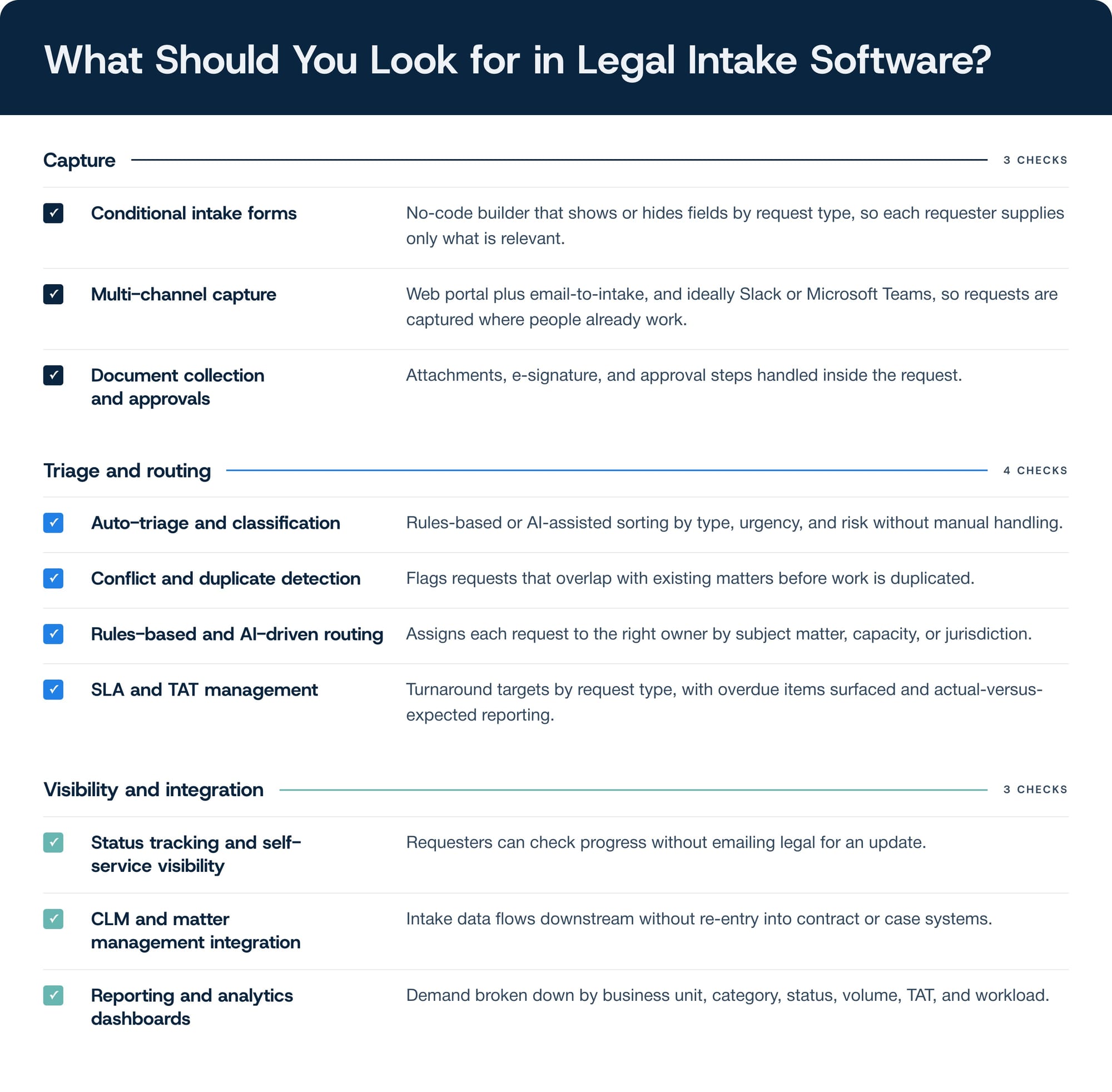
Provakil's Enterprise Legal Intake Management module gives the business one place to raise legal requests and gives legal a governed pipeline to manage them.
Every request enters through structured forms or email, capturing the request type, business unit, priority, jurisdiction, and supporting documents upfront, so work can begin without a round of clarifying questions.
From there, the module runs the full request lifecycle. Priority and SLA management lets legal define turnaround times by request type, then surfaces pending, urgent, and overdue items while tracking actual TAT against the expected service level. This is the discipline most intake tools skip, and it is what turns a request queue into a service the business can rely on.
Request-to-closure tracking routes each request to the right internal lawyer or external counsel and holds ownership, status, documents, clarifications, and the final resolution in one record.
Reporting dashboards then show where legal's workload actually comes from, broken down by business unit, request category, status, volume, turnaround time, and team workload, which is the evidence a GC needs when the headcount conversation comes around.
Provakil's intake covers thirteen enterprise use cases, spanning marketing and advertising clearance, HR advisory, IP and brand requests, data privacy queries, regulatory communications, and more.

Legal intake management is not a nice-to-have that mature departments eventually get around to. It is the layer that gives every other legal system clean, complete data to work with, and it is the only mechanism that shows a legal team the true shape of its own demand. The departments that manage it can see their workload, prioritize it, and prove it.
The practical starting point is smaller than it sounds. A single structured intake form that replaces an overloaded inbox already produces workload data legal has never had. From there, triage, SLAs, automation, and self-service follow the maturity curve as the data justifies each step.

A legal front door is a single, structured entry point through which all business requests for legal help enter the department. The term describes the combination of an intake portal, automated triage, routing rules, and self-service capabilities that replaces ad hoc channels with a governed process. It is used interchangeably with "legal service request management" across much of the vendor market.
Intake is upstream of matter management. It captures and qualifies the request; matter management tracks the resulting work. A request submitted through intake may become a matter, a quick advisory response, a referral to outside counsel, or a self-service resolution. Intake decides what happens to the request. Matter management manages the work once it is assigned.
Yes. Many departments start with a single structured intake form and basic routing rules, managed by a GC or senior lawyer carrying operational duties. A purpose-built intake platform reduces operational overhead enough that dedicated headcount, while valuable, isn't required to get started.
Structured intake becomes more important as team size shrinks, not less. A department of three lawyers absorbing requests through email has no mechanism to track volume, measure turnaround, or demonstrate that workload exceeds capacity. Intake data is often the first quantitative evidence a small team can present when justifying an additional hire or a technology investment.
Timelines vary by platform and scope. A basic intake portal with structured forms, routing rules, and a reporting dashboard can be operational within weeks. Broader rollouts involving multi-channel capture, SLA definitions across multiple request types, and integration with matter management or CLM systems typically take two to four months.

Dive deep into Provakil's numerous blog posts & discover how legal tech can streamline your litigation, contracts, IP, and notice management processes.