Why "We'll Know When the Invoice Arrives" Is a CFO's Nightmare
6 min read



Ask any CFO what marketing will cost next quarter, and they will pull up a forecast in seconds, complete with channel-level breakdowns and confidence intervals. Ask the same question about legal spend at a large Indian enterprise, where litigation, regulatory matters, and outside-counsel fees routinely run into crores annually, and the most common answer is still some version of "we'll know when the invoices come in."
That gap between what legal departments spend and what they can predict is not a communication problem; it is an infrastructure problem, and it has a name: the absence of predictive matter budgeting.
Every matter your department handles generates usable data, from historical spend and matter duration to staffing patterns and outcome records, yet almost none of it feeds into a forecast legal and finance teams can act on before the next invoice lands.
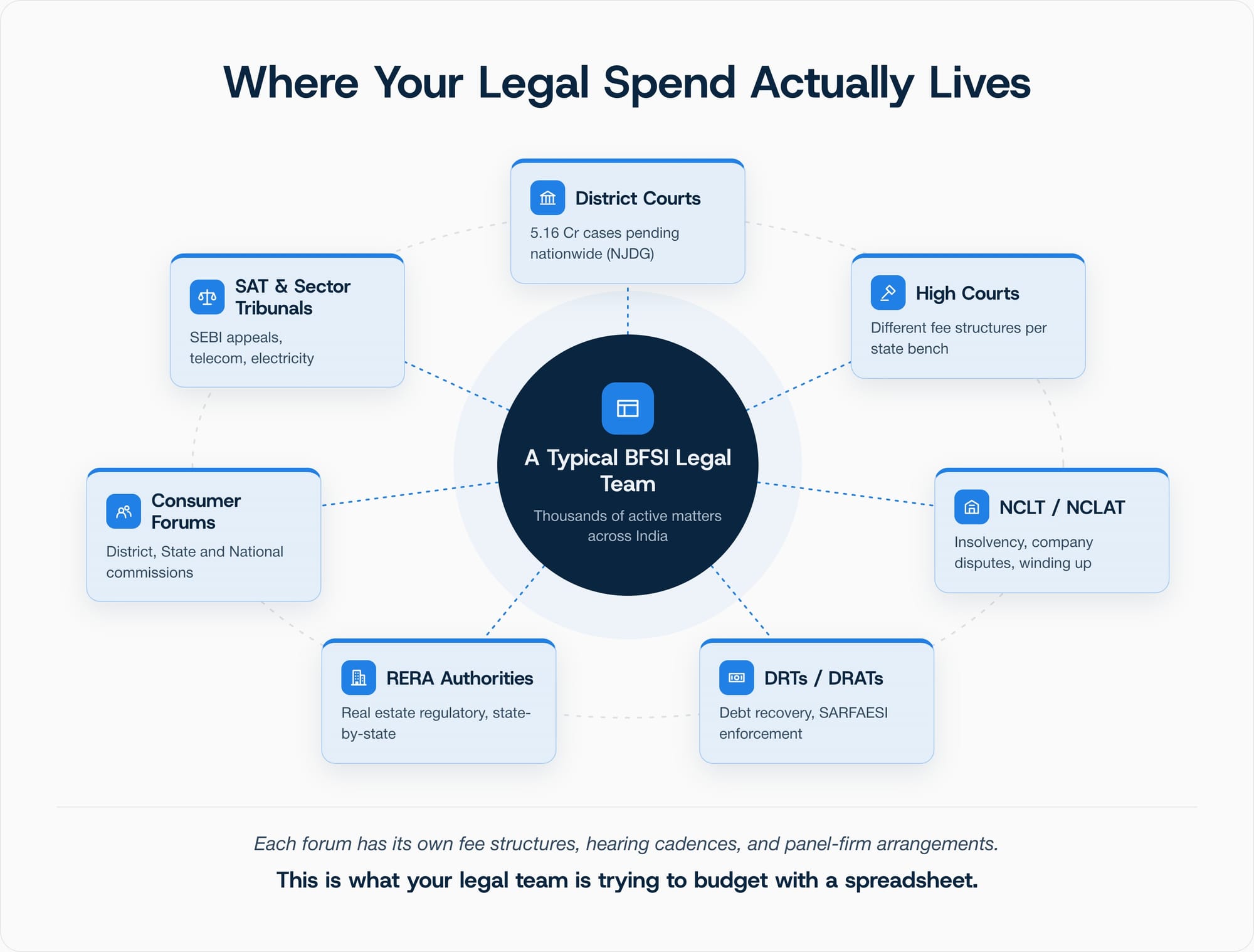
Indian enterprises operate in one of the world's most litigation-heavy legal environments, with over 5.16 crore cases pending across District and Subordinate Courts alone, according to the National Judicial Data Grid, and nearly 5.90 crore when you include High Courts and the Supreme Court.
A single large BFSI company might manage thousands of active matters spanning District Courts, High Courts, NCLTs, DRTs, RERA authorities, and consumer forums, each with its own fee structures, hearing cadences, and panel-firm arrangements. The spend data generated by all of this is enormous, yet most in-house legal teams still track it the same way they did a decade ago: in spreadsheets reconciled after the invoices arrive.
The result is a "metrics gap" where legal departments can tell the CFO what they spent last quarter but cannot forecast what they will spend next quarter. That gap leaves legal unable to justify its budget or prove its efficiency when the board asks hard questions about cost discipline.
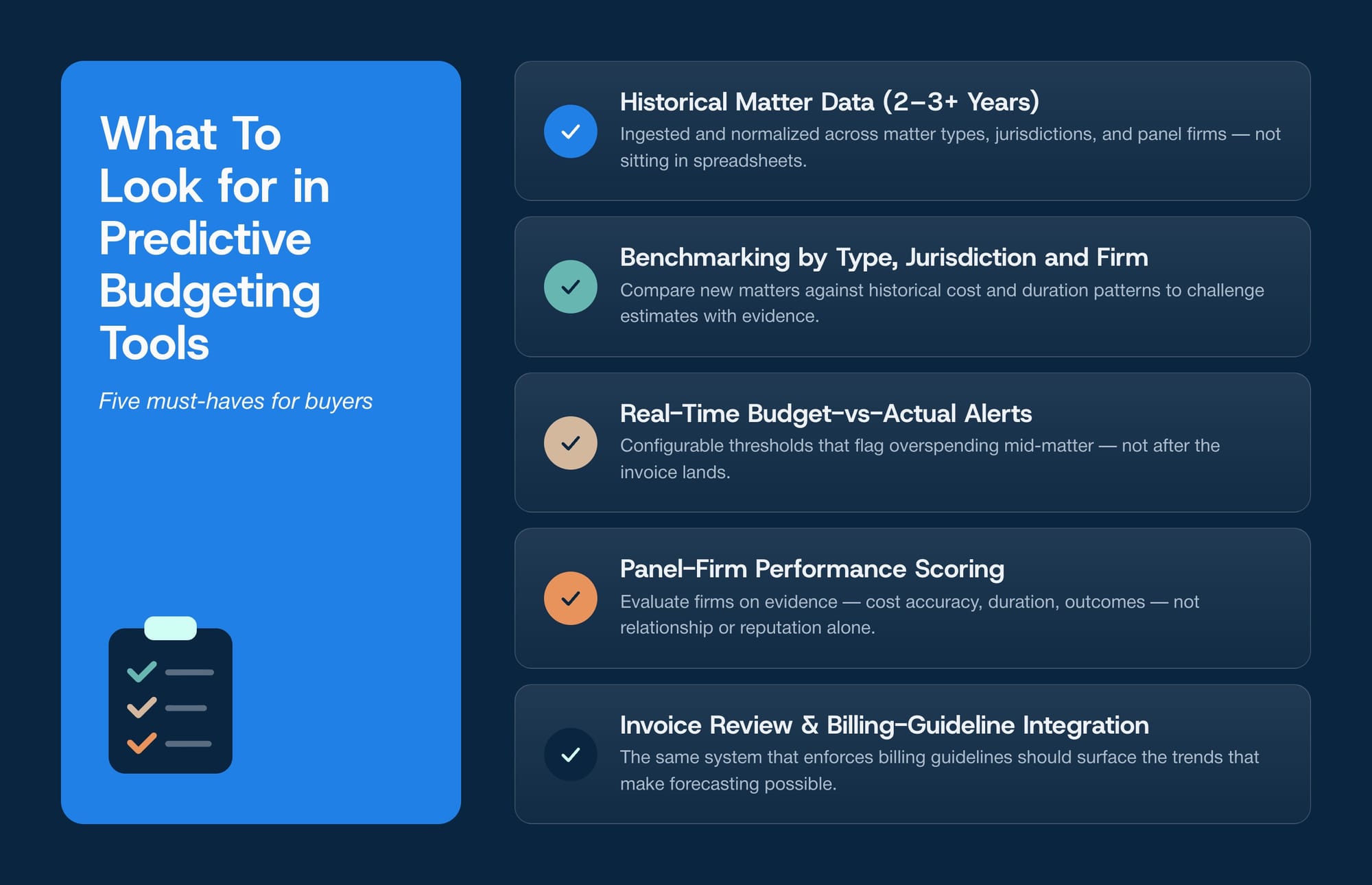
The gap between what legal departments spend and what they can forecast is not abstract. It shows up in concrete, measurable ways across Indian enterprises.
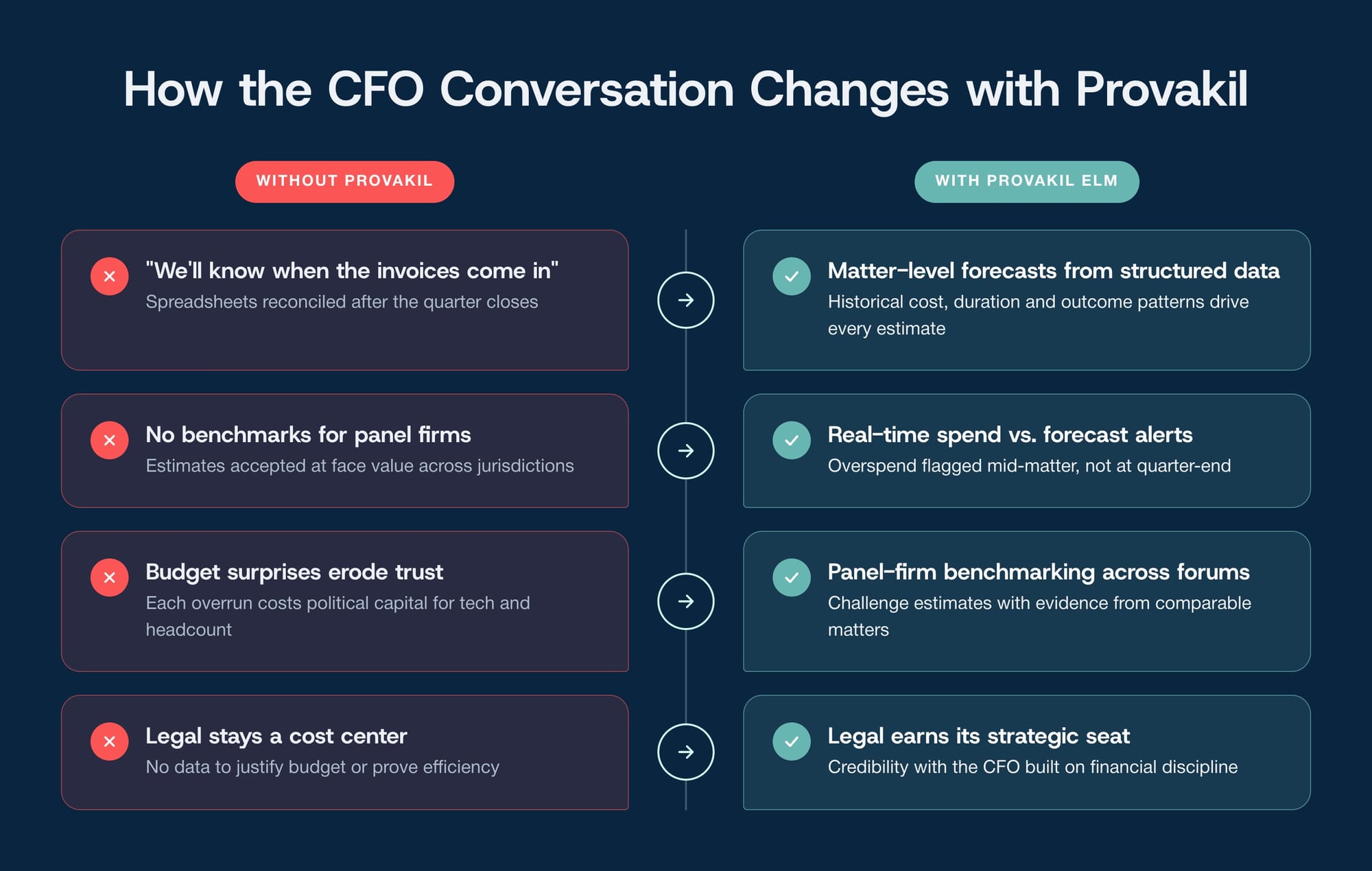
When a SARFAESI enforcement matter quietly doubles in cost because no one tracked spend rates against comparable recoveries, the CFO doesn't just see an overrun. They see a department that cannot manage its own finances.
Indian legal departments often engage panel firms across dozens of forums and jurisdictions, from NCLT benches to District Courts to sector-specific tribunals like RERA or SAT. Without historical benchmarks for matter type, jurisdiction, and complexity, there is no way to challenge a law firm's proposed fee with evidence. Departments accept estimates at face value and discover the true cost only after the work is done.
The RSGI Harvey as Foundational report (June 2026) found that 36% of in-house teams are insourcing work previously sent to outside counsel. But you cannot make smart insource-vs-outsource calls without knowing what comparable matters cost internally versus externally. For Indian enterprises managing hundreds of matters across states, this blind spot compounds rapidly.
Predictive matter budgeting is not a single feature you toggle on. It is the payoff of disciplined matter-management data collection maturing into analytics.
Every matter your department handles generates data — the type of dispute, the jurisdiction, the panel firm assigned, billing rates, duration, and outcome. The question is whether that data is structured and queryable, or scattered across spreadsheets, email threads, and PDF invoices. A well-implemented ELM platform normalizes this data, making it possible to compare a new contractual dispute in the Bombay High Court to twenty similar disputes from the past five years.
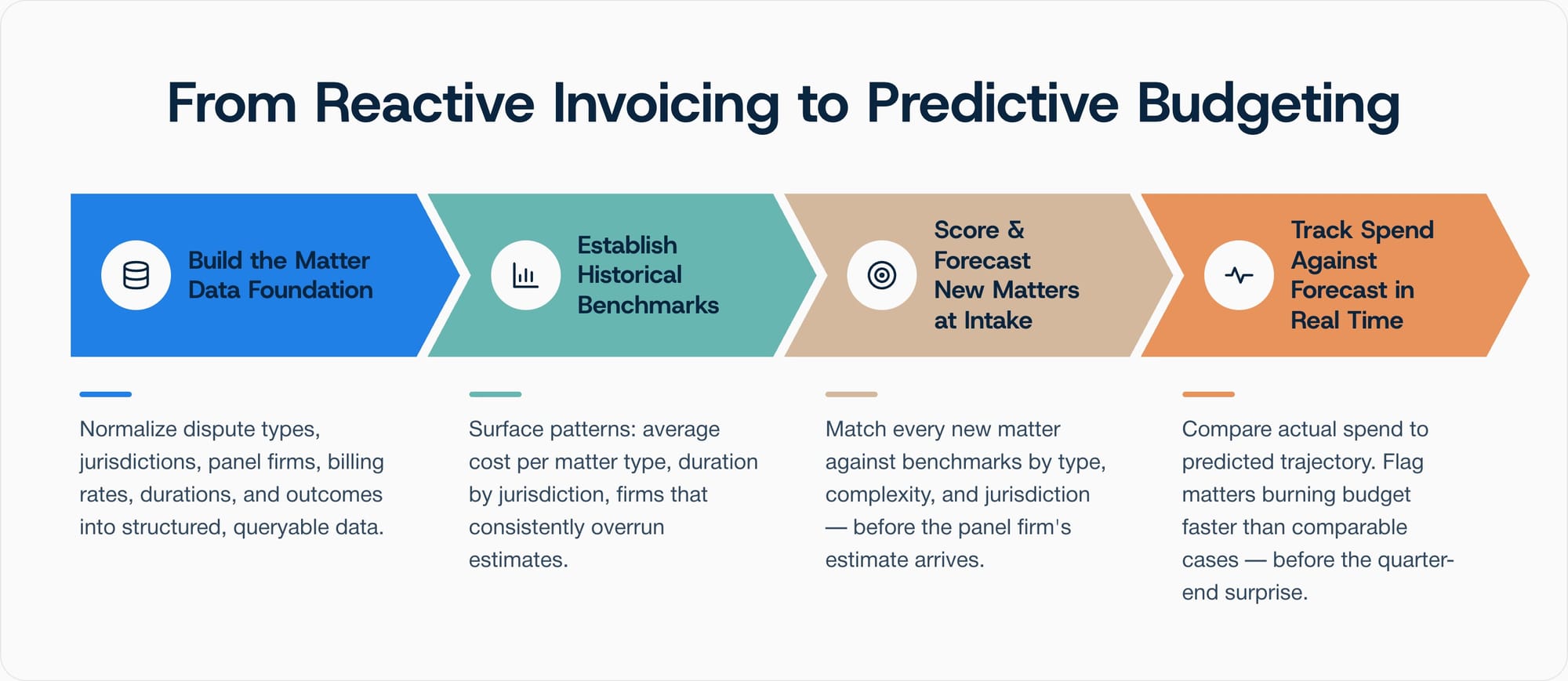
Once you have structured data, patterns emerge. You learn that employment matters in Maharashtra average 14 months and a specific cost band, or that regulatory investigations involving a particular authority run 40% over initial estimates in most cases. These benchmarks become the baseline for all future forecasting.
When a new matter arrives, the system matches it against benchmarks by type, complexity, jurisdiction, and other variables. Instead of waiting for the panel firm's estimate, the legal ops team already knows what comparable matters have cost. That shifts the conversation from "What will this cost?" to "Here is what matters as this has cost us, so tell us why this one should differ."
As invoices arrive and the matter progresses, the system compares actual spend against the predicted trajectory. A matter burning through budget 30% faster than comparable matters in month three triggers an alert before it becomes a quarter-end surprise. This is the difference between a dashboard that tells you what happened and a system that warns you what is about to happen.
Provakil's Enterprise Legal Management platform turns years of matter data into the financial intelligence that legal and finance teams need. It captures structured data — matter type, jurisdiction, panel firm assignments, billing rates, milestones, and outcomes — that predictive analytics require.
Spend tracking runs against this data in real time, so legal ops teams can compare actual costs against historical patterns rather than waiting for the quarter-end reconciliation.
For organizations managing outside counsel across Indian jurisdictions and practice areas, Provakil connects invoice review, matter management, and spend analytics into a single view. The same platform that enforces billing guidelines also surfaces the trends that make forecasting possible.

The legal departments that will earn strategic influence in the next two years are the ones that answer the CFO's question with data, not with "we'll know when the invoices come in." Predictive matter budgeting is not a futuristic ambition. It is the natural result of structured matter data, historical benchmarks, and real-time spend tracking working together.
The ACC/Everlaw survey found that 48% of in-house teams expect legal to take a more strategic role within a year. But influence requires credibility, and credibility requires financial discipline. Indian enterprises sitting on years of litigation and matter data already have the raw material. The gap is the analytics layer that turns that data into forecasts.

It uses historical matter data — cost, duration, jurisdiction, and outcomes — to forecast what new legal matters will cost before invoices arrive, replacing reactive spend tracking with forward-looking intelligence.
At least two to three years of structured matter data with consistent attributes like matter type, jurisdiction, and panel firm. An ELM platform that normalizes data across years accelerates this significantly.
Yes. Historical benchmarks let you challenge law firm proposals with evidence, identify firms that consistently exceed estimates, and make informed insource-vs-outsource decisions.
Spend tracking shows what you already spent. Predictive budgeting forecasts what you will likely spend based on historical patterns, like a GPS versus a rearview mirror.
It sits on top of matter management, invoice review, and outside-counsel management, drawing data from all three to produce forecasts, benchmarks, and variance alerts.

Dive deep into Provakil's numerous blog posts & discover how legal tech can streamline your litigation, contracts, IP, and notice management processes.