Agentic CLM Explained: What It Actually Means for Legal and Procurement Teams
6 min read



Every CLM vendor in 2026 calls its product "agentic." The word appears on landing pages, in analyst briefings, and in conference keynotes, often without a clear definition. For legal and procurement leaders evaluating their next platform, the confusion is expensive. Picking a tool that markets the label but delivers a basic chatbot means another year of manual obligation tracking and missed renewal windows.
Agentic CLM is contract lifecycle management software where AI does not just assist but takes autonomous, multi-step action across the contract lifecycle.
It extracts data, reviews third-party paper against your playbooks, flags obligation risks, and increasingly executes tasks without being prompted. It is the difference between a system that waits for instructions and one that acts on them.
This blog breaks down what agentic CLM actually involves, why the shift is happening now, and how your team can separate genuine capability from vendor noise.
The term "agentic AI" describes software agents that can plan, decide, and execute multi-step tasks on their own, check results, and adjust course along the way. Applied to contract management, it means the platform does not just surface information when asked. It continuously monitors your contract portfolio and takes action when something needs attention.
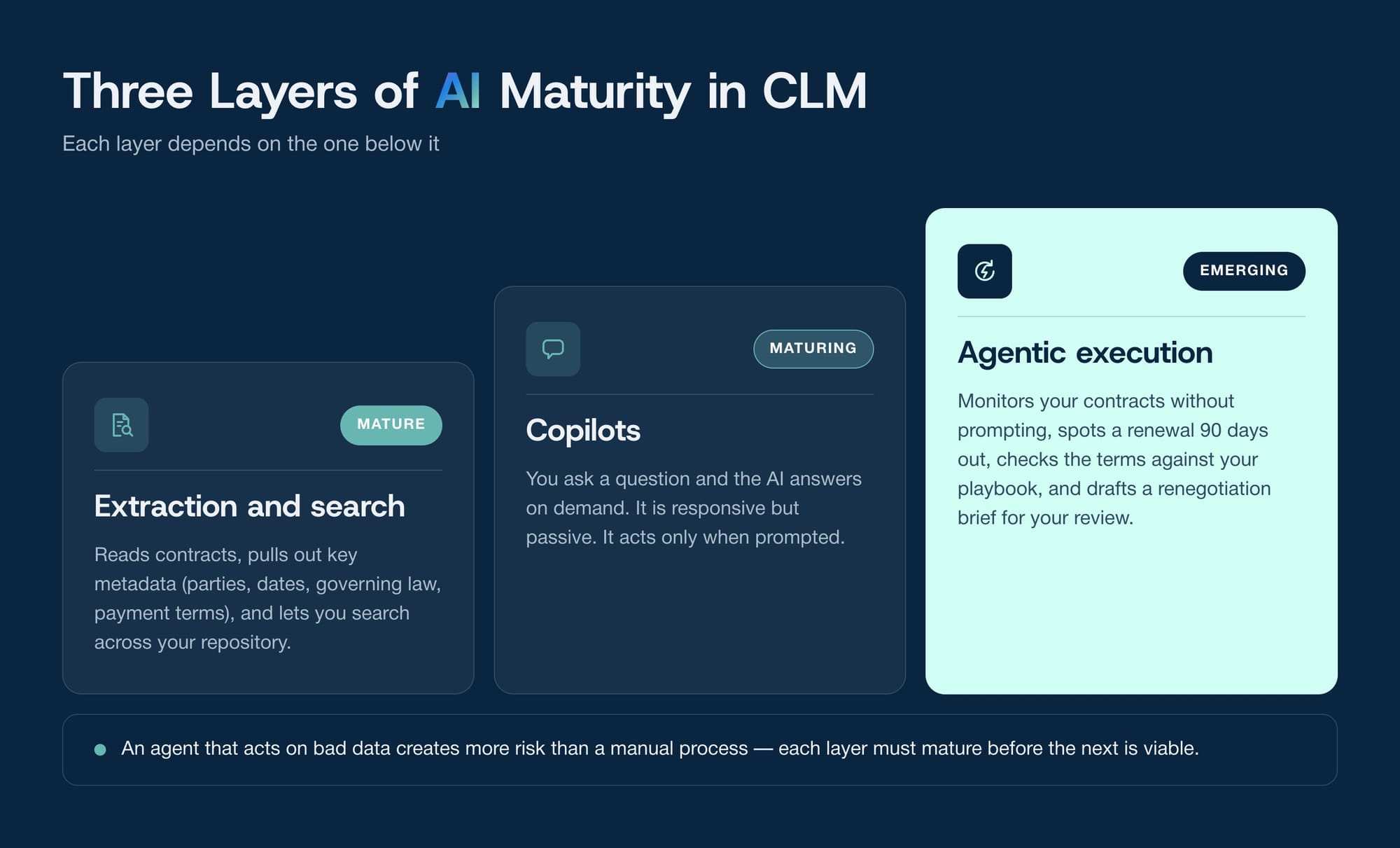
The system reads contracts, pulls out key metadata (parties, dates, governing law, payment terms), and lets you search across your repository. Most modern CLM platforms do this reliably today.
You ask a question — "Which of our vendor agreements have auto-renewal clauses?" — and the AI answers on demand. It is responsive but passive. It acts only when prompted.
The system monitors your contracts without prompting, spots a renewal 90 days out, checks the terms against your current playbook, flags a pricing clause that no longer matches your negotiation standards, and drafts a renegotiation brief for your review. It doesn't wait for you to remember the deadline.
The Thomson Reuters Institute's 2026 AI in Professional Services Report found enterprise-wide generative AI adoption across law firms and legal departments rose from 14% at the start of 2024 to 43% two years later, with the report noting that for large law firms and legal departments, those percentages are "beginning to approach 100%." The window for being an early adopter is closed. The differentiator now is execution quality — what the AI actually does, not whether you have it.
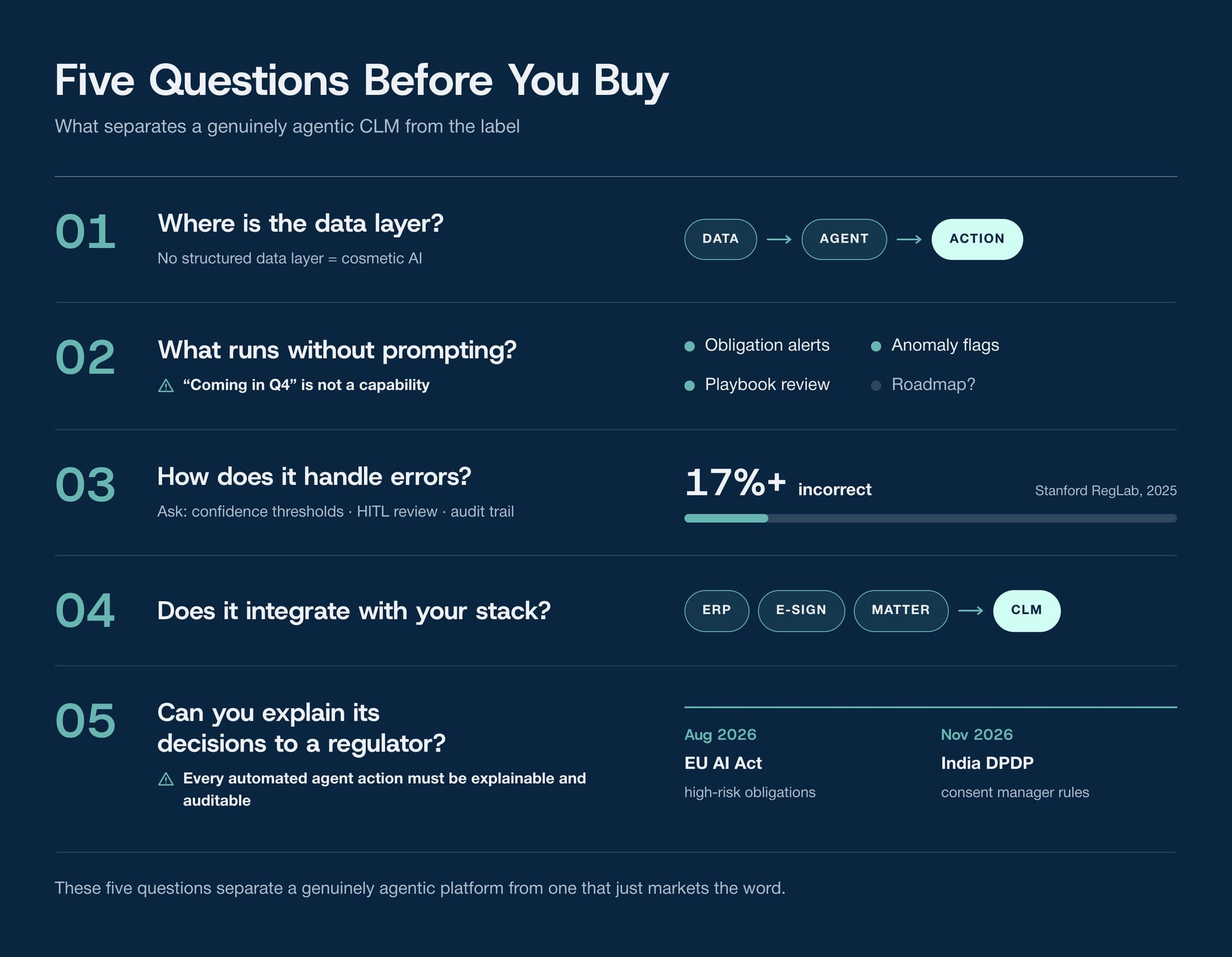
Agentic features are only as good as the structured contract data beneath them. Years of investment in extraction, OCR, and metadata normalization mean that many enterprise contract repositories now have a clean enough data layer to support autonomous action. Without that foundation, an "agent" is just a chatbot with a fancier name.
World Commerce & Contracting benchmark research finds that ineffective contract management costs companies an average of 9.2% of their annual revenue. Top performers lose roughly 3%; laggards bleed 15 to 20%. When the board sees those figures, "we'll get to it next quarter" stops being an acceptable answer for legal and procurement leadership.
Traditional AI-assisted CLM responds when you ask. You open the tool, type a query, get a result. Agentic CLM monitors your portfolio continuously. It alerts you to a compliance obligation two months before it matures, not the morning the deadline arrives.
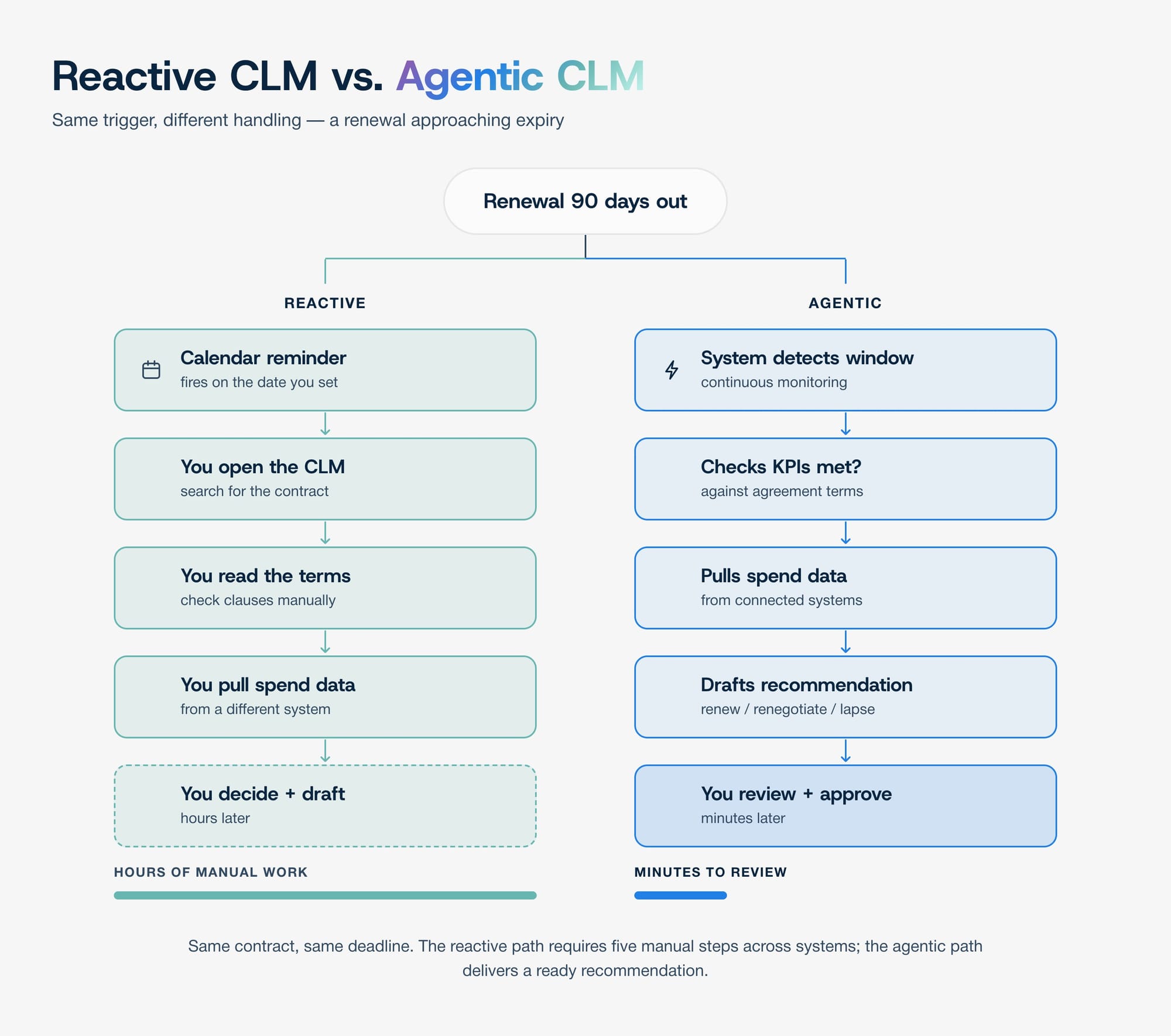
A copilot answers one question at a time. An agent chains actions together: it identifies that a contract is approaching expiry, checks whether the counterparty's performance met the KPIs defined in the agreement, pulls the relevant spend data, and surfaces a recommendation on whether to renew, renegotiate, or let it lapse. That sequence happens without separate prompts for each step.
Most CLM platforms today offer date-triggered reminders. Agentic systems go further. They look at patterns across your contract portfolio, flag unusual terms in newly ingested third-party paper, and predict which obligations are most likely to be missed based on historical data and current workload. The shift is from reactive CLM — calendar reminders for renewal and expiry dates — to proactive, predictive obligation management.
Provakil's AI-Powered CLM platform is built for the operational reality of Indian and global legal teams managing high-volume contract portfolios.
The platform covers the full lifecycle: authoring with clause libraries and playbook enforcement, negotiation tracking, e-signature integration, and post-signature obligation management with automated alerts and renewal workflows. For teams managing contracts across Indian jurisdictions alongside international agreements, Provakil natively supports multi-entity, multi-jurisdiction tracking.
What matters most for the agentic shift: Provakil's obligation-management engine does not stop at calendar reminders. It continuously monitors terms, flags deviations, and surfaces risks before they mature into losses.

The "agentic" label will keep spreading. By the time you read this, more vendors will have added it to their websites. That is fine. The label is not the risk. The risk is buying a tool that uses the word without the architecture to back it up, and spending another cycle with your team doing the work the software was supposed to handle.
Agentic CLM is not a future concept. Parts of it are production-ready now, and the rest is arriving fast. Make sure the platform fits into the systems your team already uses rather than replacing them. Teams that move first on solid foundations will spend less time catching up later.

Not yet. It can pre-screen contracts and flag playbook deviations, reducing the volume that reaches outside counsel. But high-stakes or novel clauses still need human legal judgment before sign-off.
Typically 8 to 16 weeks for mid-size portfolios. The bottleneck is usually data migration and metadata cleanup, not the software. Teams with a clean existing repository deploy faster.
Support varies by vendor. Most platforms handle English reliably. Hindi, Marathi, and other regional language support is emerging but still limited for extraction and autonomous review.
Organizations managing 500-plus active contracts typically see measurable ROI. Below that threshold, a well-configured copilot-tier CLM may deliver enough value without the added complexity.
Look for platforms offering on-premise or region-specific cloud deployment. Confirm AI processing stays within your chosen jurisdiction and that contract data is not used to train third-party models.

Dive deep into Provakil's numerous blog posts & discover how legal tech can streamline your litigation, contracts, IP, and notice management processes.