Provakil vs. Icertis: Which CLM Software Fits Your Legal Team in 2026?
8 min read



If your legal department only managed contracts, this would be a short comparison. Icertis has spent 15 years and half a billion dollars to become the deepest pure-play contract lifecycle management software on the market. Ten million contracts, $7.5 trillion in value managed, five Gartner Magic Quadrant nods; on paper, the conversation should be over.
However, in reality, it is anything but over, and 300+ global enterprises agree.
What analyst quadrants do not capture is what happens outside the contract. Most legal departments run litigation across dozens of courts and forums, manage IP portfolios with deadlines that do not wait, oversee entity governance across subsidiaries and jurisdictions, and somehow report on all of it before the next board meeting.
This Provakil vs. Icertis evaluation is not a contest over which CLM has deeper clause libraries. It is a question of whether your legal team needs a contract-only tool with a year-long rollout, or a legal operations platform that covers CLM, litigation management, IP management, and more in one system, live in weeks, without the enterprise-only price tag.
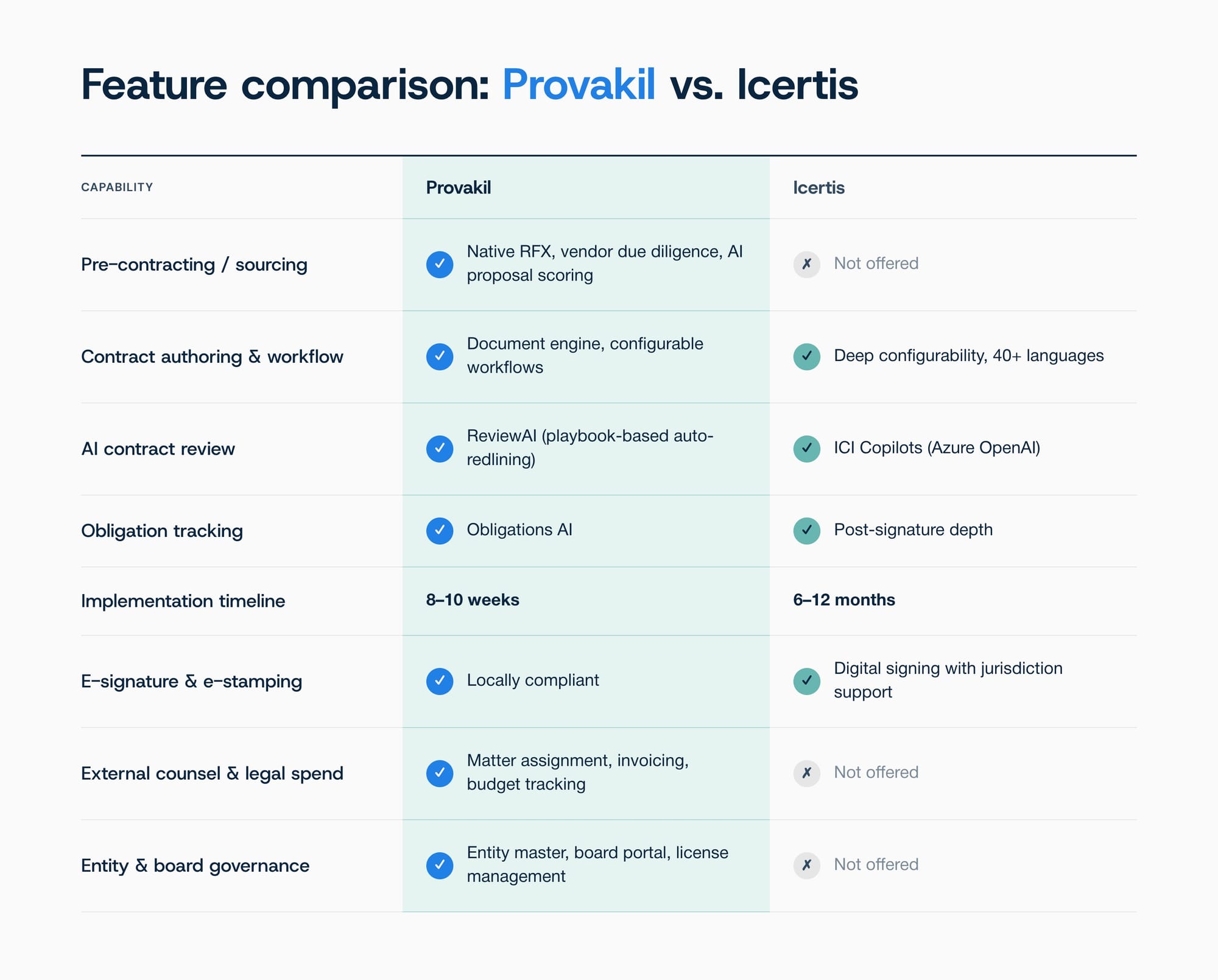
On the contract lifecycle itself, both platforms cover the basics: authoring, template management, configurable workflows, digital signing, obligation tracking, renewal reminders, and analytics.
The differences show up when you look at where each platform draws the boundaries.
Icertis offers deep configurability across the contract lifecycle: clause libraries in 40+ languages, mature ERP integrations with SAP and Salesforce, and post-signature obligation tracking that G2 and Gartner Peer Insights reviewers rate highly.
None of that is in dispute. What is worth noting is that all of it lives within a single function. The contract is the ceiling of what Icertis does, and everything your legal team handles outside of contracts, which for most departments is the majority of the work, requires a different vendor entirely.
Provakil starts before Icertis even enters the picture. Native RFX and tender management, vendor due diligence workflows, and AI-based proposal scoring give procurement and legal teams a governed process from sourcing through signature.
ReviewAI, Provakil's playbook-based auto-redlining engine, reviews contracts against configurable playbooks and extracts 30+ metadata fields per document. Obligations AI tracks post-signature commitments, renewal dates, and compliance milestones across the full contract repository.
For digital signing, Provakil supports locally compliant e-signature and e-stamping, including integrations with DocuSign, Leegality, and MSB Docs, which matters in jurisdictions where global e-sign providers alone do not meet local statutory requirements.
The short version: if your evaluation starts and ends at contracts, Icertis's depth within that scope is real. If your evaluation starts upstream at sourcing and vendor diligence, Provakil captures an entire phase of the lifecycle that Icertis skips.
This is where the comparison stops being a feature-for-feature exercise and becomes something structurally different. It is the single most important section in this piece for anyone running a legal department, not just a contracting function.
Icertis is a CLM, and only a CLM. It does not offer litigation management, legal spend management, or entity and board governance.
If your legal department handles those functions, and virtually every legal department of any scale does, an Icertis deployment means buying or building a separate stack of tools for everything outside the contract, then integrating those tools, then maintaining those integrations through upgrades, then explaining to the CFO why a single department needs five different vendors.
Provakil folds all of those functions into one governed system:
The math for buyers is more straightforward than most vendor comparisons make it seem. Add up what Icertis costs for contracts, then add a separate tool for litigation, another for IP, another for counsel management, and another for governance. Factor in the integration work, the multiple vendor relationships, and the ongoing maintenance burden of keeping it all connected.
Compare that total to a single platform that covers the full scope from a single vendor with a single implementation. That is the cost comparison Icertis would rather you evaluate later, and the one Provakil invites you to do first.
Both platforms put AI at the center of their contract workflows. The difference is what that AI can see.
Icertis markets its ICI Copilots as enterprise contract AI built on Microsoft Azure OpenAI Service, designed to extract attributes and clauses, scan for compliance issues, and generate executive summaries of contracts. But ICI Copilots see contracts. Only contracts. They do not touch litigation data or governance workflows, because Icertis does not have those modules to feed them.
Provakil's AI centers on ReviewAI, which auto-redlines contracts against configurable playbooks, and Obligations AI, which extracts and tracks post-signature commitments.
The platform extracts 30+ data points per contract and delivers a 60% faster contract review cycle. Provakil's AI operates across the full legal operations lifecycle, not within a single module. Cross-functional intelligence across your entire legal function is a fundamentally different proposition from deeper intelligence within a single silo.
The question is not which AI is more sophisticated in a lab. It is which AI sees enough of your legal department to be useful. An AI that goes deep on contracts but is blind to every other function your team runs, or an AI that works across contracts, litigation, IP, and counsel management in one governed system, gives your team 360° intelligence.
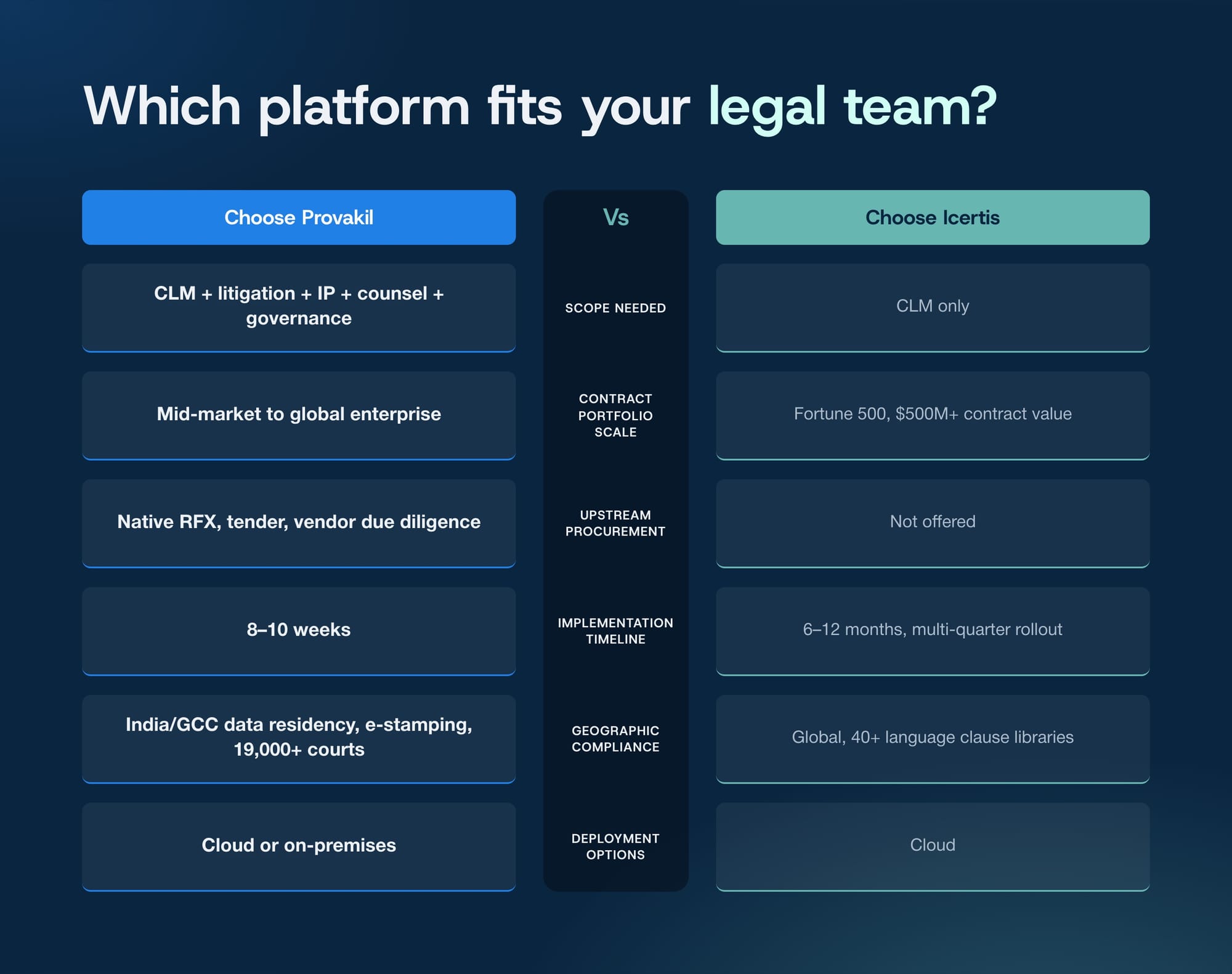
Icertis uses custom, quote-only pricing. Third-party analyses put annual subscriptions at $150,000 to $500,000+, with first-year total cost of ownership commonly exceeding $500,000 once implementation services are included, and pricing roughly 34% above the CLM market average.
Implementation runs six to twelve months for standard enterprise deployments, longer for complex global rollouts.
The cost does not flatten after go-live, either. G2 and Capterra reviewers consistently flag heavy customization overhead, ongoing dependency on implementation partners, and a steep learning curve.
Provakil's quote-based pricing scales from mid-market through global enterprise without a $500K floor. Implementation is completed within weeks, meaning a legal team reaches live operations in the time it takes most Icertis deployments to be in discovery.
Cloud and on-premises options are available, with contract abstraction and OCR-based migration support to migrate legacy repositories to the platform.
Most evaluation teams compare Provakil's quote against Icertis's quote in isolation, but that misses the point. Icertis covers contracts and nothing else. Provakil's single-platform quote, compared against the full multi-vendor total, is the comparison that changes the outcome of most evaluations.

We agree: Icertis built the deepest contract tool in the market; however, Provakil built a solution for how legal teams actually work.
If your legal department begins and ends with contracts, and you have the budget and the year to prove it, Icertis is a defensible choice. But most legal teams manage far more than contracts. They manage litigation, IP portfolios, compliance obligations, entity governance, and the thousand operational threads that connect it all.
For those teams, Provakil represents a different category of platform entirely: one that covers CLM, litigation, IP, counsel management, legal spend, and entity governance in a single system, deployed in weeks, at a cost that does not require a Fortune 500 budget to justify.
The question was never "which CLM is deeper?" It was "what does your legal team actually need?"

For legal teams that need CLM plus litigation, IP, counsel management, and governance in one system, yes. Provakil deploys in weeks at a fraction of the cost. Icertis remains the fit only for Fortune 500-scale portfolios where clause configurability across 40+ languages outweighs every other factor.
Yes. Provakil operates from offices in Pune, Delhi, Dubai, and KSA, and serves enterprises across India, the GCC, and Southeast Asia. Data residency is available in India, UAE, KSA, and Malaysia, with locally compliant e-signature and e-stamping across all markets served.
Provakil runs legal and contract operations for 300+ global enterprises and 50+ government entities, with SOC 2, GDPR, ISO 27001, and ISO 9001:2015 certifications. Cloud and on-premises deployment are both available, with data residency in India, UAE, KSA, and Malaysia.
Yes. Provakil offers contract abstraction and migration support, including OCR-based legacy import, to move existing repositories onto the platform. The eight-to-ten-week implementation timeline factors in migration planning, so your team is not rebuilding from scratch.
Yes. Provakil integrates with Microsoft Word and 365, Salesforce, SAP, Oracle, Zoho, Google Workspace, Okta, Dropbox, and DocuSign, among others. Unlike Icertis, those integrations connect across the full legal-ops suite, not just the contract module.

Dive deep into Provakil's numerous blog posts & discover how legal tech can streamline your litigation, contracts, IP, and notice management processes.