DPDP-Compliant Contracting: What Every Vendor Agreement in India Must Now Include
7 min read



When the DPDP Rules 2025 were finally notified in the third week of November, the Digital Personal Data Protection Act gained the implementing regulations it had lacked for two years, and legal teams across the country felt the ground shift under vendor contracts they had been renewing on autopilot.
You know the exercise that followed. You pull up the vendor master list and start scrolling through the payroll processors, cloud hosting providers, CRM platforms, HR tech vendors, and background verification agencies. Personal data flows through hundreds of those relationships, often through processors your team stopped thinking about the day the MSA was countersigned.
Under the DPDP Act 2023 and DPDP Rules 2025, a Data Fiduciary in India may engage a Data Processor only under a valid contract containing specific mandatory clauses. A standard MSA, however thorough its commercial terms, does not satisfy this requirement. For legal teams managing large vendor portfolios, DPDP-compliant contracting has become a contract lifecycle management discipline, not a one-time compliance fix.
Section 8(2) of the DPDP Act changes how every vendor engagement involving personal data must be structured. It does not require a privacy policy update or a data-handling addendum tucked into Schedule 7 of your existing MSA; it requires a valid contract between the Fiduciary and the Processor that imposes specific obligations mirroring the Fiduciary's statutory duties under the Act.
Rule 6 spells out the specifics: the contract must mandate encryption, access controls, backup protocols, and log retention of at least one year, all equivalent to the safeguards the Fiduciary applies to its own data processing.
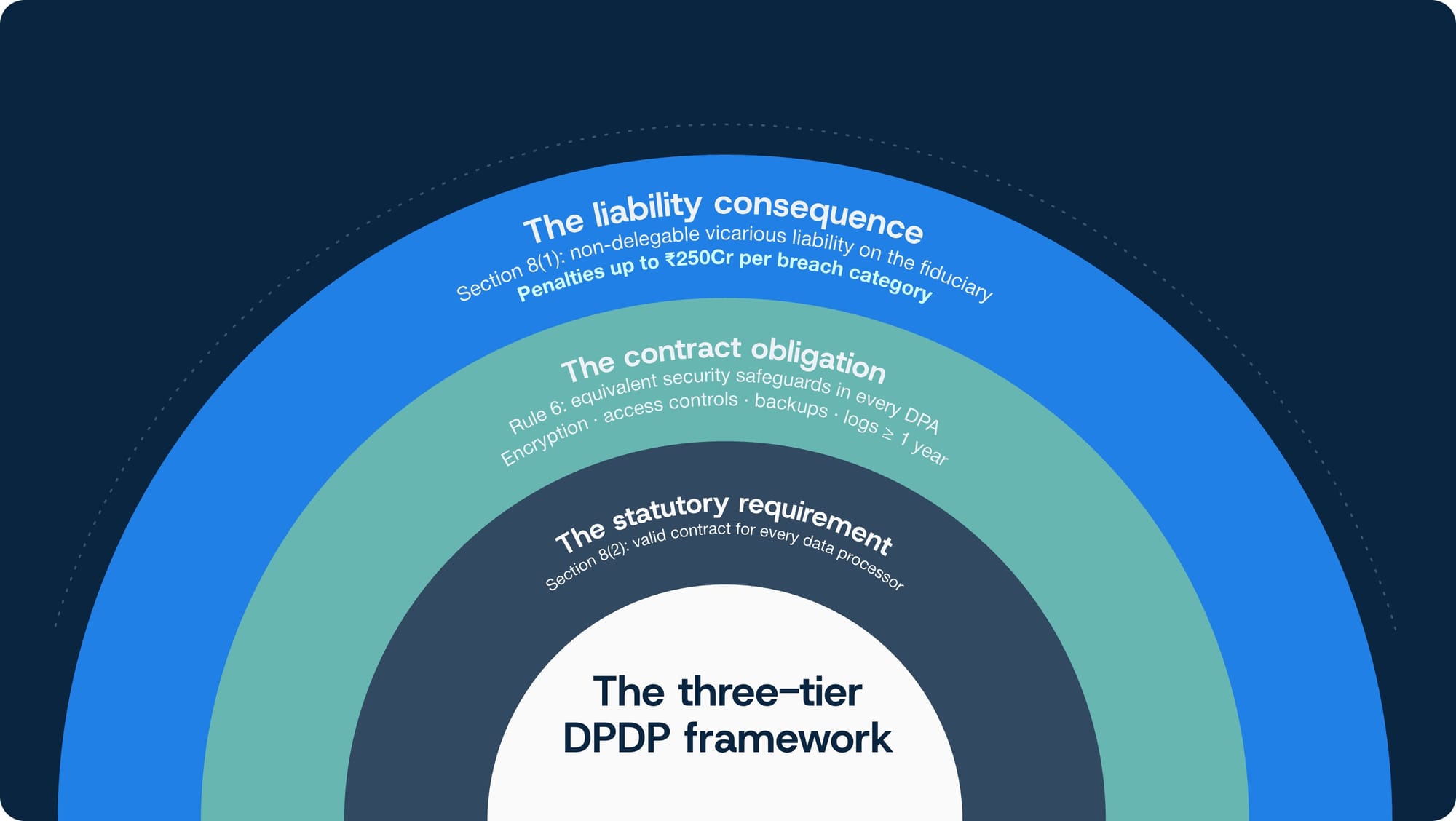
Section 8(1) rewrites the risk calculus by imposing non-delegable, absolute vicarious liability on the Data Fiduciary for anything the Data Processor does with personal data under the engagement. When your processor causes a breach, the penalty falls on you as the Fiduciary, regardless of where the fault originated. The Data Processing Agreement is not a compliance formality; it is the Fiduciary's primary legal defense when something goes wrong, and without the mandatory clauses in that agreement, the defense has no foundation.
One clarification that trips up a surprising number of legal teams: the DPDP Act contains no "sensitive personal data" category. Personal data is defined once, in Section 2(t), by identifiability alone. If secondary commentary told your team that health data or financial data triggers additional DPA requirements under DPDP, that commentary is working from an outdated framework that does not apply here.
The phased enforcement timeline puts a concrete boundary around the urgency. Phase 2 activates around November 2026 with the Consent Manager framework under Rule 4. Phase 3, around May 2027, brings the Data Protection Board's penalty powers into force, reaching up to INR 250 crore per breach category.
By the time you have worked through Section 8 and Rule 6, the gap between what your standard vendor MSA covers and what the DPDP Act demands becomes impossible to overlook. Your existing MSA handles payment terms, intellectual property ownership, limitation of liability, confidentiality, and termination, all the commercial staples your legal team has negotiated dozens of times without much friction.
What it almost certainly does not contain is the set of clauses the DPDP Act now requires in every contract governing the processing of personal data. A DPDP-compliant Data Processing Agreement must include these eight mandatory elements:
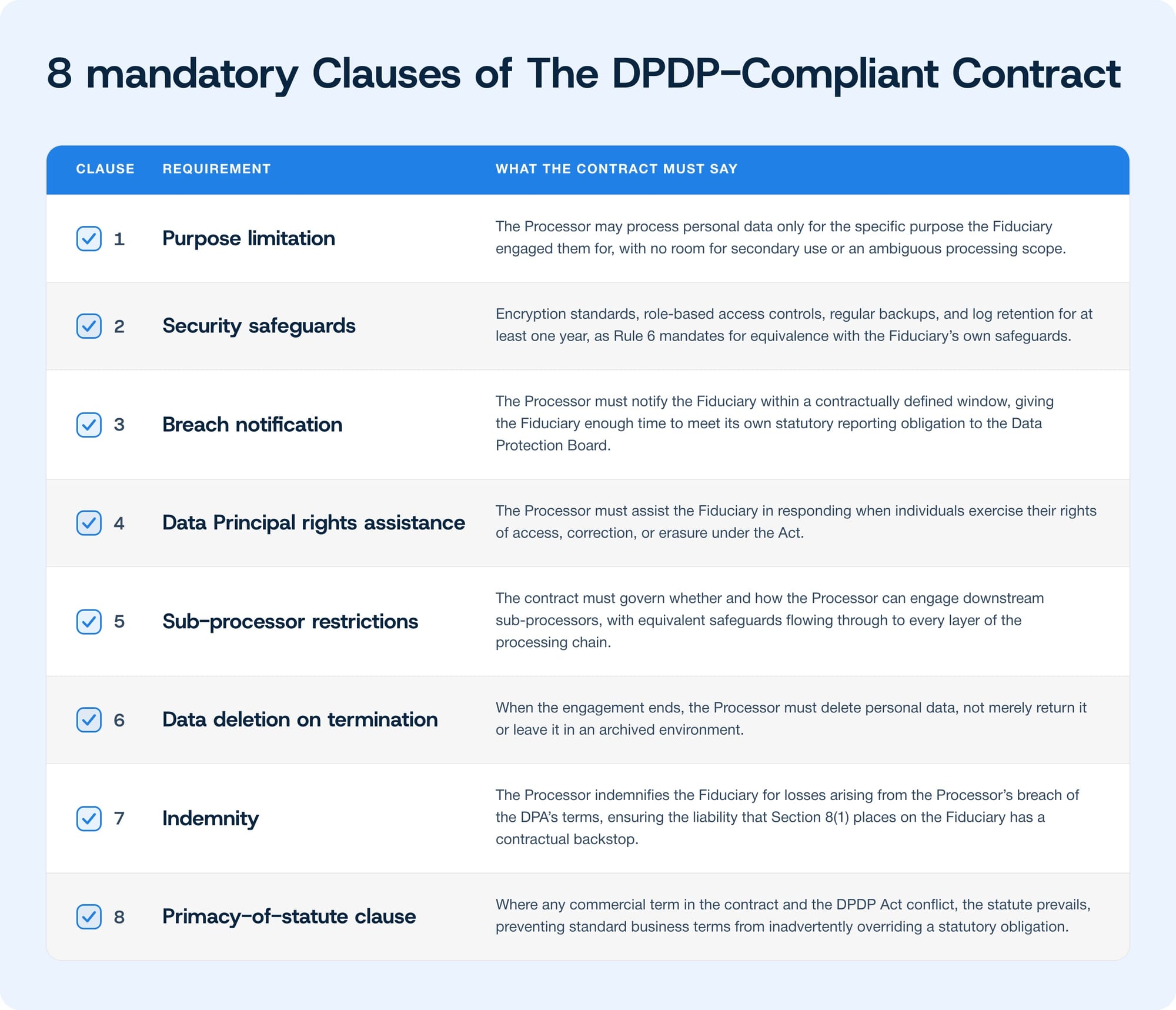
Now multiply those eight requirements across every vendor contract in your master list that involves personal data. If the remediation plan runs on tracked-change Word documents circulating through a shared drive, the math stops working well before you reach the bottom of that list.
What turns DPDP-compliant contracting from a one-time remediation project into a permanent organizational capability is the infrastructure sitting underneath it: a system that templates, reviews, tracks, and enforces those clauses across your entire vendor portfolio, not just during the initial push but through every renewal, renegotiation, and new vendor onboarding that follows.
Provakil's AI-powered CLM is designed for exactly this kind of regulatory contracting challenge. Its clause library lets legal teams build pre-approved DPDP-compliant DPA templates and deploy them across the vendor base without drafting each agreement from scratch.
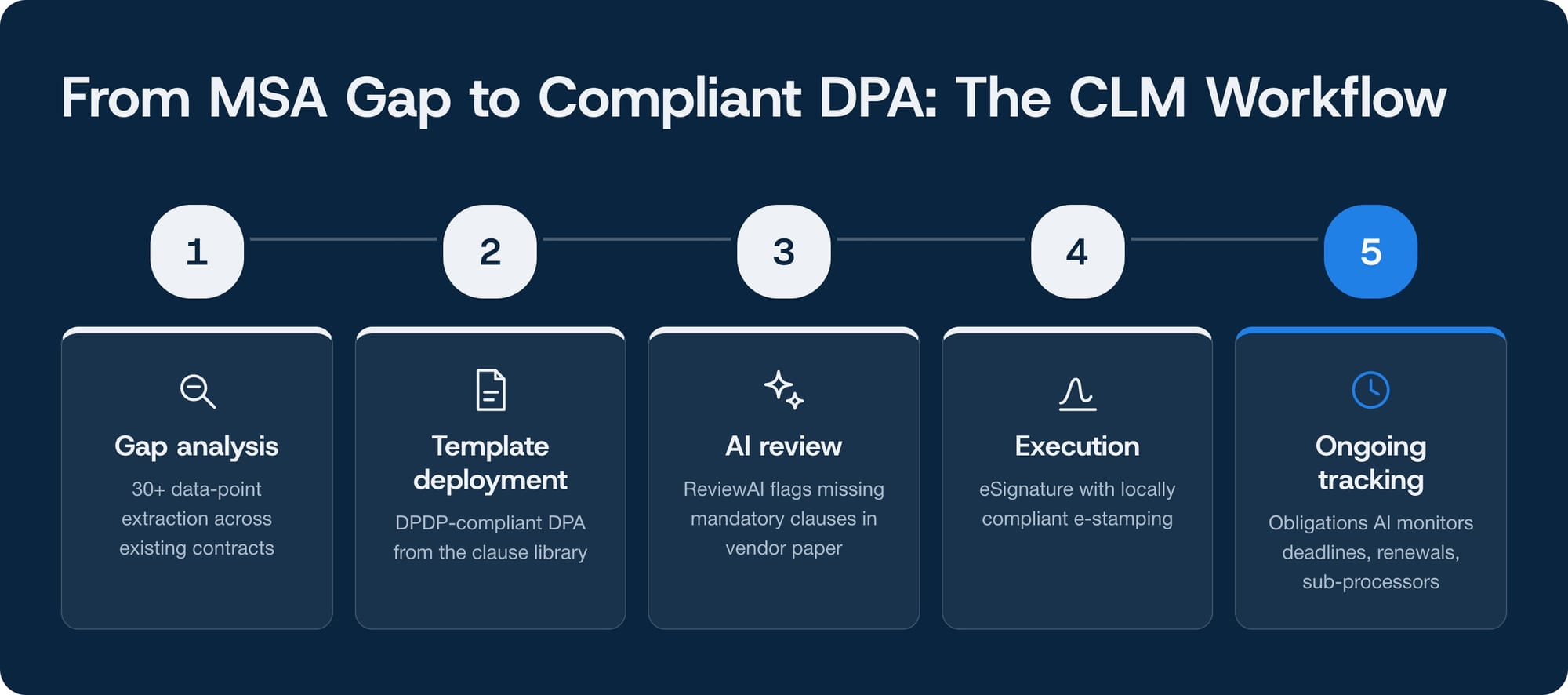
Provakil's AI-led contract intelligence reads incoming vendor paper against your DPDP playbook and flags every contract missing mandatory clauses, catching gaps at the review stage rather than discovering them during a regulatory audit months later. It tracks the ongoing deadlines every executed DPA creates: breach-notification response windows, deletion-on-termination timelines, sub-processor compliance checkpoints, and renewal dates where clause updates may be required.
When you are dealing with a legacy vendor base, Provakil's 30+ data-point extraction runs a gap analysis across the existing contract portfolio, mapping exactly where DPA coverage falls short before remediation begins. And every action in the workflow, from template deployment to clause-level negotiation to final execution via Provakil's locally compliant E-signature with E-stamping integration, generates an audit trail that is regulator-ready.
Organizations treating DPDP-compliant contracting as a CLM discipline will finish the initial remediation and stay compliant as the rules evolve, without rebuilding their contract base each time a new notification drops.

For the teams that treated DPDP-compliant contracting as a systems problem rather than a paperwork problem, their vendor list no longer reads like a liability ledger. Their DPA templates live in a clause library, ready to deploy the moment a new engagement comes through. Incoming vendor paper gets flagged automatically when mandatory clauses are missing, and breach-notification deadlines and deletion timelines are tracked in obligation management workflows rather than in calendar entries someone might dismiss.
DPDP has permanently changed the legal infrastructure of vendor relationships in India. The phased enforcement window is narrower than it appears when you account for the months needed to negotiate amendments with processors who have their own legal teams and timelines. The organizations building the CLM discipline around DPDP-compliant contracting today are laying infrastructure that will serve them through every future regulation that rewrites how Indian enterprises manage personal data.

Yes. If a vendor relationship involves processing personal data and the existing contract lacks the mandatory DPA clauses, the Fiduciary must remediate the agreement to comply with Section 8(2) and Rule 6 before the relevant enforcement phase activates, regardless of when the original MSA was signed.
A GDPR-aligned global template covers some of the same principles, including purpose limitation, breach notification, and sub-processor restrictions. However, it will not address DPDP-specific requirements such as the Section 8(1) vicarious liability framework, the Rule 6 log-retention mandate of at least one year, the primacy-of-statute clause, or the absence of a "sensitive personal data" tier. Indian law requires an India-specific DPA layer.
The risk sits entirely with the Data Fiduciary. Section 8(1) holds the Fiduciary vicariously liable for the Processor's actions regardless of what the contract says. Engaging a processor without a compliant DPA means accepting full penalty exposure, up to INR 250 crore per breach category, with no contractual indemnity or liability backstop.
The Act requires a valid contract with each Data Processor, but it does not prescribe the form. A standalone DPA, a DPA schedule annexed to the MSA, or a DPA incorporated by reference into a master agreement can satisfy Section 8(2), provided each contains all eight mandatory clauses and is specific to the processing purpose of that engagement.

Dive deep into Provakil's numerous blog posts & discover how legal tech can streamline your litigation, contracts, IP, and notice management processes.