Why Global Case-Management Software Breaks Down in Indian Courts
7 min read



You are standing outside a district court at 10:15 in the morning, scrolling through your phone and holding a stack of files; somewhere inside, your matter is listed, but the supplementary causelist went up at 9:47 p.m. last night, and you only caught it because a junior happened to check. Your software, the one your firm adopted six months ago because it looked polished and came recommended by a colleague who practices in London, has no idea the listing exists.
Case management software for Indian courts needs to do something that global tools were never designed to do. It needs to track hearings across 25 High Courts, over 600 district courts, and thousands of tribunals, consumer forums, and regulatory bodies, each with its own causelist schedule, procedural rules, and data format.
Global platforms were built for the US and UK court system, where a single federal or state docket number follows a matter from filing to resolution. In India, the judiciary's architecture is different, and software that ignores that difference will quietly let hearings fall through the cracks.
This blog walks through the specific points where global tools fail in Indian courts and explains what India-first case management actually requires.
The answer starts with sheer scale and fragmentation. India's judiciary handles a pendency of over 5 crore cases across all levels. The National Judicial Data Grid (NJDG) now provides access to case status for more than 23.81 crore cases and over 23.02 crore orders and judgments, spread across the Supreme Court, High Courts, and district and subordinate courts.
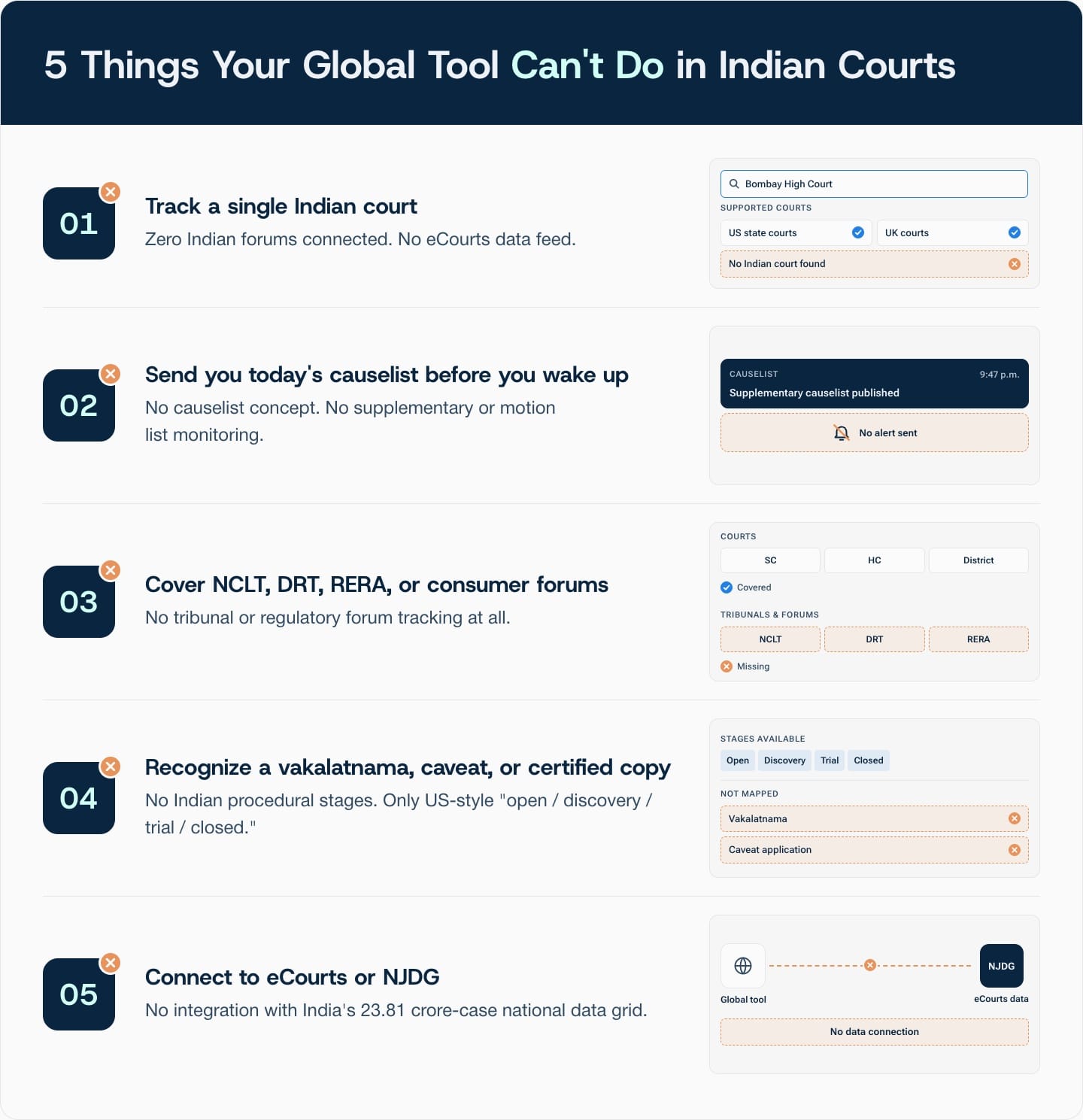
Add the National Company Law Tribunal (NCLT) and its appellate body, NCLAT; the Debt Recovery Tribunals (DRTs); RERA authorities across every state; consumer dispute redressal commissions at three tiers; labor courts; income tax appellate tribunals; and various sector-specific regulatory forums to that, and you have more than 19,000 distinct forums, making it one of the largest and most fragmented court systems anywhere in the world.
Each forum has its own case-numbering system, procedural stages, and schedule for publishing causelists. A district court in Maharashtra does not publish its causelist the same way a DRT in Chennai does, and neither looks anything like the NCLT principal bench listing.
Global tools were built around a much simpler assumption: one court system, one docket format, one set of procedural rules. A US attorney using Clio can pull case data from a state court docket because that docket follows a standardized structure. An Indian advocate juggling matters across the Bombay High Court, a district court in Thane, and the NCLT Mumbai bench cannot rely on the same logic. The data sources, formats, and update frequencies all differ.
The phrase "India-first" is not marketing. It describes a design decision at the architecture level: build the software around how Indian courts actually work, instead of bolting on Indian features after the fact.
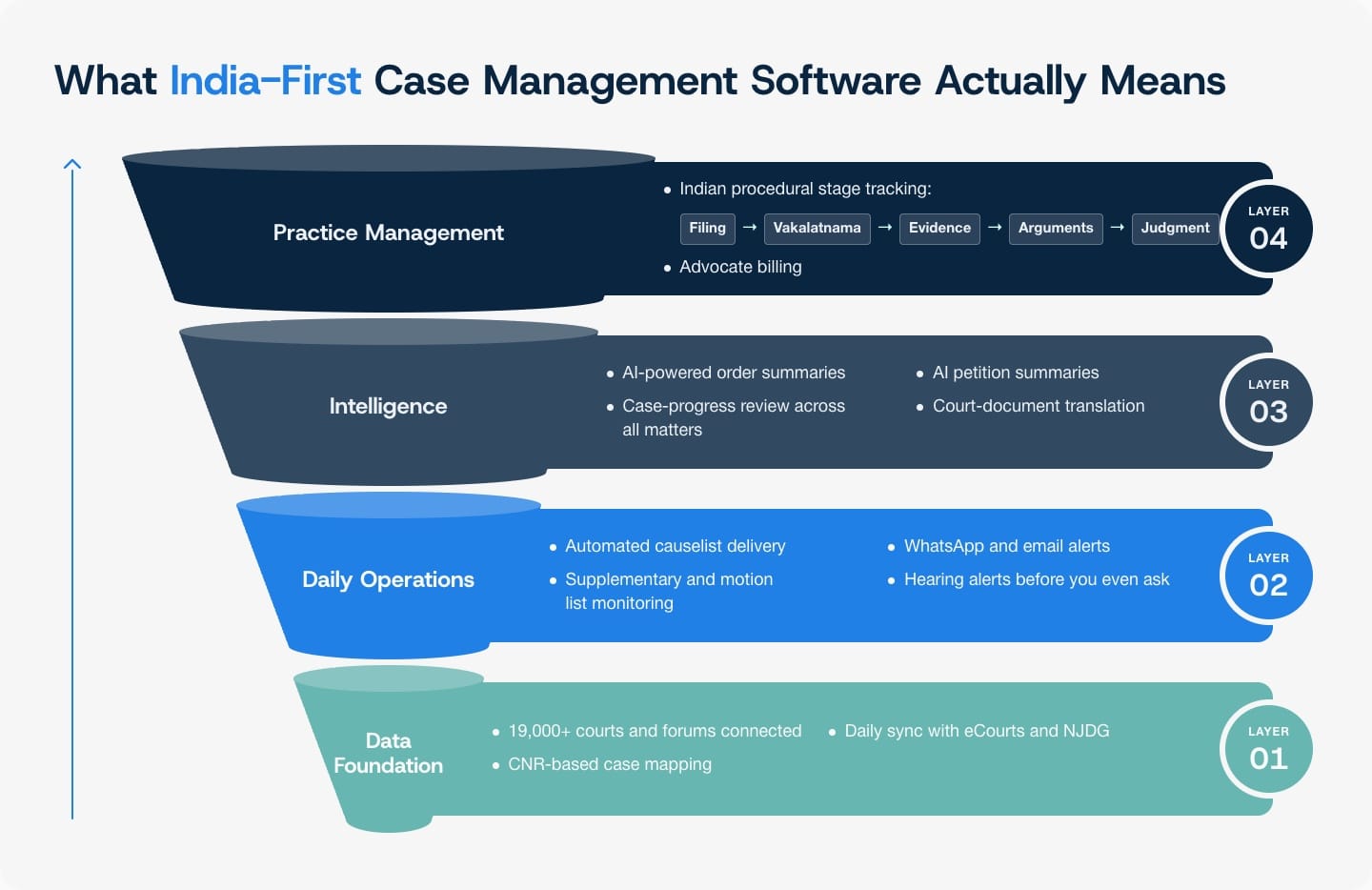
An India-first platform tracks cases across the full hierarchy. That means the Supreme Court, all 25 High Courts, district and subordinate courts, and the full range of tribunals and regulatory forums. Provakil, for instance, integrates with over 19,000 Indian courts and forums, covering NCLT, RERA, DRT, consumer forums, and labor tribunals alongside the regular court system. That coverage is not a checklist item. It is the data infrastructure that every other feature depends on.
India-first architecture means the software monitors causelists automatically, including supplementary and motion causelists, and pushes alerts to users through the channels they actually use. Provakil delivers personalized causelists over WhatsApp and email, so the advocate checking their phone between courts at 7 a.m. knows exactly where they need to be and at what item number. No manual entry, no checking multiple court websites.
Global AI features are trained on US and UK legal language and document types. India-first AI needs to read Indian court orders, summarize them in context, and handle the specific structure of Indian judgments, which follow their own citation conventions, procedural references, and statutory framework.
Provakil's AI layer generates order and petition summaries, reviews case progress across matters, and translates court documents, all tuned to Indian legal language and court output formats. This capability is fundamentally different from a generic AI assistant bolted onto a US-centric tool.
The workflow engine needs to map to Indian procedural stages natively, from filing and vakalatnama to evidence, arguments, and judgment. The billing module also needs to handle GST-compliant invoicing, because Indian law firms are legally required to produce it. Provakil covers both, along with expense tracking, team management, and client communication, designed around how Indian practitioners actually run their offices.
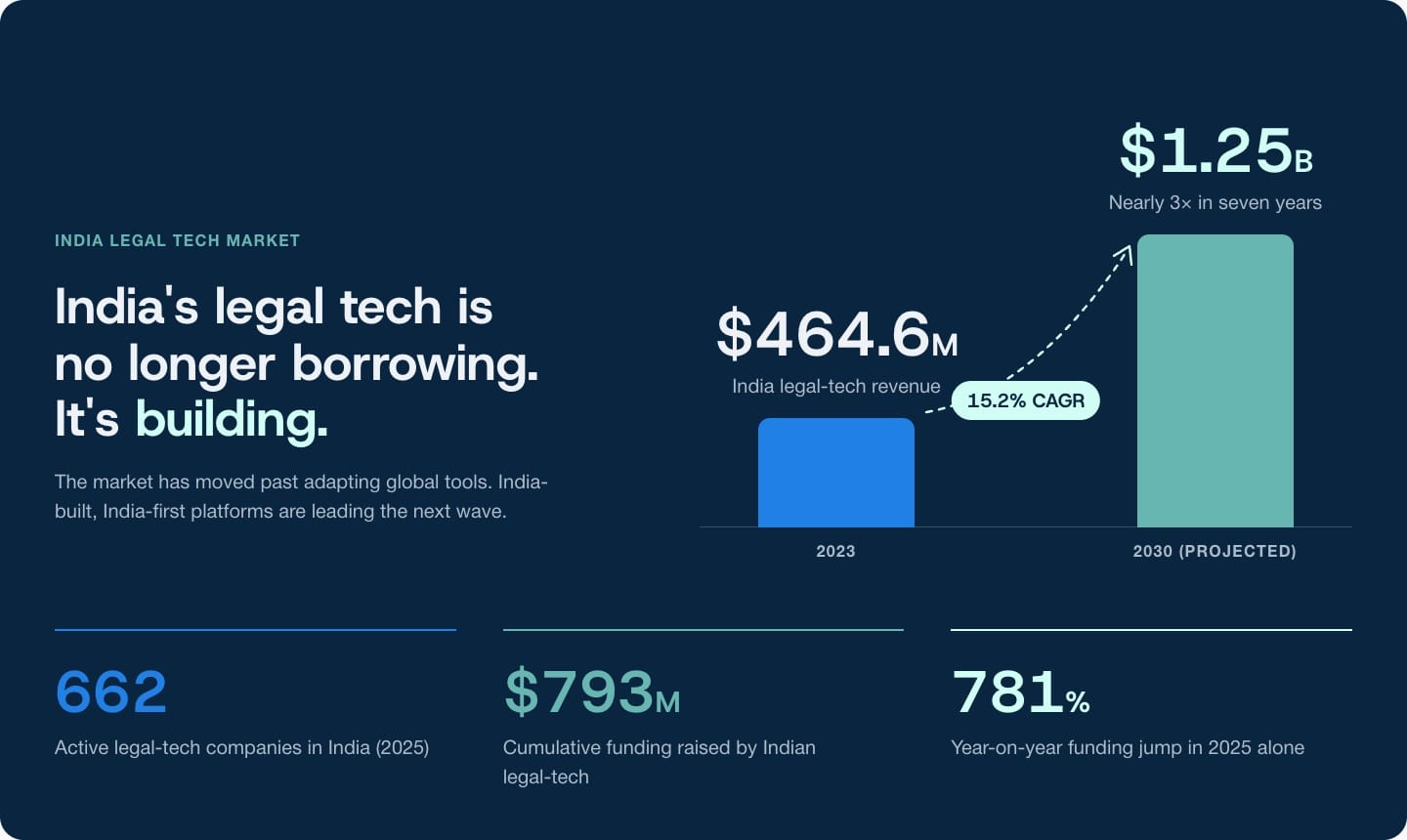
India's legal-technology market generated USD 464.6 million in revenue in 2023 and is projected to reach USD 1,253.1 million by 2030, according to Grand View Research, growing at a compound annual rate of 15.2%. The country hosted 662 active legal-technology companies in 2025, and the sector raised cumulative funding of approximately USD 793 million, with 2025 alone seeing a 781% rise in funding compared with the previous year.
This growth reflects a market that is choosing India-built solutions over adapted global ones. CB Insights has described Provakil as "the most functionally complete Indian-built platform in its category" for corporate legal departments handling high-volume litigation across multiple jurisdictions.

If you are an advocate or a law firm evaluating case-management software, the first question is not which tool has the best interface or the most AI features. The first question is whether the tool knows your courts. Can it pull your causelist before you wake up? Does it cover the NCLT bench where your insolvency matter is listed? Will it alert you when a supplementary list goes up at 10 p.m.?
If the answer to any of those is no, you are not saving time. You are adding a layer of false confidence on top of a manual process. The software looks like it is managing your cases, but the real tracking is still happening in your head, your diary, and your junior's WhatsApp messages.
India-first case management software means your solution works the way your practice actually works. It means fewer missed hearings, fewer frantic morning calls, and more time spent on the work that grows your reputation and your practice.

Global tools are built for US and UK court systems. They have no connection to Indian eCourts or NJDG, no causelist tracking, no coverage of Indian tribunals like NCLT, DRT, or RERA, and no support for Indian procedural stages or document types. You would need to enter every hearing date manually and track every causelist change yourself, which defeats the purpose of case-management software. India-specific tools like Provakil integrate directly with over 19,000 Indian courts and forums.
The National Judicial Data Grid (NJDG) is a national repository of case data synchronized daily from courts across India. It covers over 23.81 crore cases and 23.02 crore orders and judgments. A case-management solutions that connects to NJDG can automatically pull case status, hearing dates, and order updates, so you do not have to check individual court websites.
Provakil integrates with over 19,000 Indian courts and forums, including the Supreme Court, all 25 High Courts, district and subordinate courts, NCLT, RERA authorities, DRTs, consumer commissions, and other tribunals. It delivers personalized causelists over WhatsApp and email, tracks hearing dates automatically, and provides AI-generated summaries of court orders and petitions.
India-first platforms like Provakil are built with local data residency, hosting data within India. The Digital Personal Data Protection Act, 2023 (DPDP) makes data security a statutory obligation for law firms handling client information. Choosing a platform with Indian data residency is both a security and compliance decision.
Focus on five things: breadth of court and forum coverage, automated causelist tracking with real-time alerts, integration with eCourts and NJDG, support for Indian procedural stages and document types, and GST-compliant billing. If a platform cannot demonstrate these, it was not built for Indian practice.

Dive deep into Provakil's numerous blog posts & discover how legal tech can streamline your litigation, contracts, IP, and notice management processes.