Why Legal Collections Management Software Breaks When Three Statutes Are Tracked Separately
6 min read



Every General Counsel or Head of Legal at an Indian bank or NBFC has lived through a particular kind of morning at least once, which begins with a phone call about a hearing everyone forgot was scheduled. The Section 138 complaint filed eight months ago came up for hearing on Tuesday. The SARFAESI possession notice for the same borrower's secured property, tracked in a different spreadsheet by a different team, had its 60-day response window lapse that same day. And somewhere in a DRT in Mumbai, an application against the same account was listed for arguments and wasn't flagged because the DRT tracker lives in an inbox, not a system.
Legal collections management software that cannot hold all three proceedings in one place, with one hearing calendar and one evidentiary chain, is three disconnected ledgers pretending to be a system of record, and the pretense holds exactly until a DRT challenge asks for the complete trail.
Every legal team running these three tracks on separate systems is accumulating risk that becomes visible only after it has cost them something.
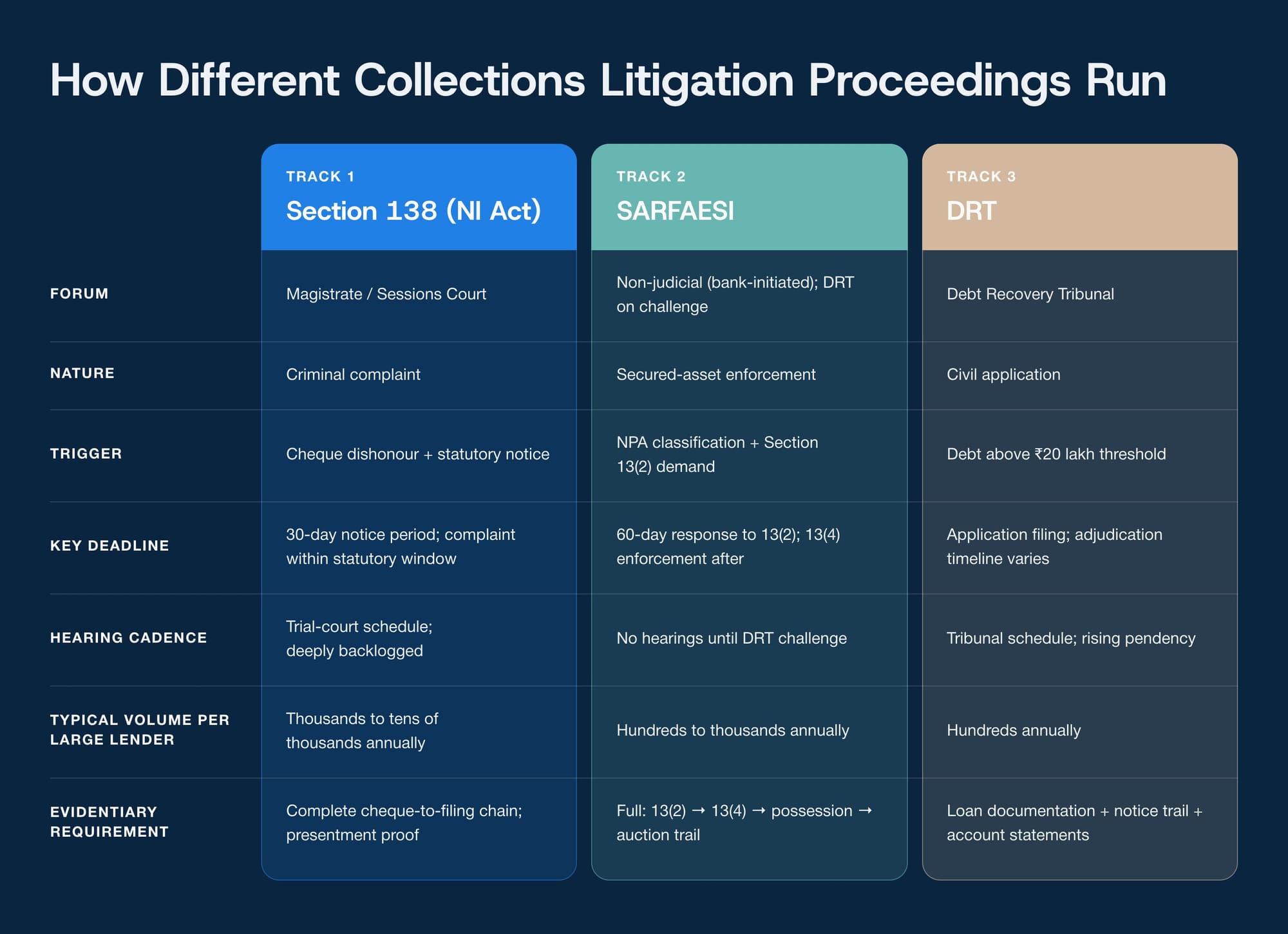
Most legal teams will tell you they have a system for tracking recovery litigation, and what they mean is that they have a system for one piece of it, usually SARFAESI because the deadlines are the most immediately punishing, while the other two statutes run on some combination of advocate reports, shared folders, and email threads. That fragmentation creates specific failures that compound across a portfolio of thousands of accounts.
Missed hearings are the most visible failure. A missed Section 138 hearing can produce an ex parte order, a missed DRT date can forfeit the right to present evidence, and the real cost is downstream litigation when those outcomes must be challenged.
The broken evidentiary chain may be the most consequential failure of all. A DRT challenge to a SARFAESI action will ask for the complete account history: NPA classification, Section 13(2) demand notice, borrower response, 13(4) enforcement, and often the parallel Section 138 filing.
When these documents live in different systems, assembling the trail for a single account can take days, and that overhead scales linearly with case volume.
A system of record is the single platform where the legal team can confirm the complete status, history, and evidentiary trail of every recovery proceeding across every statute, forum, and advocate without opening another tool or asking another person. Any legal collections management software claiming that title should be tested against specific requirements.
The software needs native, statute-specific workflows for Section 138, SARFAESI, and DRT. A SARFAESI workflow must track the 13(2), 13(4), possession, and auction lifecycle with stage-specific deadline alerts. A Section 138 workflow must track the cheque-dishonor-to-filing chain and the trial calendar. A DRT workflow must accommodate the tribunal's procedural stages and distinct hearing cadence. Generic matter templates with custom field labels do not qualify.
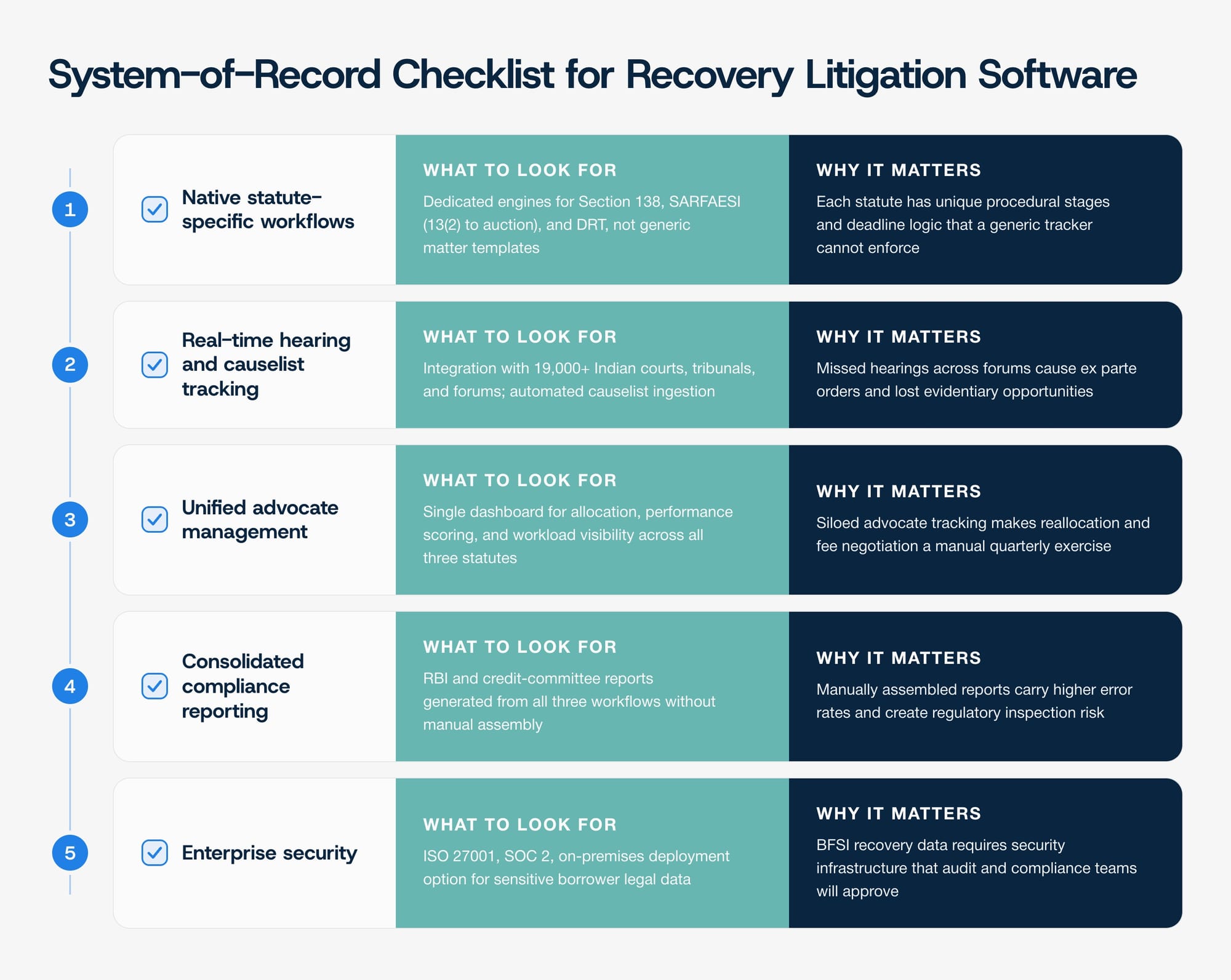
Provakil was built for this problem, and the specifics matter. For Section 138, Provakil runs a dedicated workflow engine that tracks proceedings from cheque dishonor through statutory notice, complaint filing, trial hearings, and resolution.
For SARFAESI, Provakil manages the full 13(2) demand notice through 13(4) enforcement, possession, and auction lifecycle with stage-specific deadline alerts. The evidentiary chain stays intact within the system, so when a borrower files a DRT challenge, the complete trail from NPA classification through every enforcement step is available immediately.
For DRT and NCLT proceedings, Provakil provides forum-specific workflow tracking with procedural stages mapped to each tribunal's cadence, and hearing dates feed into the same unified calendar that covers Section 138 trial dates and SARFAESI enforcement timelines.
Across all three statutes, Provakil's advocate management dashboard gives the legal team a single view of every empanelled advocate's caseload, performance, adjournment history, and billing. Legal-spend tracking breaks down by statute, stage, forum, and advocate, and compliance reporting generates RBI and credit-committee reports in regulator-approved formats from all three workflows without manual extraction.

The morning phone call about a hearing nobody remembered is not a failure of the people managing recovery litigation at Indian banks and NBFCs; it is a failure of the systems they were given to manage it with. Software designed for a single statute, or borrowed from a global litigation template that knows nothing about Indian courts, was never going to hold up when the reality demands three parallel statutory proceedings tracked across thousands of accounts and dozens of forums.
That reality is getting harder, not simpler. The Supreme Court's Sanjabij Tari guidelines are reshaping Section 138 procedure. SARFAESI referral volumes continue to grow, with 2,15,709 cases in FY25. DRT pendency is a structural concern the Finance Ministry has publicly acknowledged. Each of these pressures strengthens the case for a unified system of record and makes fragmented tracking harder to justify.

Yes. A lender can file a Section 138 criminal complaint for a dishonored cheque, initiate SARFAESI enforcement against the same borrower's secured assets, and file a DRT application for civil recovery of the outstanding debt, all at the same time. Indian courts have consistently held that these are distinct legal remedies that do not bar one another.
Each statute requires its own documentation chain, but the records overlap. The Section 138 trail needs the original cheque, proof of presentment, and statutory notice. SARFAESI requires the full 13(2) through 13(4) enforcement trail. DRT needs the loan agreement, account statements, and notice history. When all three run in parallel, a single consolidated record that links every document to the borrower account eliminates the risk of inconsistent filings across forums.
Most lenders empanel separate advocate panels by statute and geography, meaning a single borrower's three proceedings may be handled by three different advocates in three different cities. Leading legal teams are shifting toward unified allocation models that factor in expertise across statutes, current workload, and historical performance, rather than statute-specific rosters managed independently.
Amounts recovered through SARFAESI asset enforcement or a DRT decree are typically adjusted against the total outstanding, which can affect the quantum claimed in other pending proceedings. Lenders must track recoveries across all three tracks in real time to avoid overclaiming, which courts have flagged as an abuse of process in multiple reported decisions.
Generally, yes. Under Section 17 of the SARFAESI Act, a borrower aggrieved by a secured creditor's action must file an application before the Debt Recovery Tribunal within 45 days of the action. High Courts have entertained writ petitions in limited circumstances, but the statutory remedy before the DRT is the prescribed first recourse.

Dive deep into Provakil's numerous blog posts & discover how legal tech can streamline your litigation, contracts, IP, and notice management processes.