Provakil vs. CredResolve: Why a Recovery Service Isn't Legal Collections Management Software
6 min read



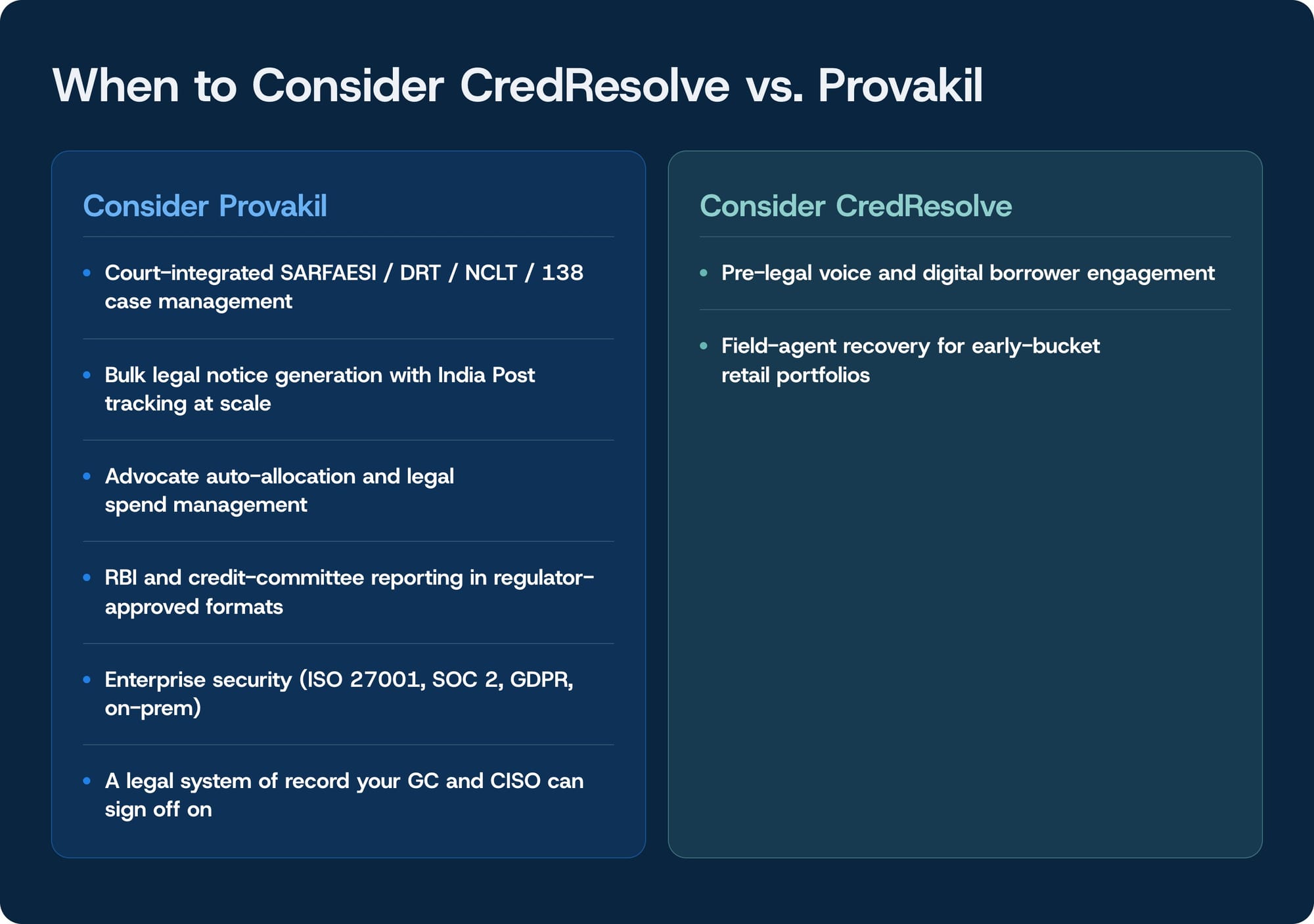
CredResolve is a debt recovery vendor that combines AI voice bots with its own field agents to collect on early-bucket delinquencies across India. Lenders pay on results, not on a software license, and for pre-legal collections the model works. But CredResolve also positions itself as a legal automation platform, and that is where the comparison with Provakil begins.
Provakil is legal collections management software built for BFSI legal teams at banks, NBFCs, and housing finance companies. It tracks cases across 19,000+ Indian court forums, runs dedicated workflow engines for SARFAESI, DRT, NCLT, and Section 138 proceedings, auto-allocates matters to advocates, manages legal spend by proceeding and stage. It is debt management software built for what happens when a loan leaves the collections floor and enters a courtroom.
The two platforms serve different stages of the recovery lifecycle, and this blog lays out exactly where CredResolve's legal capability ends and where Provakil's begins.
CredResolve's collections infrastructure is straightforward enough: Chakra handles multilingual AI voice engagement, a company-run field network covers 10 Indian states (expanding to 15), and AI-driven connectivity scoring prioritizes borrower outreach. For early-bucket pre-legal retail portfolios, that structure has its place in the market.
Its legal page carries "digital legal notices" with no published volume benchmarks, no template specifications, no India Post tracking, and no jurisdiction-aware formatting. "Online litigation handling" appears to lack eCourts integration, case-tracking capability, and workflow support for SARFAESI, DRT, NCLT, Section 138, or arbitration proceedings.
No advocate allocation, no legal spend management, and no compliance reporting beyond a generic "RBI-compliant" statement that links to no audit documentation.
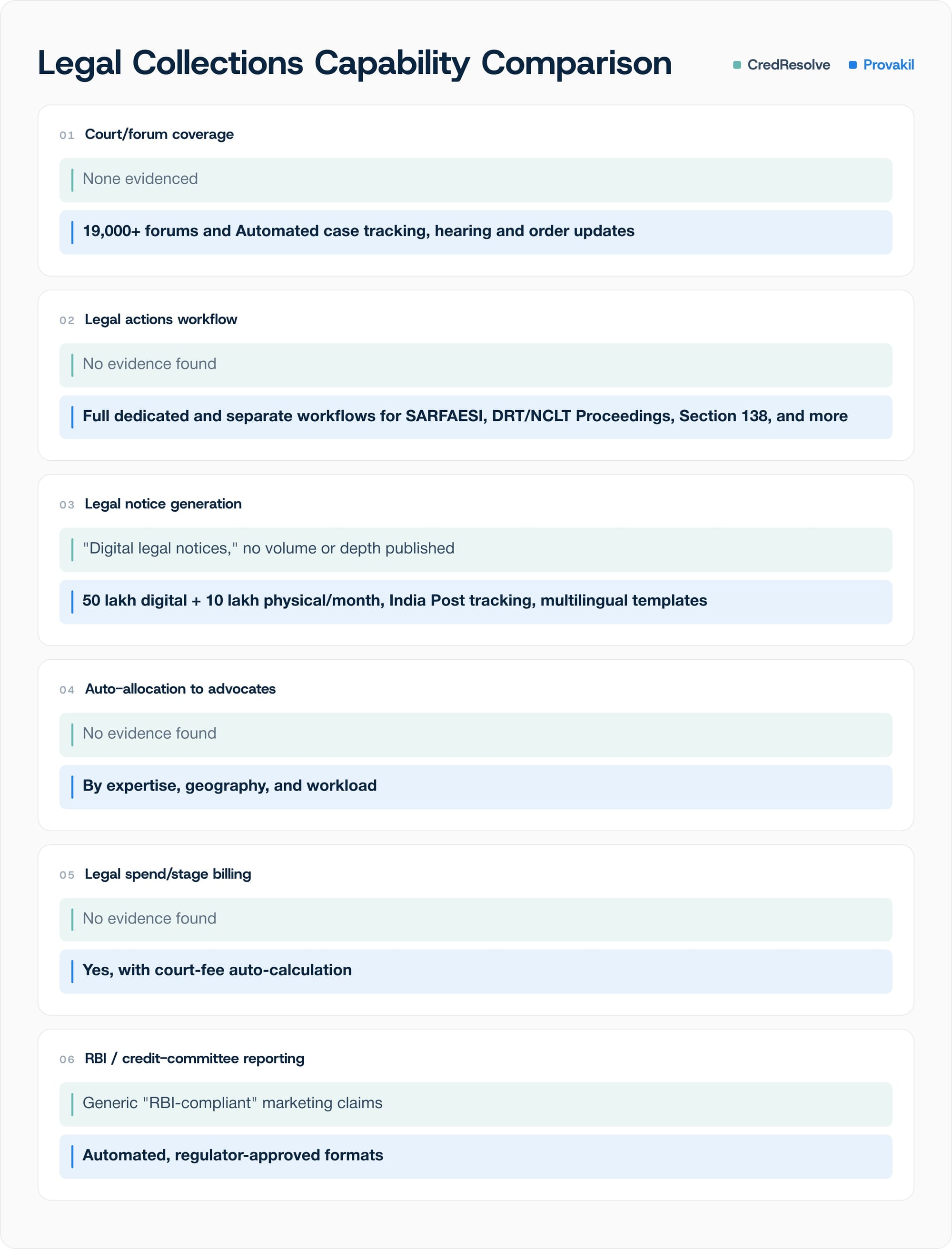
Legal notice management at enterprise scale starts with jurisdiction-aware templates mapped to statutory requirements across states and languages, generated automatically when a loan crosses the DPD threshold that triggers NPA classification.
Provakil processes 50 lakh digital and 10 lakh physical legal notices monthly dispatched through India Post with proof-of-delivery tracking and linked to the underlying case record so that the notice itself becomes a court-admissible artifact in any subsequent proceeding.
SARFAESI, DRT petitions, NCLT insolvency filings, Section 138 complaint-to-trial lifecycles, and arbitration proceedings each run through their own dedicated legal actions workflows with distinct procedural logic, timelines, and documentation checkpoints.
A single borrower default can trigger four concurrent legal tracks across multiple jurisdictions, and Provakil manages all of them from a single case record while keeping each proceeding's workflow, deadlines, and court orders separate.
Advocates get auto-allocated to matters based on expertise, geography, and current caseload, with a mobile interface for courtroom updates and performance tracking across the empanelled panel. Legal spend tracks by proceeding type and stage, with court fees auto-calculated and spend dashboards that give the Head of Legal portfolio-wide cost visibility.
CredResolve's commercial structure is worth understanding separately because it affects more than feature coverage. Unlike a SaaS vendor that sells software, CredResolve operates recovery on the institution's behalf through its own agents, bots, and systems, with pricing tied to collection outcomes. For pre-legal collections, that skin-in-the-game model aligns the vendor's incentives with the lender's.
For legal recovery, it introduces chain-of-custody questions. When a SARFAESI possession is challenged in the DRT, or a Section 138 complaint advances to trial, the institution filing the case needs unbroken custody of every notice dispatch record, proof of delivery, court order, hearing transcript, and advocate submission. A service vendor controlling that evidentiary chain without ISO 27001, SOC 2, or
This is not a theoretical risk. RBI's 2025 Digital Lending Directions extended the regulatory perimeter to recovery, making the regulated entity fully accountable for its service providers' conduct.

Across all three comparisons in this series, the same structural distinction held. Credgenics is the most formidable competitor, with a genuine Litigation Management System and real eCourts integration, but its litigation module drives recovery outcomes rather than enterprise legal operations.
CreditNirvana has LegalCollect with at least some eCourt integration, but its legal depth thins past notice dispatch and basic status tracking. CredResolve has the widest gap: a recovery service model with strong pre-legal infrastructure and minimal legal capability behind the marketing language.
What connects all three is that legal capability was added in service of a collections platform. Provakil's legal collections module was built in service of a legal function. Legal collections is no longer a back-office concern; it is a compliance and board-reporting function, and the tools your institution selects will determine whether your legal team can demonstrate defensible, auditable recovery processes under regulatory scrutiny.

Yes. Provakil's Legal Collections Management module integrates with loan management systems, CRM platforms, and core banking infrastructure via prebuilt integrations and APIs. Case data, borrower records, and DPD classifications flow in automatically, so legal teams work from a single source of truth without re-keying data from upstream systems.
Provakil includes a dedicated repossession workflow covering seizure memo generation, vehicle inventory tracking, repossession agency allocation, and documentation management through release or auction. Each step is logged and linked to the parent case file, maintaining the evidentiary chain if the repossession is contested.
Provakil generates legal notices in multiple Indian languages using jurisdiction-aware templates mapped to statutory requirements. This covers demand notices, possession notices, and borrower communications across states, with each notice linked to its case record and dispatch tracked through India Post integration.
Yes, and many BFSI clients run exactly this configuration. Pre-legal digital and field collections operate through a dedicated platform, and once a loan enters legal recovery, it moves to Provakil for court proceedings, statutory workflows, and advocate management. The two systems serve different stages of the recovery lifecycle without overlap.
Provakil produces automated reports in regulator-approved formats for RBI submissions and internal credit committee reviews, including NPA aging, recovery-stage tracking, legal spend summaries, and proceeding-wise status reports. These are generated directly from live case data without manual reformatting or export manipulation.

Dive deep into Provakil's numerous blog posts & discover how legal tech can streamline your litigation, contracts, IP, and notice management processes.