Provakil vs Credgenics: The Must-Read Legal Collections Management Software Showdown
7 min read



The collections team picked the platform years ago, and the legal team has been making it work ever since. That is how most BFSI lenders ended up running SARFAESI possessions, Section 138 filings, and RBI compliance reports through debt management software that was designed to chase recoveries, not to build a defensible legal record.
If your legal team is comparing Provakil and Credgenics for debt-recovery litigation, here is the short version: Credgenics is a collections platform that bolted on a litigation module. Provakil is legal collections management software built for enterprise legal operations. One tracks loan accounts; the other tracks court cases across 19,000+ forums, manages the full SARFAESI lifecycle, generates RBI-ready compliance reports, and ties legal collections to your contracts, IP, and compliance workflows in a single system of record.
Credgenics is a collections platform. That is what it was built to be, and the collections side of the house is well-covered. The part that concerns your legal team is the Litigation Management System sitting inside that collections stack.
On the spec sheet, the LMS lists Section 138, arbitration, SARFAESI, IBC, and a handful of other matter types. It connects to eCourts for basic case status, and there is a mobile app called CaseView that lets empanelled advocates update cases from the courtroom. That checks the "we have litigation" box on an RFP.
But an RFP checkbox and a legal team's daily reality are different things. The LMS was designed to accelerate recovery, not to be the system your General Counsel relies on when a SARFAESI possession hits court or the RBI asks for an audit trail. The difference between those two design goals shows up in every capability that actually matters to the legal function.
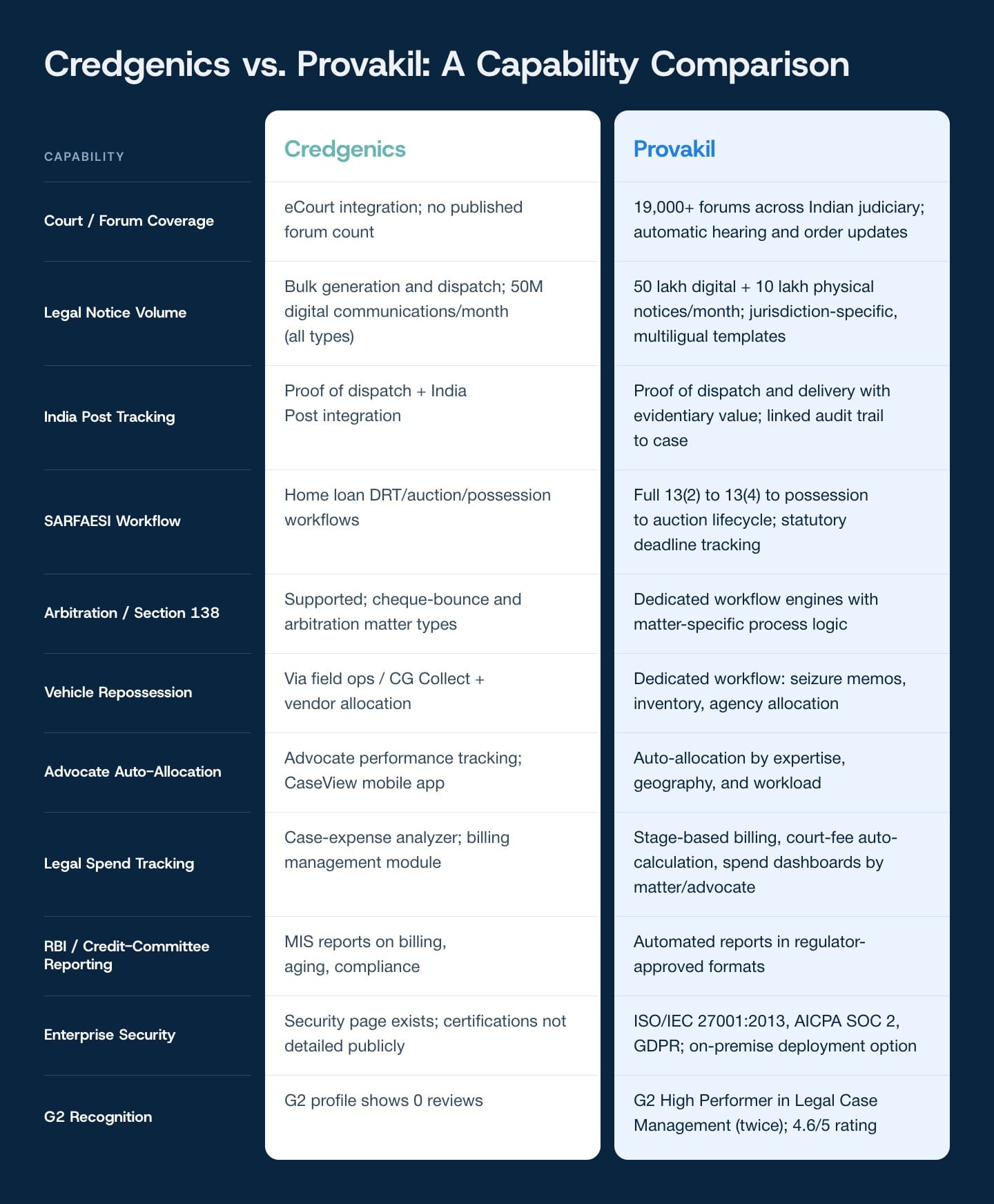
Your legal team does not measure success in recovery rates or cost-to-collect. It measures success in defensibility, in whether the work holds up under scrutiny. Can you reconstruct the full notice-to-case evidentiary trail for a Section 138 matter from a single system?
Can you prove that the SARFAESI 13(2) demand notice was sent on the correct date, to the correct address, with verifiable proof of delivery, and that the 60-day borrower response window was tracked without anyone toggling among three spreadsheets?
These are the questions where a collections module and legal collections management software become distinct conversations.
Credgenics processes 50 million digital messages a month across all channels. Impressive throughput if you are running a recovery operation. Less impressive if you are building a legal record. What it does not publish is how many courts and forums its litigation module actually covers.
Provakil integrates with 19,000+ courts, forums, and tribunals across the Indian judiciary, pulling automatic updates on hearings and orders daily. When a case is listed, or an order is passed, your team is notified without having to check a government website manually.
Provakil was built for the legal function, and every design decision in the legal collections module reflects that. Where a collections platform adds litigation as a downstream step in the recovery funnel, Provakil starts at the legal workflow and works outward from there.
Start with notice management. Provakil handles up to 50 lakh+ digital and 10 lakh+ physical legal notices per month, with jurisdiction-specific templates, India Post tracking for proof of dispatch and delivery, and a linked audit trail that connects every notice to the case it ultimately becomes part of.
Your SARFAESI matters move through the full lifecycle from 13(2) to 13(4) to possession to auction in one system, with every statutory deadline tracked automatically. Section 138 and arbitration cases run through dedicated workflow engines with their own process logic, not a generic litigation bucket that treats every matter the same.
Advocates are auto-allocated by expertise, geography, and workload, so the right counsel handles the right matter in the right jurisdiction without manual assignment.
Legal spend is tracked at the stage level, with court fees calculated automatically and spend dashboards showing where money went, by matter type, by advocate, by jurisdiction, so the legal function can account for every rupee before the CFO asks.
And if your legal function also handles contracts, IP filings, or entity compliance, Provakil covers those in the same platform.
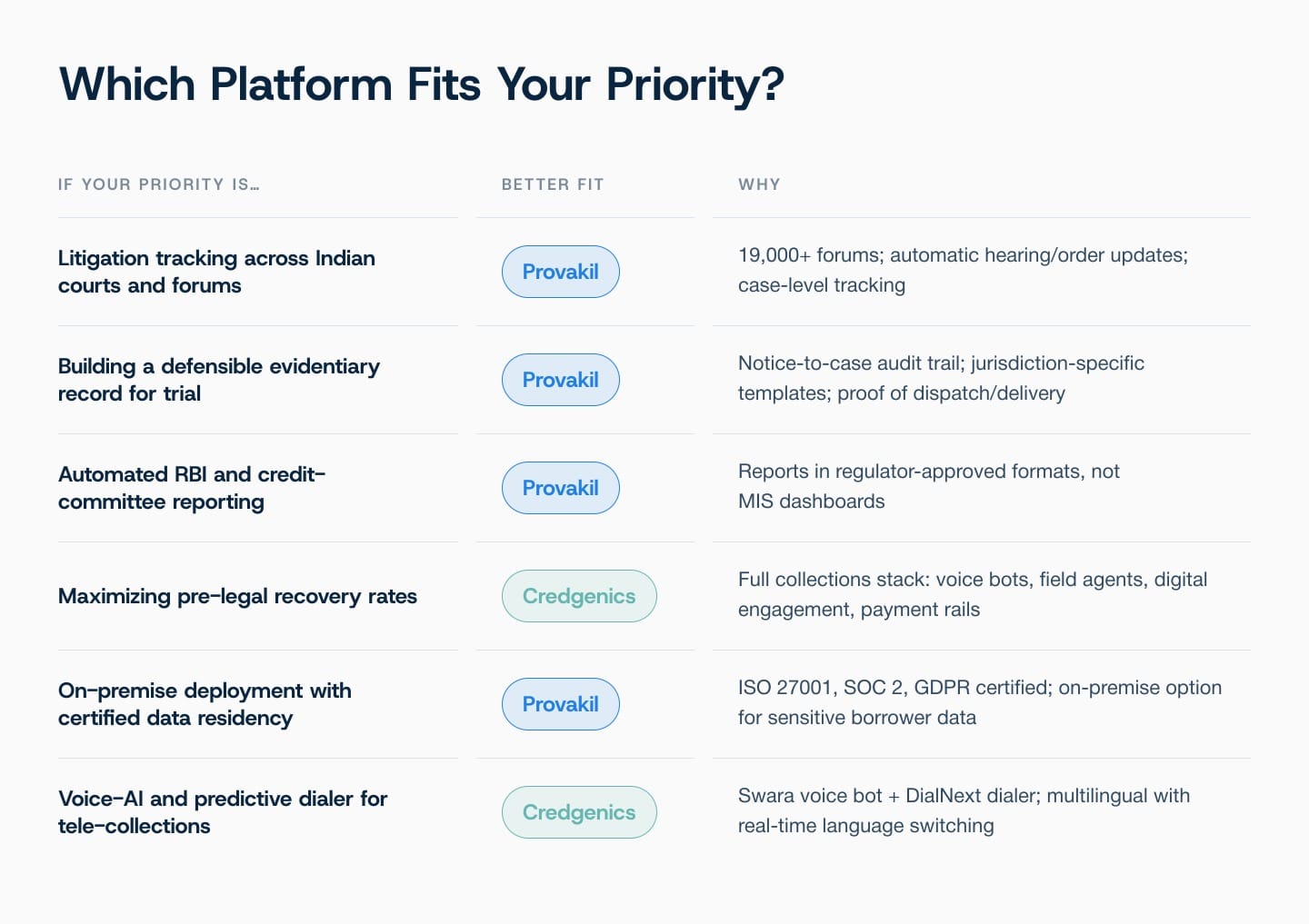
Strip away the feature lists, and this comparison maps to an organizational question. Credgenics was designed for the Collections Head who reports on recovery rates, portfolio resolution, and cost-to-collect. Provakil was designed for the General Counsel who reports on case outcomes, regulatory compliance, legal spend, and enterprise risk.
The collections team runs its pre-legal engagement, voice bots, and field agents on whichever platform delivers the highest recovery volume. The legal team needs something structurally different: litigation management across all relevant forums; an evidentiary chain that withstands cross-examination in a courtroom; notice management with jurisdiction-specific templates and proof of delivery; and reporting that satisfies the regulator without manual assembly.
Those are not "nice-to-have" features on a collections platform. They are the core requirements of a legal function operating under regulatory scrutiny.
If your organization already runs Credgenics for recovery operations, Provakil is not proposing a rip-and-replace. It is asking a simpler question: does your legal team have the system of record it needs, or has it been borrowing one from the collections floor?

The market is splitting in real time. Collections platforms keep investing in smarter bots, faster dialers, more field agents, and more payment rails. Legal collections management software is heading in the opposite direction: evidentiary rigor, regulatory compliance, and defensibility at trial.
The regulatory direction, shaped by RBI 2025, leaves little room for ambiguity: compliance-first, auditable, and built for accountability. Every quarter, the legal function's reporting obligations become more specific, and the tolerance narrows.
The question for your next vendor evaluation is not which platform has more modules or a longer feature list. It is which platform does the things your legal team will be held accountable for when the regulator, the board, or the courtroom asks.

Yes. Many BFSI organizations run separate platforms for collections operations and legal operations. Credgenics can handle pre-legal engagement and recovery workflows while Provakil governs the legal collections lifecycle: litigation tracking, notice management with evidentiary value, compliance reporting, and legal spend accountability.
The 2025 Directions extended the regulatory perimeter across the full loan lifecycle, including recovery. Regulated entities now bear liability for the conduct of lending service providers and must maintain timestamped audit logs. Legal collections software needs to support real-time SARFAESI triggering at 90 DPD, auditable notice trails, and reporting in regulator-approved formats to meet these obligations.
No. Credgenics is a collections-first platform without CLM, IP management, or a broader enterprise legal operations layer. Legal teams managing contracts, trademarks, or compliance alongside litigation and collections would need a separate vendor or manual processes to cover those workflows.
At minimum, look for ISO/IEC 27001 for information security management, SOC 2 for service organization controls, and GDPR compliance for data protection. On-premises deployment options matter for banks with data-residency mandates. Confirm that the vendor publishes specific certification details rather than displaying generic compliance language.
Collections platforms automate bulk dispatch and track delivery status. Legal collections management software includes jurisdiction-specific notice templates, proof of dispatch and delivery with evidentiary value, India Post tracking integration, and a linked audit trail that connects each notice to the resulting case. That trail is what makes a Section 138 or SARFAESI proceeding defensible in court.

Dive deep into Provakil's numerous blog posts & discover how legal tech can streamline your litigation, contracts, IP, and notice management processes.