Managing SARFAESI Proceedings at Scale: What Most Legal Teams Still Get Wrong
7 min read



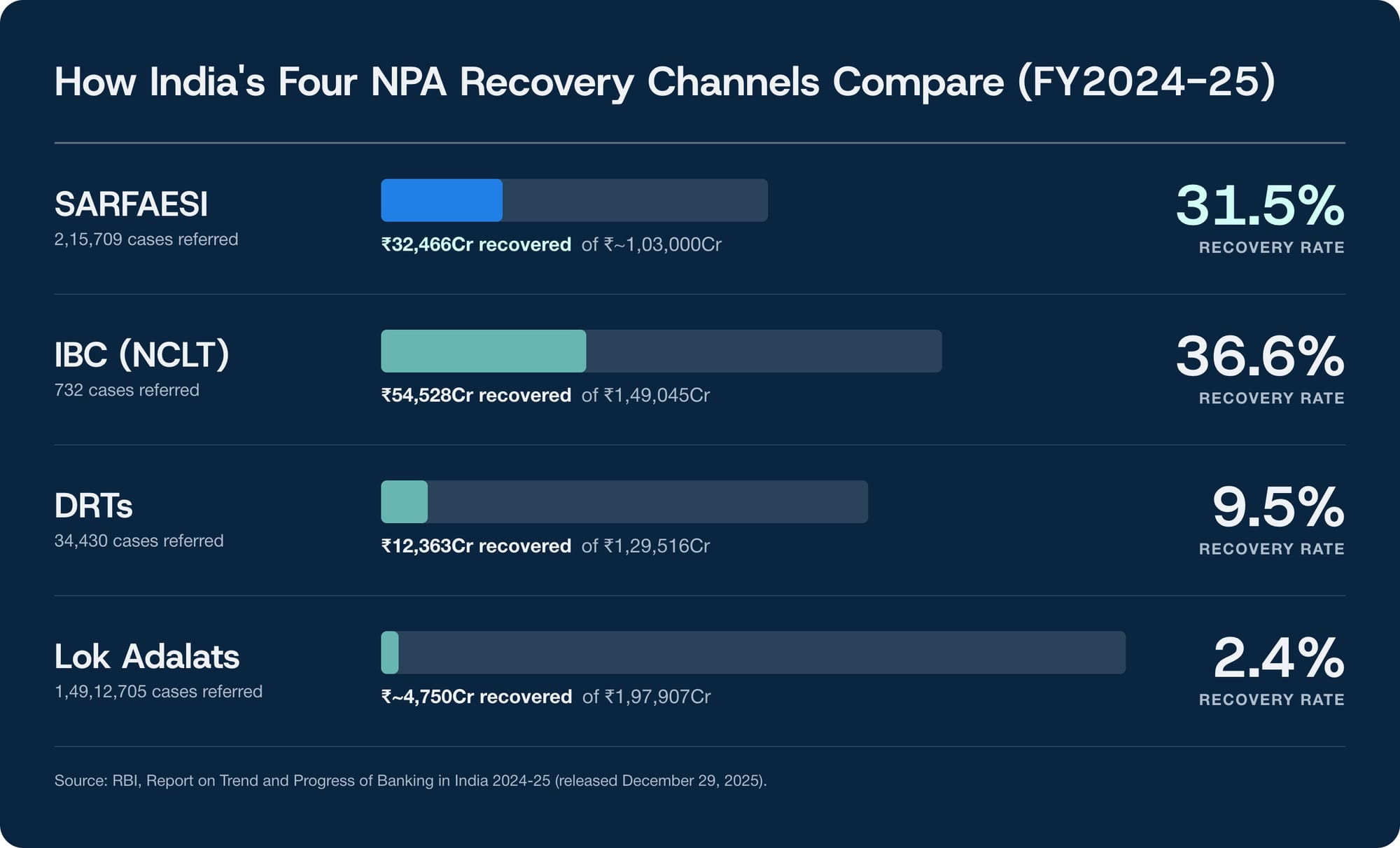
In FY2024-25, Indian banks referred 215,709 cases under SARFAESI, with ₹1.03 lakh crore in secured assets at stake. The recovery rate improved to 31.5%, up from 25.4% a year earlier, yet nearly 70 paise of every rupee referred still did not come back.
The SARFAESI recovery process gives lenders something no other recovery channel offers: the ability to enforce security interests without court intervention. But that statutory power is only as good as the system executing it.
Managing SARFAESI proceedings at scale requires purpose-built legal collections technology that tracks every statutory deadline across hundreds of concurrent matters, maintains an unbroken evidentiary chain from Section 13(2) demand notice through possession and auction, and produces regulator-ready reports without manual assembly.
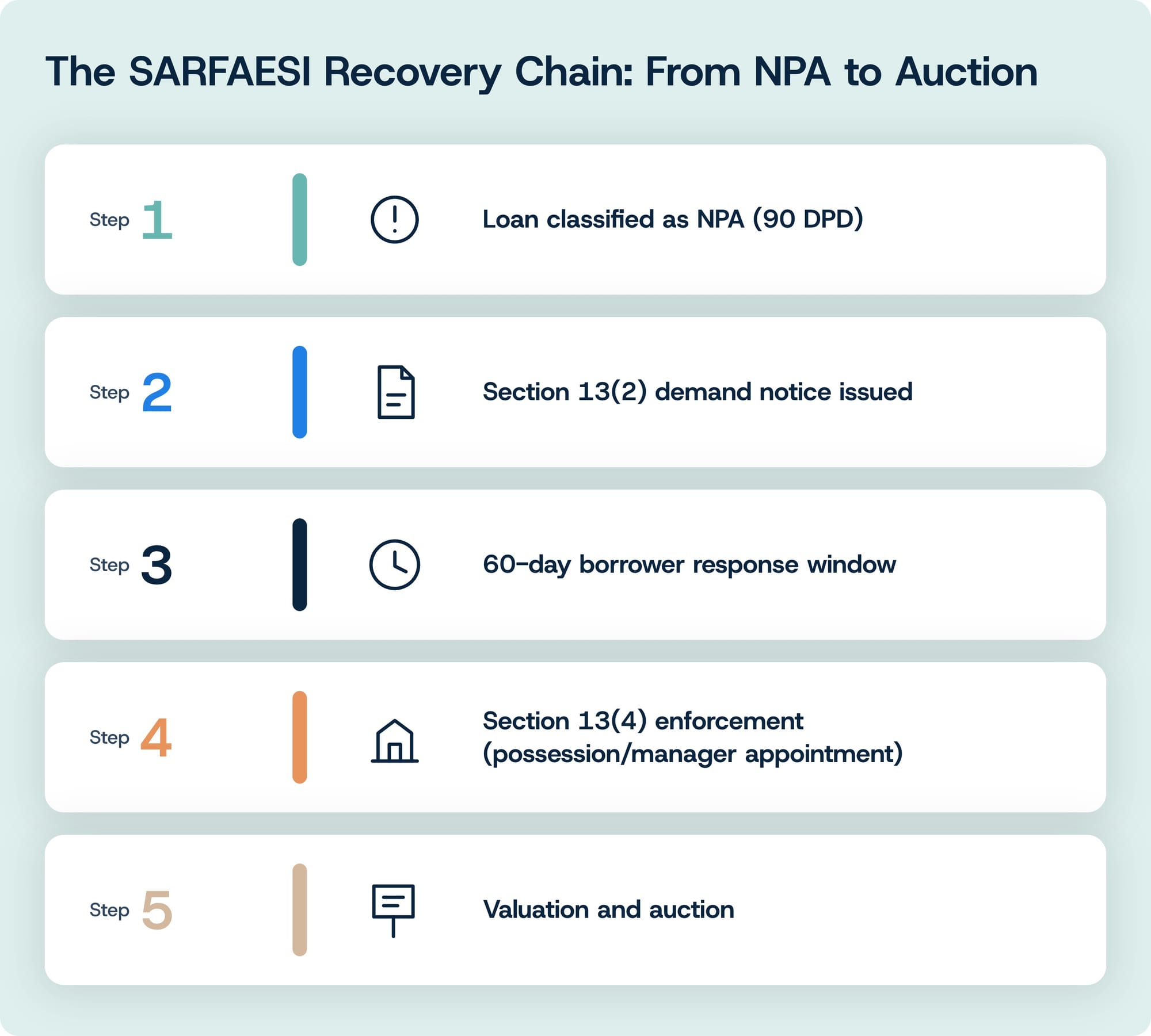
SARFAESI is not one action but a statutory chain where each link carries its own deadline, documentation requirement, and risk of borrower challenge.
A loan crosses 90 days past due and becomes an NPA. The lender issues a Section 13(2) demand notice requiring repayment of the outstanding secured debt. The borrower then has 60 days to respond: repay, raise a representation, or do nothing.
If the debt remains unpaid and any representation is rejected, the lender proceeds to Section 13(4) enforcement, taking possession of the secured asset, appointing a manager, or recovering the debt from a third party holding the borrower's assets.
After possession, the lender arranges a sale, typically through auction, following the valuation and notice requirements under the Security Interest (Enforcement) Rules, 2002.
At any point, the borrower can file a Section 17 appeal at the Debt Recovery Tribunal. The statute requires disposal within 60 days, extendable to four months, though in practice these matters stretch far longer.
The 60-day borrower response window after a Section 13(2) notice is non-negotiable. If your team moves to possession before it expires, the entire proceeding is challengeable under Section 17. If the window expires and your team does not move promptly to 13(4) enforcement, the matter stalls while the borrower's financial position deteriorates and assets depreciate.
A Section 13(2) demand notice is a statutory instrument, not a letter. It must accurately state the outstanding amount, the secured-asset details, and the demand for repayment within 60 days, and any inconsistency gives the borrower grounds for a Section 17 challenge at the DRT.
This problem compounds rapidly at volume: when notices are generated manually or through disconnected templates, the risk of defective notices scales directly with the caseload.
Legal teams at large banks and NBFCs report SARFAESI progress to internal credit committees, to the board, and to the RBI. Each audience wants different versions: stage-wise breakdowns, branch-wise recovery rates, aging of possession matters, auction realization against valuation.
When the underlying data lives in spreadsheets, branch-level trackers, and email threads with empanelled advocates, producing these reports takes days each cycle.
The RBI (Digital Lending) Directions, 2025 (circular RBI/2025-26/36, dated May 8, 2025) did not introduce SARFAESI-specific mandates. What they did, arguably more consequential for legal collections teams in practice, was extend the regulatory perimeter from loan origination to the full loan lifecycle, including recovery.
Two requirements in particular reshape how legal collections teams must operate. First, any recovery agent authorized by the lender must be individually disclosed to the borrower via SMS and email before the agent makes contact, whether the agent is an advocate handling a SARFAESI matter or a field recovery executive.
Second, all data collection during the recovery process must maintain an audit trail (Para 10.1), and the regulated entity remains fully liable for agent and LSP conduct throughout.
The Directions do not prescribe how a lender must trigger or manage SARFAESI proceedings. Still, the compliance expectation they set, covering agent-level traceability, borrower-level disclosure, and auditable data handling across recovery, means that running SARFAESI on unconnected tools and manual handoffs is no longer just inefficient.
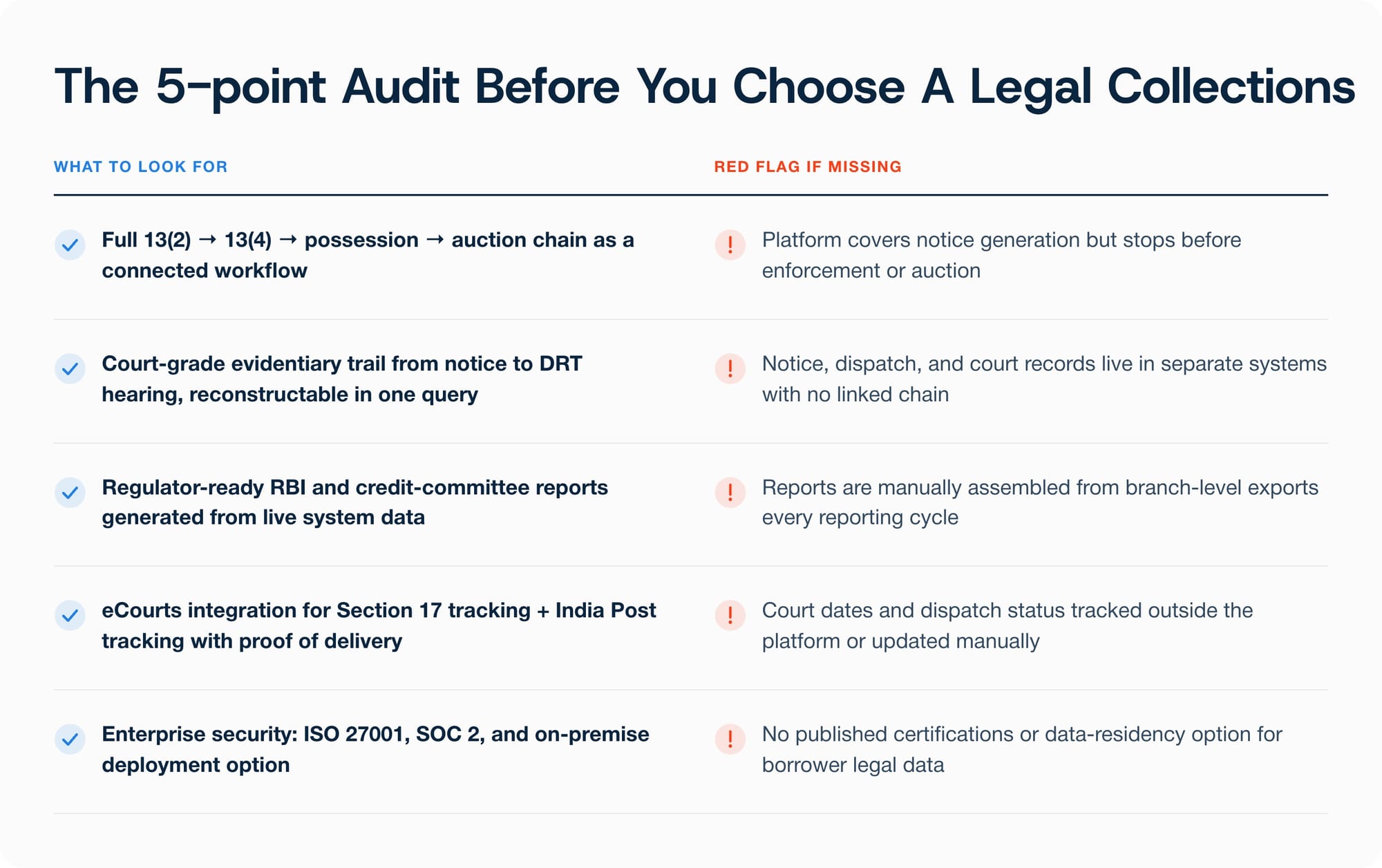
Each of the failure patterns above- missed deadlines, broken evidentiary trails, and fragmented reporting- traces back to an architecture problem rather than a discipline problem. Provakil's Legal Collections Management module is purpose-built to close these gaps across the full 13(2)-to-auction chain.
When a loan is classified NPA, Provakil auto-generates the Section 13(2) demand notice using the borrower, loan, and secured-asset data already in the system. Notices follow jurisdiction-specific templates and are dispatched through India Post with real-time tracking and proof of delivery.
The 60-day borrower response window starts with a system-set countdown; if the borrower files a representation, Provakil logs it against the matter and alerts the assigned officer; if the window lapses without a response, the matter is automatically queued for 13(4) enforcement.
Once a matter moves to Section 13(4), Provakil transitions it to the enforcement stage with its own set of workflows: valuation, possession notice, physical possession, auction notice, reserve-price approval, and sale.
For vehicle and movable-asset loans, dedicated repossession workflows handle seizure memo generation, inventory tracking, and recovery-agency allocation, with each step timestamped and linked to the same case record.
When a borrower files a Section 17 challenge at the DRT, the matter moves into litigation without leaving the system. Provakil auto-allocates DRT matters to empanelled advocates by expertise and geography, automatically pulls hearing dates and order updates from eCourts, and keeps the SARFAESI proceeding and its DRT challenge linked in a single evidentiary chain.
RBI and credit-committee reports are generated directly from the system in regulator-approved formats, drawing from the same live data across branches, loan types, and forums. The Head of Legal, the credit committee, and the board all see numbers from one source, with no manual aggregation, version-control risk, or reporting lag.
Banks like ICICI Bank and Axis Bank run their legal collections on Provakil because, at portfolio scale, managing SARFAESI proceedings across disconnected tools doesn't survive either regulatory scrutiny or the operational reality of six-figure annual caseloads.

SARFAESI remains the single most powerful recovery mechanism available to secured lenders in India, delivering a 31.5% recovery rate in FY25 across more than two lakh cases, second only to IBC in rate and far ahead in operational volume. The gross NPA ratio for scheduled commercial banks fell to 2.2% as of March 2025, a multi-year low. However, the absolute stock of stressed assets still runs in the lakhs of crores, and the volume of SARFAESI-eligible accounts is not shrinking fast enough to manage on spreadsheets and email.
The legal teams that recover more from SARFAESI aren't working harder; they're working on systems that enforce every deadline, link every document, and report every metric without manual intervention, because that is what the statute demands and what the regulator now expects.

Yes. A guarantor's liability is co-extensive with the principal debtor under Section 128 of the Indian Contract Act, 1872. The Supreme Court confirmed this in Industrial Investment Bank of India Ltd. v. Biswanath Jhunjhunwala (2009) and held in SBI v. V. Ramakrishnan (2018) that an IBC moratorium against the principal debtor does not bar SARFAESI action against a personal guarantor.
NBFCs with an asset size of ₹100 crore or more can invoke SARFAESI for secured debts of ₹20 lakh and above (MoF notification S.O. 856(E), February 2020; debt floor per S.O. 652(E), February 2021). HFCs registered under the NHB Act qualify separately, and per a 2024 Madhya Pradesh High Court ruling, the ₹20 lakh NBFC floor does not apply.
After NPA classification, the lender issues a Section 13(2) demand notice giving the borrower 60 days to repay. If the debt remains unpaid, the lender can proceed to Section 13(4) enforcement, meaning the earliest possible enforcement action is roughly 60 days after the notice. In practice, factoring in notice preparation, dispatch, and internal approvals, the timeline typically runs three to five months.
The borrower, guarantor, or any affected person can file under Section 17 at the Debt Recovery Tribunal. The statute requires disposal within 60 days, extendable to four months, though the DRT can set aside or modify the lender's action if it finds a procedural deficiency. This is why the evidentiary quality of the demand notice, dispatch records, and enforcement documentation is critical to sustaining a SARFAESI proceeding under challenge.

Dive deep into Provakil's numerous blog posts & discover how legal tech can streamline your litigation, contracts, IP, and notice management processes.