Three Hidden Costs Your Law Firm Pays Every Day and How Practice Management Software Fixes Them
8 min read



It is 8:45 a.m., and you are rushing between courts, juggling matters in two different forums, when a junior calls to say they cannot find the order copy from last week's hearing. You tell them to check WhatsApp. They already did. They checked email, the shared drive, and the folder someone created on the desktop three months ago. Fifteen minutes later, the document turns up in an old thread buried under 200 messages.
That search cost your chamber a quarter of a billable hour before the working day even started, and nobody recorded the loss.
Indian law firms and chambers bleed time and revenue in three areas most never bother to quantify: scattered documents that take minutes (or hours) to retrieve, missed court deadlines that escalate into ex parte orders, and manual workflows that guarantee billing leakage at month-end.
Together, these operational drains consume senior and junior time alike, compound with every new matter the firm takes on, and keep practices stuck in a cycle of administrative firefighting. Court-aware practice management software for law firms eliminates all three by centralizing case data, automating deadline tracking across forums, and tying billing directly to matter activity.
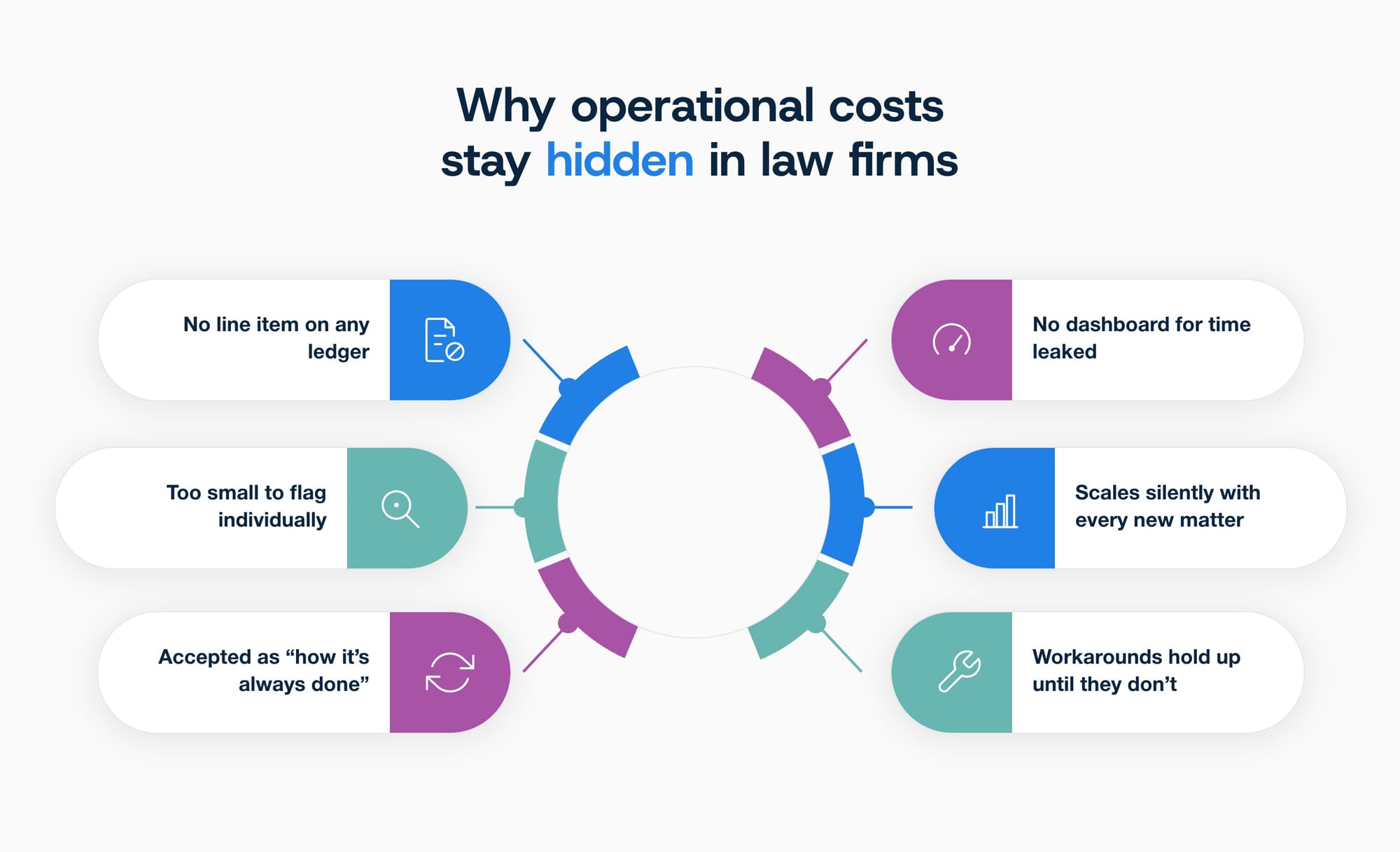
No invoice in the history of legal practice has ever read "four hours lost to searching WhatsApp for an order copy." No ledger records the revenue a firm forfeits when a junior reconstructs timesheets from memory and under-bills by 20% or more. These costs are invisible precisely because they hide inside everyday routines that everyone in the chamber accepts as normal: checking multiple court portals each evening, forwarding documents one recipient at a time, copying case numbers from a causelist PDF into a spreadsheet that goes stale by the next hearing date.
The compound effect is where the real damage sits. A chamber tracking 100 active matters across five or six forums can lose dozens of hours each week to these tasks alone. Multiply that by average billing rates, and the annual cost rivals a senior associate's compensation. The three sections below break that silent number into its component parts so you can measure your own.
Most Indian chambers and mid-sized law firms still run document management through a combination of WhatsApp groups, email threads, Google Drive folders, and physical files stacked in cabinets. The arrangement holds together until someone needs to retrieve a specific order copy, a signed vakalatnama, or a client memo from three months ago.
Then the search begins: scroll through WhatsApp, scan the Drive, ask a colleague who might remember, open old email attachments one by one. For an advocate billing even modestly, that search time is revenue the firm never recovers.
The problem scales with practice size. A solo advocate with 20 matters might survive on folders and memory. A chamber tracking 80 to 150 matters across district courts, High Courts, and tribunals cannot, because the volume of orders, filings, and correspondence outgrows any unstructured system within months.
Case management software for advocates replaces the patchwork with a single, searchable case workspace. Every document, order, filing, and note lives under the matter it belongs to. Advocates search by party name, case number, forum, or keyword and reach the right file in seconds rather than minutes.
Version control is built into the workspace. When someone edits a document, the system tracks the change and preserves every previous version. Role-based permissions control who can view or modify sensitive files, so client documents stay out of open WhatsApp groups with unclear membership.
For firms using Provakil's digital case workspace, the shift from scattered storage to centralized access made the daily document hunt a thing of the past. Orders and judgments are fetched automatically from court portals and linked to the correct matter without anyone lifting a finger.
A single missed listing can cascade faster than most advocates expect. The supplementary causelist goes up after business hours. No one in the chamber catches it. The next morning the matter is called, no one appears, and the court proceeds ex parte. The client hears about it days later, not from the firm, but from the opposing side. The damage is legal, financial, and reputational all at once, and reputations in legal practice take years to build.
Missed deadlines remain one of the leading causes of malpractice claims globally, but in Indian litigation the risk has a specific shape. Hearings scatter across district courts, High Courts, tribunals, RERA authorities, consumer forums, and tax forums. An advocate or chamber monitoring matters across many of these forums faces a volume of daily listings that no paper diary or Excel sheet can reliably track. The supplementary causelist alone, published late and updated without notice, catches firms off guard regularly.
Court-aware case management software monitors listings and orders across forums automatically. Instead of logging into multiple court portals every evening, the firm receives updates pushed to the channels advocates actually check.
Provakil tracks hearings, orders, and listings across 19,000+ Indian forums and pushes personalized causelists to each advocate on WhatsApp and email daily. Supplementary and advanced causelists are captured too, closing the gap that manual monitoring leaves wide open.
When a new case is filed against a client, the platform sends an alert the moment the filing appears on the court portal, well before service, reducing the risk of an undetected ex parte proceeding.
Ask any junior associate when they last completed their timesheet, and the honest answer is usually "last weekend, from memory." When time entries are reconstructed days after the work was done, billable hours slip through unrecorded. Industry estimates place the leakage at 10 to 30% of recoverable time. For a chamber billing even moderately, that gap translates to lakhs in annual revenue the firm earned but never invoiced.
The fragmentation reaches beyond billing. Firms that track tasks in one application, communicate through another, store documents in a third, and generate invoices in a fourth introduce delay, duplication, and error at every handoff. A senior advocate chasing a junior for timesheet data, reconciling it against the matter file, and formatting an invoice in Word is performing work that technology eliminated years ago for every other professional-services industry.
A single-workspace platform ties time tracking to the matter itself. Advocates log hours from a mobile app while they are still at the courthouse, not from memory weeks later. Invoices generate directly from case-linked timesheets with branded templates that reflect the firm's identity. Status tracking shows which invoices are sent, pending, or paid.
Provakil's billing and timesheet module delivered an 85% reduction in invoicing time for Adv. Digant Kakkad. Sankhla & Associates reported a 20% reduction in operational costs after moving to the platform. These are not abstract efficiency figures. They represent revenue the firms were already earning but failing to collect, converted back into actual income.

The three costs covered in this piece are not dramatic, headline-making failures. They are slow, daily accumulations: ten minutes searching WhatsApp for a document, a supplementary causelist nobody caught, a month of billable hours reconstructed from memory and under-reported by double digits.
Their invisibility is precisely what makes them dangerous, because firms adapt to the drag instead of measuring it, and every new matter added to the docket makes the leak a little wider.
For most firms, the math resolves itself quickly: the annual cost of these invisible leaks dwarfs the investment in a platform designed to close them.

Solo advocates tracking more than 15 to 20 active matters across multiple forums hit the same operational drag that larger chambers face, just at a smaller scale. Automated causelists, document fetching, and case-linked billing save time regardless of headcount. The deciding factor is the volume of matters and forums the advocate monitors.
Generic tools have no integration with Indian court data. They cannot pull causelists, fetch orders, send hearing alerts, or track new filings across forums. A firm using Trello still has to check court portals manually, copy data into cards, and update statuses by hand. Court-aware platforms like Provakil automate that entire layer because they connect natively to 19,000+ Indian forums.
Migration typically involves importing the firm's active matter list, mapping each matter to the correct forum, and uploading existing documents into the case workspace. Provakil supports onboarding with dedicated implementation assistance rather than expecting a self-serve upload, so firms do not navigate the transition alone.
Provakil's mobile apps on Android and iOS support offline access to downloaded documents and case data. Updates sync automatically when connectivity returns. This is a deliberate design choice for Indian courts, where district court complexes frequently lack reliable internet.
Timelines vary with firm size and the number of active matters, but most firms complete forum mapping, matter import, user setup, and initial training within a few weeks. Provakil assigns onboarding support to every new customer rather than relying on self-serve activation.

Dive deep into Provakil's numerous blog posts & discover how legal tech can streamline your litigation, contracts, IP, and notice management processes.