How Can Litigation Management Software Help Indian Firms Tackle Case Backlogs?
8 min read



Litigation management software is a centralized, cloud-based platform that pulls case data directly from courts, tracks deadlines automatically, and gives lawyers and their teams a single workspace for every matter, document, and client communication.
With India's pending caseload now past 5.6 crore across all court tiers and the trajectory still climbing, the question for law firms is not whether to adopt this kind of platform. It is how much longer they can afford not to.
Every litigation lawyer in India can feel the pressure even without looking at the national numbers. Caseloads grow every year, court capacity does not keep pace, and the gap between what needs tracking and what any team can track manually keeps widening. Litigation management software is how firms stop absorbing those losses as a cost of doing business.
The backlog is not new, but its acceleration is worth paying attention to. Between December 2023 and mid-2026, total pendency grew by roughly 55 lakh cases despite continuous disposal.
As of the latest available data, Indian courts report approximately 4.5 crore cases in district and subordinate courts, 64 to 65 lakh in High Courts, and more than 96,000 in the Supreme Court. These numbers keep climbing because new filings consistently outpace disposals, and the judge-to-population ratio has barely shifted in over a decade.
But the backlog is not just a capacity problem for courts. It is a workflow problem for every lawyer operating within them. A litigation practice handling 500 matters across multiple courts and tribunals needs to monitor each forum's website daily for listing changes, adjournments, uploaded orders, and causelists additions.
In most firms, that monitoring still happens manually: a junior associate or clerk cycles through court websites each morning, copies dates into a shared spreadsheet, and hopes nothing slipped through overnight. When an adjournment notice is uploaded after business hours or a revised hearing date appears only in a fresh court order, the manual process has no safety net.
India's e-Courts project has digitized significant parts of the court infrastructure. The National Judicial Data Grid now hosts more than 27.64 crore orders and judgments, and the e-Courts Services app has crossed 2.69 crore downloads among lawyers. Courts send millions of SMS and email alerts daily, and case status information is available online for most computerized courts. This is real progress, and it created the raw data layer that litigation management software depends on.
What e-Courts did not provide is the orchestration layer on top of that data. The app delivers updates, but not filtered, prioritized workflows tailored to a specific lawyer's case portfolio. A lawyer still has to interpret each alert, cross-reference it against their own matter list, decide what action to take, and communicate the update to both the client and the team. That orchestration, the process of turning court data into actionable daily work, is exactly what intelligent litigation management software provides.
Litigation management software (also called legal case management software or a case management system) is a single platform that replaces the scattered tools lawyers use to run their practice.
Case files, court dates, client details, documents, billing records, and team assignments live in one searchable workspace instead of across filing cabinets, email threads, WhatsApp groups, and handwritten diaries.
What separates it from a spreadsheet or a generic project management tool is court-system integration. A spreadsheet records what you type into it. A litigation management platform pulls data directly from courts: new hearing dates, orders, adjournments, and causelists updates. It routes those updates to the right lawyer, flags approaching deadlines, and logs every change automatically. Your job shifts from hunting for information to acting on it.
Indian courts publish updates across thousands of separate websites, each with its own format and update schedule. An intelligent platform monitors these sources continuously and pushes case alerts to the lawyer's phone or desktop the moment something changes.
Provakil's litigation management module ingests data from more than 19,000 courts, tribunals, and forums across India, turning what used to be hours of daily checking into a notification that arrives within minutes.
Checking whether your matters are listed for the day, and at which court, in which courtroom, and at what item number, is one of the most time-consuming daily rituals in Indian litigation. A good platform generates a personalized causelist for each lawyer on the team every morning, pulling directly from the court data feed. You open the app and see exactly where you need to be, without visiting a single court website.
Indian courtrooms rarely have reliable Wi-Fi. A platform that works only on a desktop browser is practically inaccessible for half the working day. Mobile apps with offline caching let lawyers pull up case files, review upcoming hearings, and draft notes between arguments without depending on connectivity. When the connection returns, everything syncs automatically.
A solo practitioner tracks their own dates. A firm with ten lawyers and thirty paralegals needs to know who is responsible for which filing, which associate is preparing which brief, and whether the deadline for written submissions in a particular matter has been calendared. Task management modules assign work, set reminders, and give partners a dashboard view of the entire team's load across all active matters.
When every case lives in one system, the data becomes queryable. Which matters have been pending longest? Which courts have the slowest disposal rates for your case types? How is workload distributed across the team? These are questions that no spreadsheet answers reliably across a portfolio of hundreds or thousands of matters. Reporting dashboards turn operational data into management insight and give firms the numbers they need for client reviews, resource planning, and decisions about which matters to prioritize.
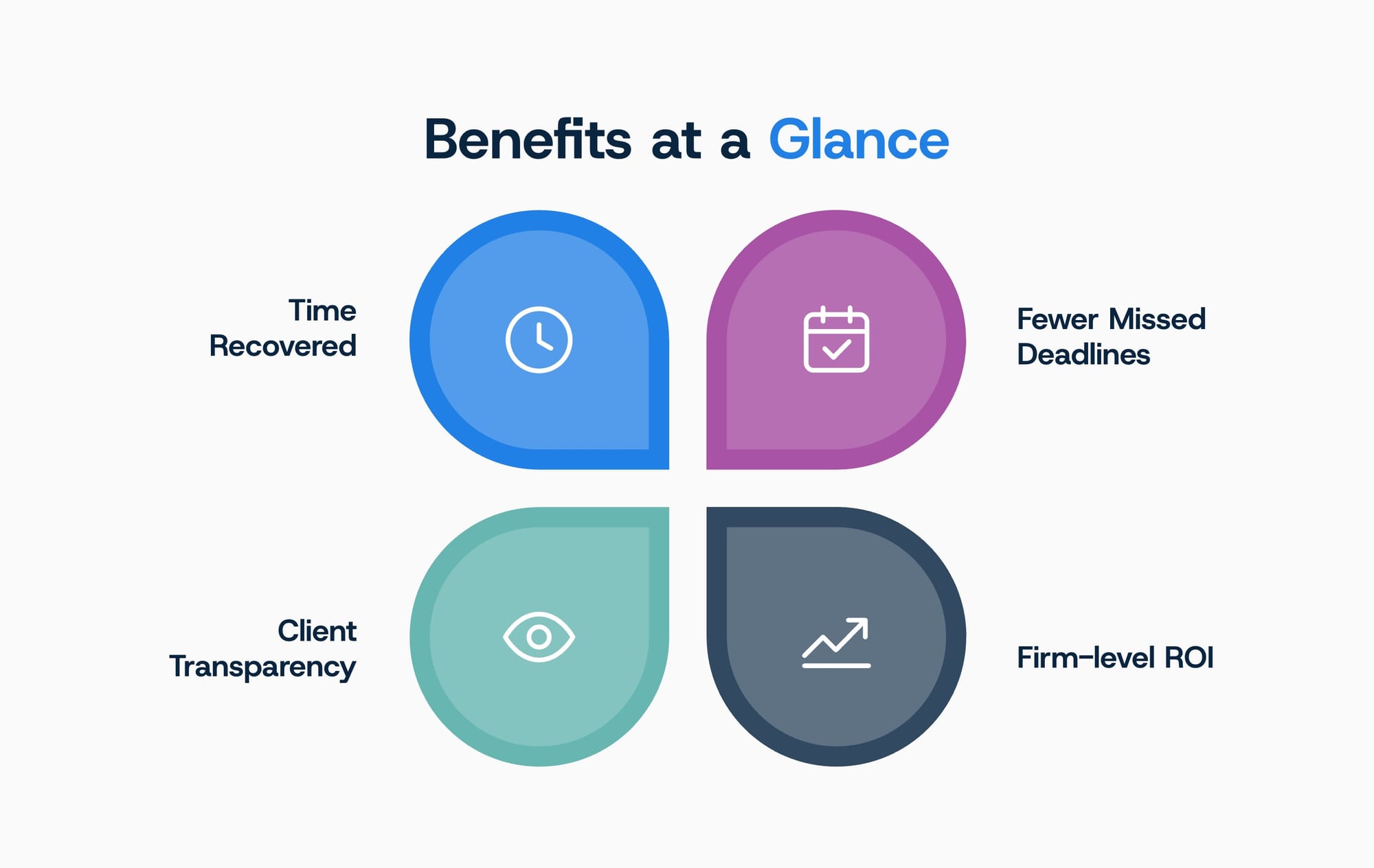
Manual court monitoring, causelists checks, and status calls consume hours every week that could go toward billable legal work. A Bengaluru-based law firm using Provakil’s Case Management Software reclaimed 35 hours of productive time per period and improved case-tracking accuracy by 50% after adopting the platform.
The single most expensive failure in litigation is the one where nobody knew the date had changed. Automated alerts and system-generated causelists reduce that risk to near zero for every court the platform covers. When a hearing is preponed or a new order is uploaded, the system flags it before anyone has to remember to check.
Clients want to know what is happening with their case without calling to ask. Platforms with client portals or automated status notifications shift that communication burden from the lawyer to the system. The client sees the next date, the latest order, and any pending action items in real time. That responsiveness builds trust and cuts the volume of status-inquiry calls that interrupt deep work.
Future of Professionals Report 2025 found that 53% of organizations were already seeing measurable returns, directly or indirectly, from their AI investment.
For a litigation practice, the calculation is straightforward: if the platform saves each lawyer even five hours a week and prevents one missed-deadline incident per quarter, the subscription cost justifies itself well before you factor in the reputational value of consistently responsive client service.

India's litigation backlog is not waiting for a technology decision. The gap between 5.09 crore cases in December 2023 and more than 5.64 crore by mid-2026 represents millions of new matters entering a system that was already stretched past its limits.
Litigation management software does not fix the judge shortage or clear the backlog. What it does is give each lawyer and each team a reliable, automated information layer that keeps every matter visible, every deadline tracked, and every client informed without relying on memory or manual effort. For firms managing Indian litigation at any meaningful scale, that layer has moved from convenient to non-negotiable.

Coverage depends on the vendor. Some platforms focus on High Courts or specific states only. Provakil monitors more than 19,000 courts, tribunals, and forums, including district courts, High Courts, the Supreme Court, NCLT, NCLAT, RERA authorities, consumer forums, and other specialized bodies. Before choosing a platform, confirm that it covers the specific forums where your firm's matters are listed, and ask how frequently data is refreshed for each court type.
Timelines depend on firm size, the number of legacy matters to migrate, and how formalized your current tracking process is. Most cloud-based platforms can onboard a small-to-mid-size firm within a few weeks, with data migration and team training running in parallel. Larger firms with thousands of active matters may need a phased rollout over one to two months.
Reputable platforms use encryption at rest and in transit, role-based access controls, and regular security audits. Provakil restricts case visibility by role and team so that associates access only the matters assigned to them.
The e-Courts app provides raw case status data and hearing dates from courts on the National Judicial Data Grid. It is a useful public resource, but not a practice management tool. Litigation management software filters that data for your specific portfolio, generates personalized causelists, automates deadline tracking, manages documents and tasks, and surfaces analytics. The e-Courts app tells you a date changed. A litigation management platform tells your team what to do about it.

Dive deep into Provakil's numerous blog posts & discover how legal tech can streamline your litigation, contracts, IP, and notice management processes.