Provakil vs. Sirion: A Head-to-Head of Agentic AI and Full AI CLM Software
7 min read



Sirion publishes the kind of AI credentials most CLM vendors only put on a roadmap slide: a 94.2% extraction accuracy benchmark, named agentic AI, and three consecutive Gartner Customers' Choice awards. If AI depth is the only criterion on your AI CLM software evaluation scorecard, you can stop reading here.
For every other legal team, this comparison between Provakil and Sirion looks different.
Contracts do not start with the contract but with the RFX, the tender evaluation, and the vendor due diligence that happens before a single template is opened. They do not end at obligation extraction either, not when your team needs India-specific e-stamping, data residency across four jurisdictions, and a deployment timeline measured in weeks rather than quarters.
The real question is not whose AI agents carry more impressive names. It is how much of your contract operation each platform actually covers, and whether that coverage extends to the jurisdictions where your team works.
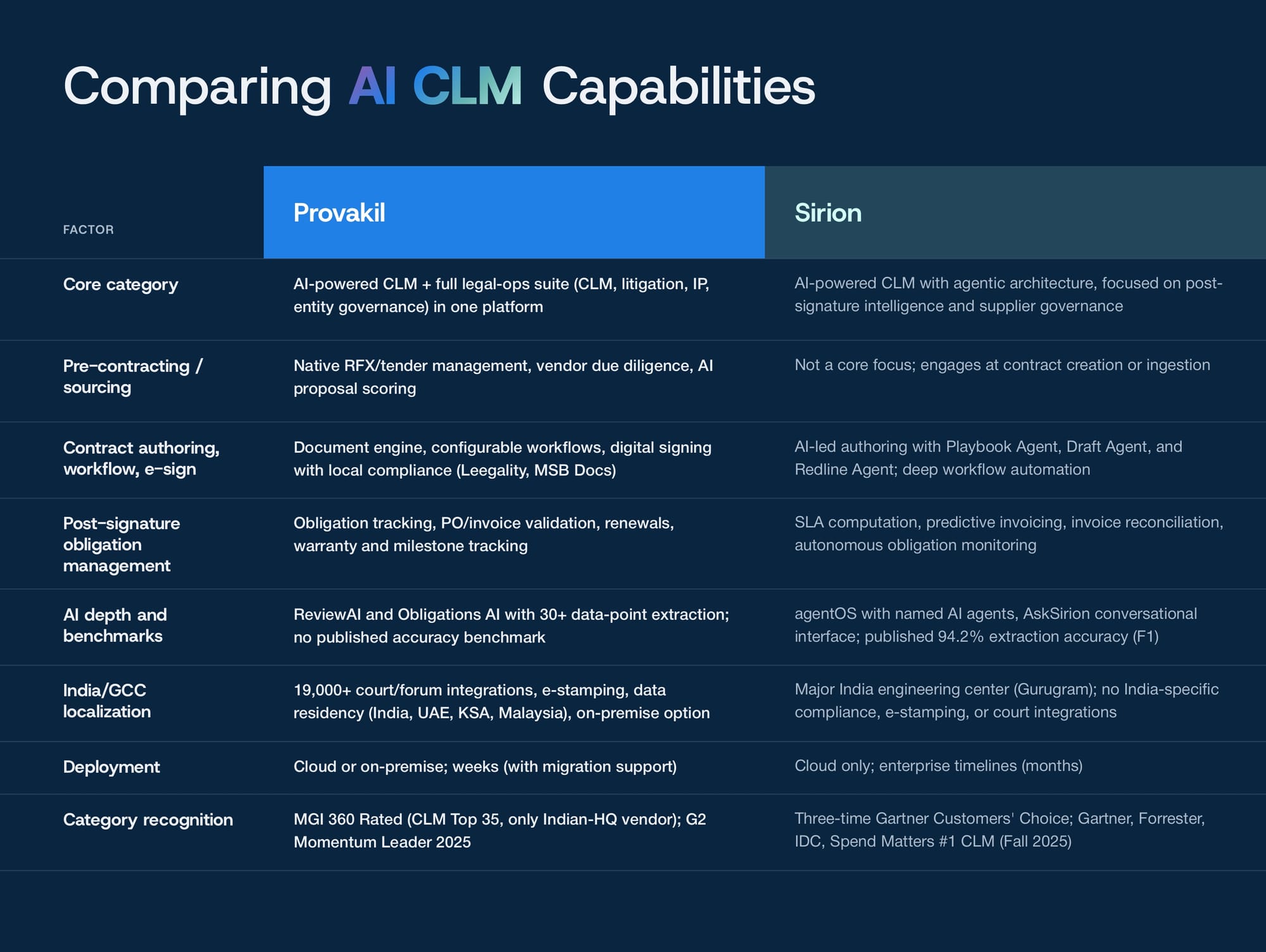
Both platforms cover the core CLM lifecycle: authoring, workflows, e-signatures, repository, obligation tracking, renewals, and analytics. The difference lies in where each platform's coverage starts and ends.
Sirion's CLM engages at contract creation or ingestion. Everything upstream of that point, including RFX workflows, tender evaluation, and vendor due diligence, lives entirely outside the platform. The platform concentrates on what happens after the signature: SLA computation, predictive invoicing, invoice reconciliation, and continuous obligation monitoring through autonomous AI agents.
Provakil's AI CLM Solution starts earlier and stretches wider. Native RFX and tender management, vendor due diligence, and AI-based proposal scoring give procurement and legal a structured process from sourcing through signature.
Post-signature, Provakil handles obligation tracking, PO/invoice validation, renewals, warranty tracking, and milestone management.
Sirion's agentOS deploys named AI agents across drafting, extraction, redlining, obligation management, and invoice reconciliation. Its published extraction benchmark claims 94.2% accuracy (F1 score) across 1,200+ contract fields, and the AskSirion conversational interface lets users query their contract portfolio in natural language.
Now consider what those agents do not cover.
There is no AI-based proposal scoring, no vendor due diligence automation, and no pre-contracting workflow. Sirion's AI operates across the contracting lifecycle, from creation through post-signature, and within that scope, the depth is considerable.
Outside that scope, the AI does not exist. Your procurement team needs a separate platform for sourcing. Your compliance team needs separate workflows for regional regulatory requirements. Your India-based legal team needs separate integrations for everything from e-stamping to court tracking. That is a lot of "separate" for a platform that markets itself as the AI-first answer to contract operations.
The gap between these two platforms is not about who built smarter agents. It is about what each platform considers part of its job.
Provakil's RFX and tender management, vendor due diligence workflows, and AI-based proposal scoring create a structured path from sourcing through contract creation. Sirion's contract lifecycle management platform does not engage until a contract already exists or is being created, so these capabilities either require separate tools or fall outside any managed workflow entirely.
Provakil integrates 19,000+ Indian courts and forums, e-stamping through Leegality and MSB Docs, and local data residency across India, the UAE, KSA, and Malaysia. Sirion maintains a major engineering center in Gurugram, but its product does not include India-specific compliance features, regional e-stamping, or local court integrations.
For legal teams operating under Indian, Gulf, or Southeast Asian regulatory frameworks, this is not a nice-to-have on a vendor scorecard. It is a functional requirement that determines whether the platform works at all.
Provakil offers cloud or on-premise hosting, while Sirion is cloud-delivered with no published on-premise option. Government entities, PSUs, and regulated enterprises in India and the Gulf frequently require on-premise deployment as a policy non-negotiable, and Provakil serves 50+ such organizations today.
Provakil is positioned for deployment in weeks, with contract abstraction and migration support that compress what is typically a multi-quarter onboarding cycle. Sirion's implementation timelines are consistent with enterprise CLM platforms serving the Global 2000, typically measured in months.
Provakil's pricing scales from mid-market to large enterprise without an enterprise-only budget floor, and the quote covers the full CLM lifecycle in a single engagement rather than as separately priced add-ons.
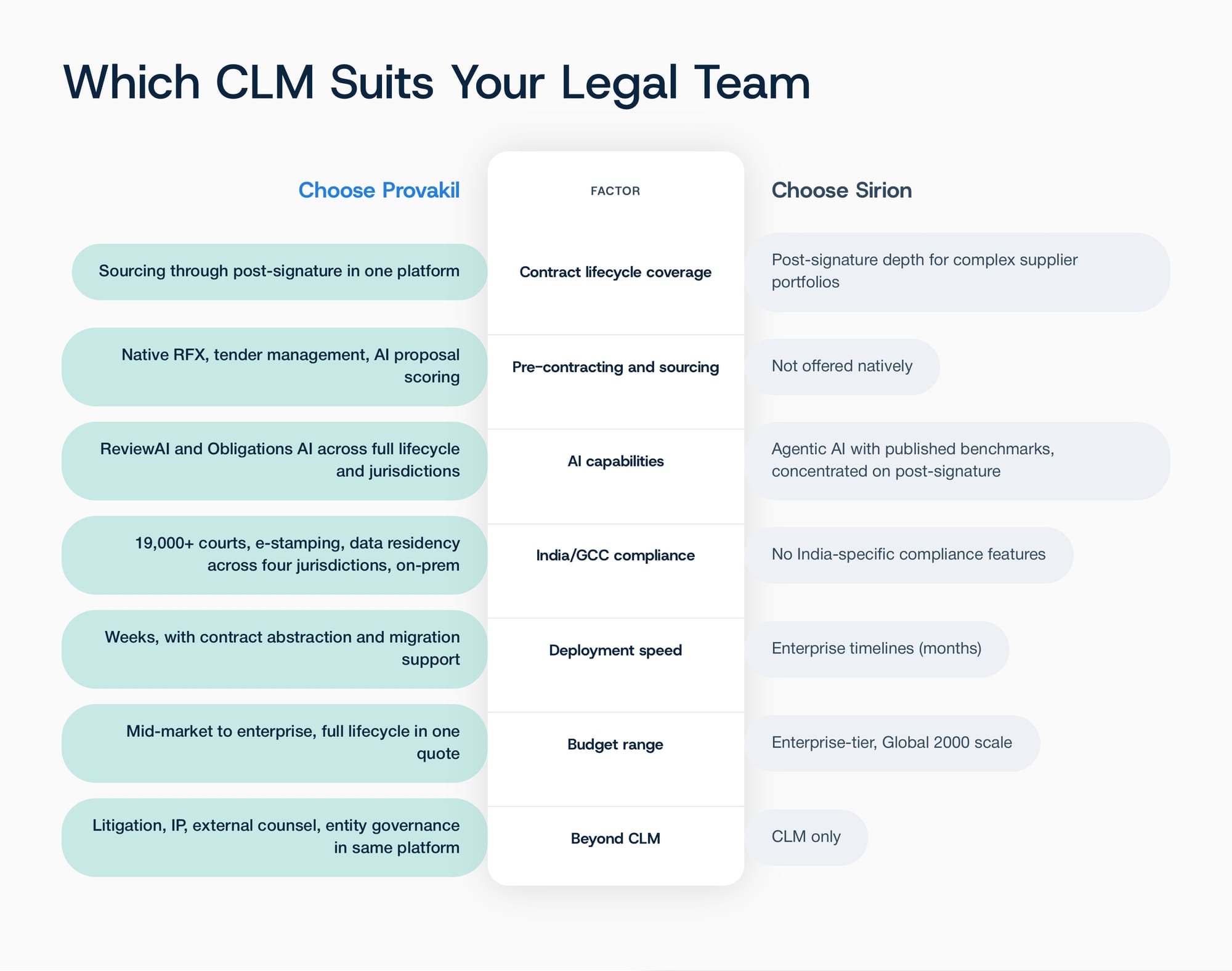
The decision gets straightforward once you stop treating AI depth as the only variable worth measuring.
Choose Provakil when your operations extend beyond the contract itself. The platform covers RFX management, vendor due diligence, and AI proposal scoring upstream, then obligation tracking, renewal management, and PO/invoice validation downstream.
Choose Sirion when post-signature contract intelligence is the primary reason you are evaluating CLM. SLA computation, predictive invoicing, invoice reconciliation, and autonomous obligation monitoring across large supplier portfolios are the functions Sirion was built to serve.
Put differently, Sirion built the smartest AI for contracts. Provakil built the CLM that covers what happens before, during, and after the contract in the jurisdictions where most of its competitors do not bother to show up.

The CLM category is not short on platforms that do impressive things inside the contracting function. What it is short on is platforms that cover the full contract operation, from sourcing and vendor evaluation through obligation tracking and compliance, without a Global 2000 budget as the entry requirement and a multi-quarter implementation as the starting timeline.
Provakil's case against Sirion follows the same pattern as the rest of this series. Against Icertis, the argument was breadth and deployment speed over configuration depth. Against Ironclad, it was bundled AI and pricing transparency over workflow-engine sophistication. Against SpotDraft, it was lifecycle coverage and India/GCC localization over CLM-pure product polish. Against Sirion, it was operational range and jurisdictional reach over post-signature AI depth. The pattern holds because the platform was built to govern the legal operation, not just the contract.

Provakil is the clear choice here. The platform offers 19,000+ Indian court and forum integrations, e-stamping through Leegality and MSB Docs, data residency in India, and on-premises deployment for regulated environments. Sirion does not offer India-specific compliance features, regional e-stamping, or local court integrations in its CLM product.
Both platforms use quote-based pricing. Sirion's pricing is positioned at the enterprise tier, consistent with platforms serving the Global 2000. Provakil scales from mid-market to large enterprise without an enterprise-only floor, and its quote covers the full CLM lifecycle, including pre-contracting, obligation tracking, and India/GCC compliance, in a single engagement.
Sirion's post-signature intelligence, including SLA tracking, invoice reconciliation, and obligation monitoring, serves procurement-heavy organizations. Provakil supports procurement earlier in the process, with native RFX/tender management, vendor due diligence, and AI-driven proposal scoring upstream of contracting, while covering legal, compliance, and finance in the same workspace.
Provakil natively covers obligation tracking, PO/invoice validation, renewals, warranty tracking, and milestone management. For organizations whose primary post-signature requirements are SLA computation, predictive invoicing, and invoice reconciliation, Sirion's depth in this area is ahead of the pack. For most legal teams, Provakil's post-signature coverage is more than sufficient and comes bundled with pre-contracting, localization, and deployment flexibility that Sirion does not offer.
Provakil is positioned for deployment in weeks, with contract abstraction and migration support included in the onboarding process. Sirion's implementation timelines align with enterprise CLM platforms serving the Global 2000, typically measured in months rather than weeks. The difference matters most for organizations that need to operationalize CLM on a defined timeline, or that lack the internal resources and dedicated admin bandwidth for a multi-quarter rollout.

Dive deep into Provakil's numerous blog posts & discover how legal tech can streamline your litigation, contracts, IP, and notice management processes.