Provakil vs. Gaveli vs. VakilSathi: What "AI-Powered" Actually Means for Indian Law Firms
6 min read



Every Indian legaltech vendor's product page now features the phrase "AI-powered" somewhere between the main headline and the pricing section. The phrase AI-Powered Case Management Software has become so common that it tells a prospective buyer almost nothing, which is a problem when you are a managing partner trying to evaluate AI case management software for a firm that handles 300 matters across 6 forums and needs the technology that works.
Provakil, Gaveli, and VakilSathi all position themselves as AI-capable platforms for Indian advocates and law firms. Still, the distance between those three claims only becomes visible when you start asking a simple question: what does the AI do, specifically, when I give it a 45-page order from the Allahabad High Court in Hindi?
Provakil answers that question with four named AI features running across 19,000+ courts and published customer outcomes to back it up. Gaveli has genuine document intelligence in private beta, though beta and production are different conversations when your firm's operations are on the line. VakilSathi says "AI-enabled" without describing what that means. The rest of this comparison is about what sits behind each of those positions.
All three platforms offer some version of case tracking, documents, billing, and team management, so the baseline practice management features are not where this comparison gets interesting.
The separation happens in two places: the AI capabilities each platform can describe at feature level, and the court intelligence infrastructure underneath them. A "Not documented" entry in the table below is itself a data point, because a vendor that has built a capability will typically describe it, and one that has not will use a general label instead.
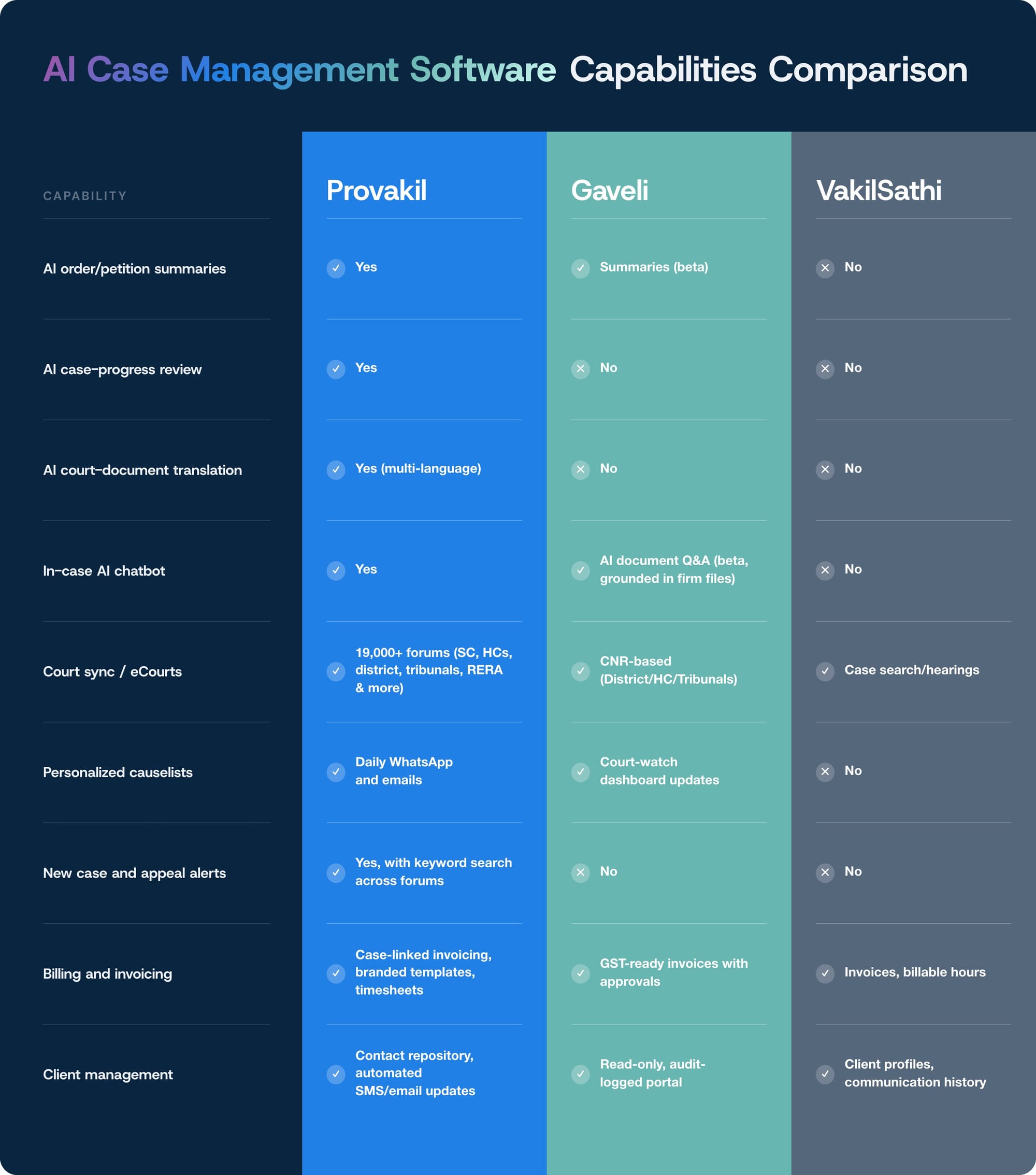
Gaveli has more substance behind its AI claim than most competitors in this set. Its document intelligence layer reads files uploaded to a matter and answers plain-language questions with summaries, key dates, and drafted replies, all grounded in the firm's own documents rather than a generic training corpus.
Gaveli is running a private beta with a founding-firm cohort handling hundreds of matters, and that beta status means no documented production track record, no customer outcome metrics available for a prospective buyer to verify, and no way to assess how the platform performs when a firm scales from a handful of test matters to a full docket across District Courts, High Courts, and Tribunals.
VakilSathi occupies a different position entirely. Its website describes "AI-enabled automation" and "AI-assisted drafting" without defining either term at the specification level. It describes no workflow, provides no sample input-output, and names no AI capability a buyer can evaluate against a competing product.
The platform underneath those labels offers a functional practice management baseline: case tracking, tasks, hearings, billing, a calendar and case diary, client profiles, and document management with version history.
Provakil's four AI capabilities are named, described at the feature level, and running in production across 19,000+ Indian courts, tribunals, and registries. They sit on the court intelligence layer the platform already operates, meaning the AI works on live, continuously updated case data.
AI Case Summary generates condensed summaries of orders and petitions, pulling key holdings, directions, compliance dates, and next steps into a readable format. CorpLit Consultants reported saving 40+ hours of administrative work per week, much of it eliminating manual order review across a large, active docket.
AI Case Review analyzes case progress and surfaces the current status, trajectory, and upcoming actions for each matter. Managing partners and senior associates who oversee teams across multiple forums get a live operational picture without assembling the same information from memory during a weekly review.
AI Order and Judgment Translation handles court documents across languages, a capability that matters in a jurisdiction where a firm in Delhi routinely receives orders from the Rajasthan High Court in Hindi, the Madras High Court in Tamil, and the Karnataka High Court in Kannada. Provakil's translation layer eliminates the separate manual translation step that otherwise sits between receiving an order and assessing its relevance.
In-Case AI Chatbot sits inside each matter and answers questions based on the documents, orders, hearing records, and history linked to that specific case. The chatbot is scoped to the matter, not a general knowledge base, so the answers are grounded in the firm's own case record rather than a broad dataset.

The number of Indian legaltech vendors claiming AI on their product pages will only increase over the next two years, and the gap between genuine capability and marketing language will get harder to spot from a homepage alone.
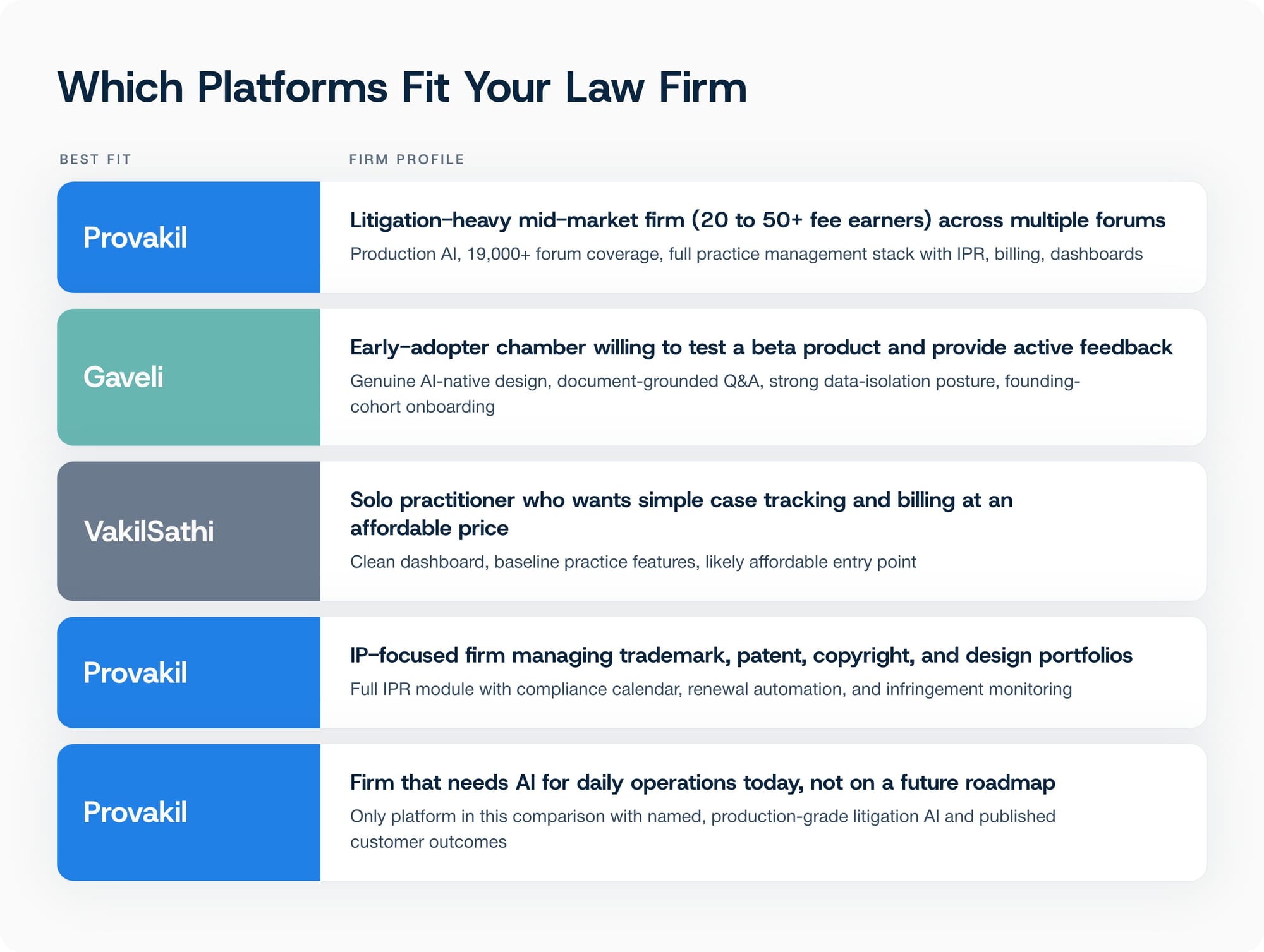
A firm evaluating practice management software in 2026 needs a sharper filter than "does the website say AI-powered?" That filter is a simple, repeatable question: what does your AI do, at feature level, and which firms are using it in production today?
Provakil answers both halves with four described AI capabilities running across 19,000+ forums and a digital case workspace that wraps court intelligence, operations, IPR, billing, and team workflows into a single platform.
If you read our earlier comparison of Provakil vs. PracticeLeague vs. MyKase, that piece covered the established incumbents and what each was originally built for. Together, they map heritage and technology, the two dimensions that define which platform actually fits a litigation-heavy Indian law firm.

No. Provakil's AI features operate on the firm's case data within the platform and do not use client documents or case records to train underlying models. The firm's data stays within its workspace and is not shared across accounts.
Provakil reports 99.5% accuracy in case tracking across its 19,000+ forum network, covering the Supreme Court, High Courts, district courts, NCLT, RERA, DRT, consumer forums, tax tribunals, and patent offices.
Case Management is the foundational product for solo advocates, covering case updates, alerts, causelists, and a digital workspace. Practice Management adds client management, IPR management, team and project management, billing, and dashboards for firms scaling beyond solo practice.
Provakil offers data residency options for India, the GCC, and Southeast Asia, along with ISO 27001 certification and SOC 2 and GDPR compliance, allowing firms with international clients to meet jurisdiction-specific data storage requirements.
Yes. Provakil integrates with Google Calendar, Microsoft Outlook, and iOS calendars, syncing hearing dates, deadlines, and task reminders directly into the tools advocates and teams already use daily.

Dive deep into Provakil's numerous blog posts & discover how legal tech can streamline your litigation, contracts, IP, and notice management processes.