Your Next Practice Management Software Will Probably Fail You the Same Way This One Did
5 min read



If your firm has tried practice management software before and ended up back on Excel and WhatsApp within a few months, you are not the exception. Most tools in this category were built for a narrower version of legal practice than what a growing Indian litigation firm actually looks like. Firms absorb these gaps because switching again feels like more work than the workaround, and that tolerance keeps the cycle going.
Legodesk and LIBRA are two of the earliest results when firms start looking again. Legodesk because it wrapped a polished cloud interface around lender and NBFC notice workflows, with dispute resolution baked into the architecture.
LIBRA because 380,000 advocates have downloaded it, and a free tier eliminates any reason not to try.
Provakil covers the full category, from case management to practice management, with real-time court intelligence across 19,000+ forums; litigation AI that summarizes orders and translates court documents; and firm-wide team workflows and dashboards that don't cap out at a single advocate or a single vertical.
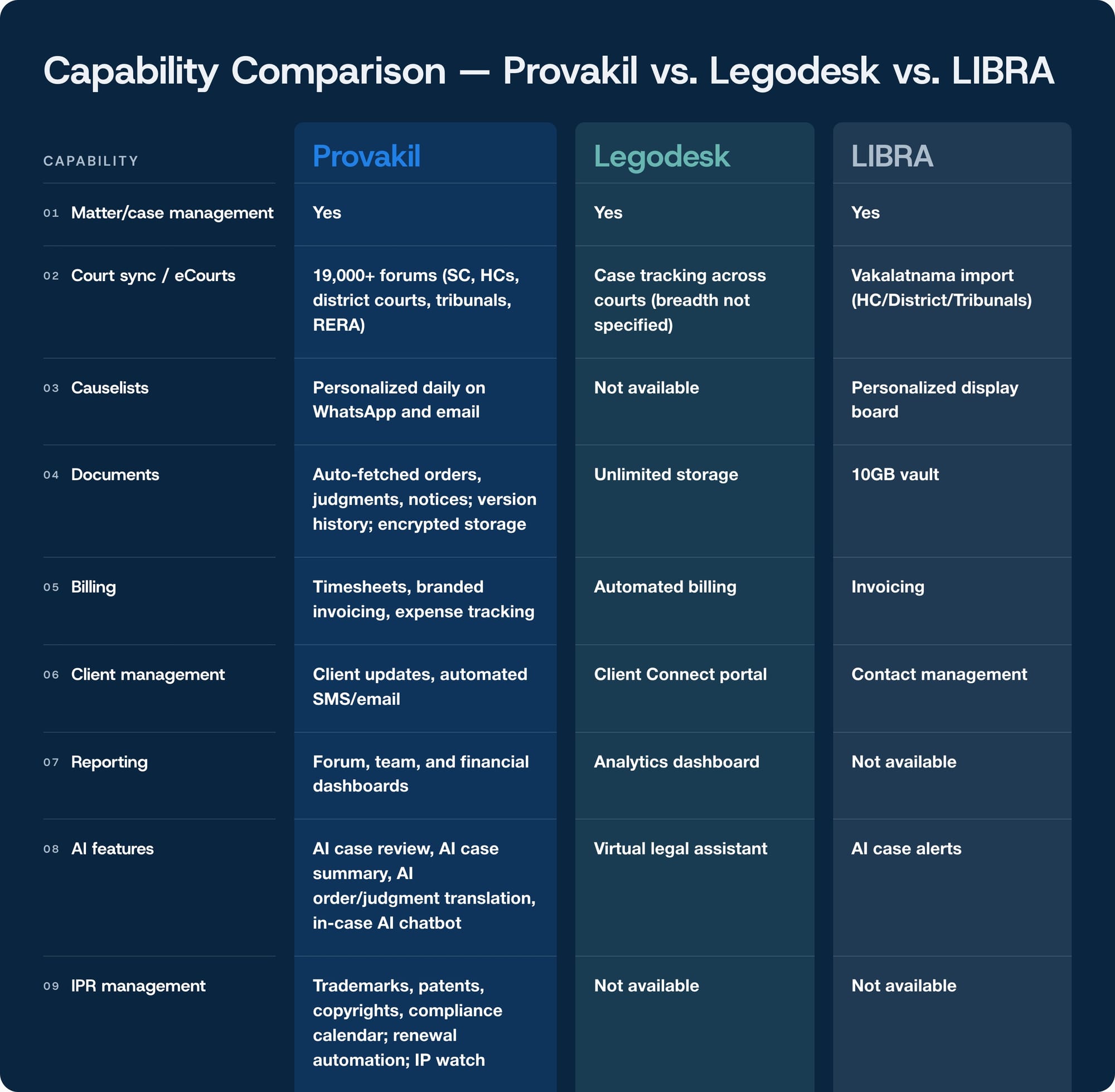
LIBRA's pitch is speed and accessibility. Upload a vakalatnama, and the app imports your cases and hearings in roughly sixty seconds. From there, you get a personalized display board, hearing notifications, and calendar sync with Google and Apple.
The limits tend to surface gradually. No generative AI powers the marketed "AI case alerts"; there's no firm-wide reporting, no IPR management, and the document vault caps at 10GB.
User reviews on the Play Store consistently flag court-coverage gaps and slow support responses, and the app was last updated in November 2025.
Legodesk approaches the market from a completely different angle. Its DNA is lender-side: NBFCs, digital lenders, and banks with legal collections portfolios. The platform handles notice automation, online dispute resolution, a client connect portal, and unlimited document storage. Billing is automated, and the cloud interface is clean enough to make a good first impression in a demo.
Step outside and the gaps become structural. Causelists are not publicly documented anywhere on the platform. The "virtual legal assistant" carries no verified litigation AI underneath it. Legodesk was optimized for a vertical, and it serves that vertical well. The question is whether your entire practice lives inside it.
Provakil monitors 19,000+ Indian forums in real time, from the Supreme Court and High Courts through district courts, NCLT, RERA, and IP registries. Every hearing, order, judgment, and listing change pushes automatically into the workspace.
Personalized causelists arrive on WhatsApp and email every morning, including supplementary and advanced causelists that most platforms miss entirely.
Provakil's litigation AI generates case summaries, reviews case progress and recommends next steps, summarizes orders and petitions, and translates court documents across jurisdictions. An in-case AI chatbot lets advocates query their own case files in natural language.
These are described as functional capabilities inside a production platform used by 10,000+ advocates and 250+ law firms.
We document the outcomes behind those capabilities. CorpLit Consultants saves 40+ hours of admin work per week. Mahesh Y.L. & Associates improved case tracking by 50%.
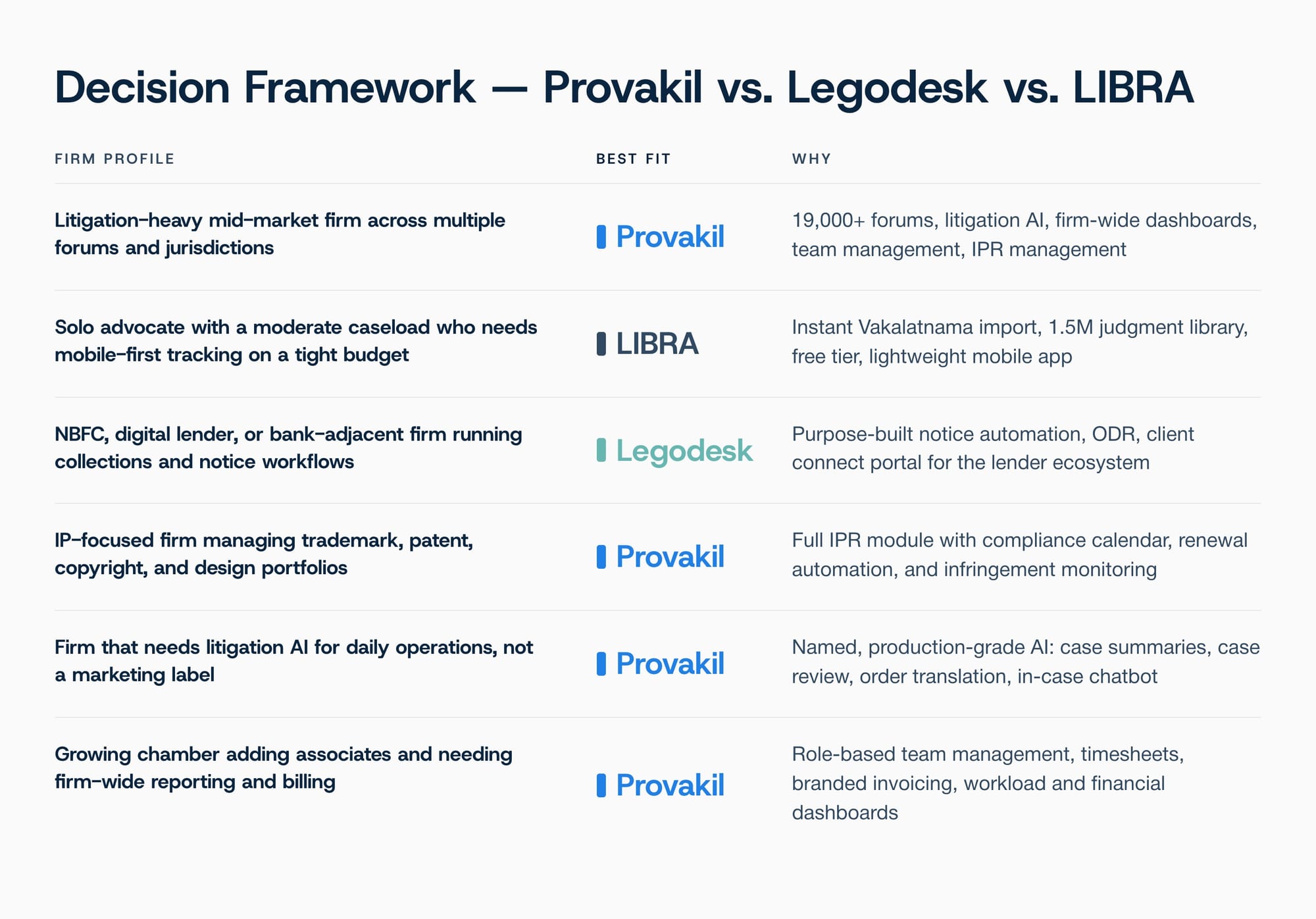
The right choice depends on what your practice needs today and what it will need twelve months from now. Neither platform, however, was built for the firm that operates across multiple forums, manages a team, tracks IP portfolios, needs AI to process the daily volume of orders and filings, and bills clients with accurate timesheets and branded invoices.
Provakil is built for that firm. If the plan is to grow the practice, the question shifts from which tool handles today to which tool will still be standing when the firm doubles.

The pattern this blog describes is not really about Legodesk or LIBRA in particular. It is about what happens whenever a tool designed for a narrow context meets a practice that has quietly outgrown it. LIBRA gives solo advocates a fast. Legodesk gives lender-adjacent firms a clean cloud workspace for collections. Both deliver within their boundaries, and recognizing those boundaries before you commit is the entire point of comparing them at the feature level.
The previous blog, where we compared Provakil against Gaveli and VakilSathi, showed that not every "AI-powered" label translates to real litigation AI; this one shows that not every cloud platform covers the same ground.

Yes. Mobile apps on Android and iOS support offline access to downloaded documents, briefs, and case files. Updates sync automatically when connectivity returns, so court preparation continues uninterrupted.
Project and team management covers litigation and non-litigation workflows with task assignment, deadlines, and role-based access. Advisory, compliance, and due diligence projects sit alongside court matters in one workspace.
Every firm gets guided onboarding: forum mapping, matter import, user role configuration, and training. Provakil is a workflow change, not a self-serve download, and the transition reflects that.
MS Word, Google Drive, MS Suite, ZOHO, Salesforce, SAP, Okta, Oracle, and Microsoft Dynamics. The platform connects to the firm's existing stack rather than replacing it.
99.5% case tracking accuracy, verified across the full forum network. At scale, even a fraction of a percent in missed updates means hearings or filings a firm never knew about.

Dive deep into Provakil's numerous blog posts & discover how legal tech can streamline your litigation, contracts, IP, and notice management processes.