Provakil vs. SpotDraft: Which India-Born AI CLM Software Should Your Legal Team Choose?
7 min read



Every CLM vendor in the market will tell you they manage the full contract lifecycle. Most of them mean the stretch between opening a template and filing a signed PDF, which is roughly like calling a kitchen remodel a complete home build because both involve countertops.
The real contract lifecycle starts at sourcing and vendor due diligence, well before any template is opened, and runs past the signature into obligation enforcement, invoice validation, and compliance tracking. Where a platform draws those start and end lines tells you more about its architecture than any feature page on its website will.
Provakil vs SpotDraft is the tightest CLM matchup in India: two platforms born here, targeting the same in-house legal buyers across India and the Gulf. SpotDraft's lifecycle starts with the template and ends with the repository. Provakil's starts with vendor sourcing and extends through post-signature obligation enforcement, with India and GCC compliance built into every stage.
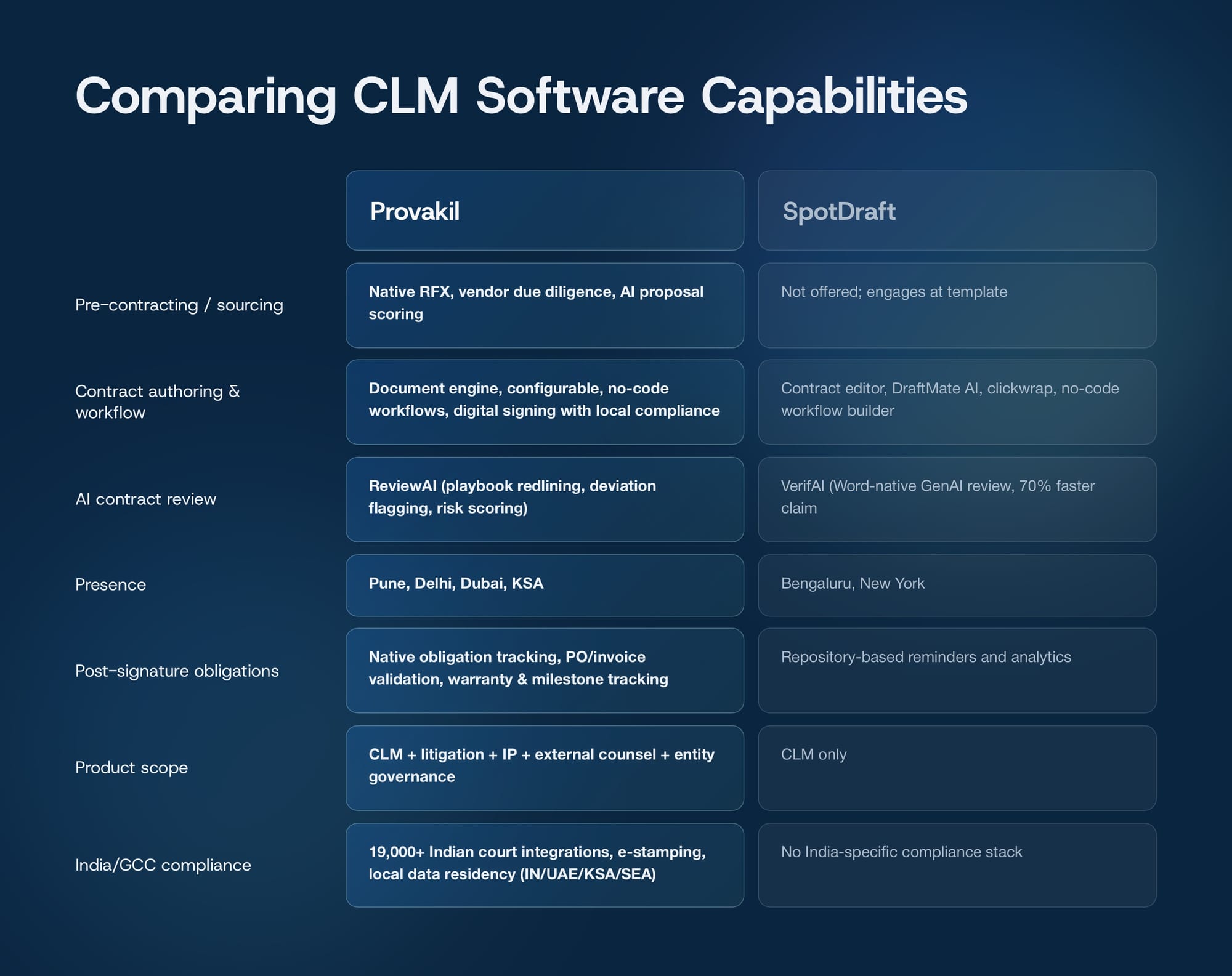
Provakil's lifecycle starts at: RFX/tender management, vendor due diligence, AI proposal scoring.
SpotDraft's lifecycle starts at: The contract template
Provakil's contract lifecycle management module begins upstream of the contract itself. By the time a template opens, the platform already holds the sourcing context, the vendor risk profile, and the evaluation trail that led to this particular deal.
SpotDraft engages when the template opens. Everything that happened before that point- the sourcing decision, the vendor evaluation, the approval to proceed- lives in a different tool or a different email thread entirely.
If your CLM has no memory of why a vendor was selected in the first place, your legal team is reconstructing context manually every time a clause calls for a judgment.
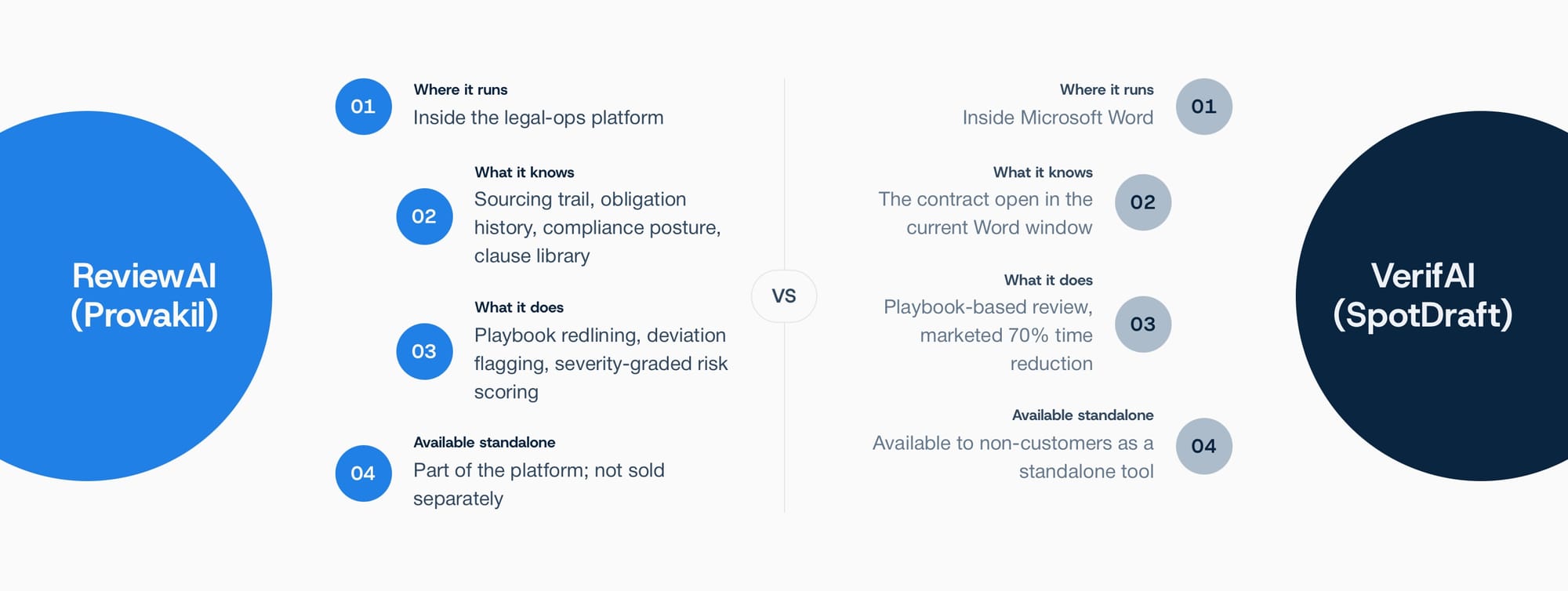
SpotDraft markets VerifAI as a generative AI review engine inside Microsoft Word that cuts contract review time by 70%. It reviews contracts against playbooks and is available as a standalone tool, even to non-customers, which suggests where SpotDraft sees its product boundary ending.
Provakil's ReviewAI performs playbook-based auto-redlining, clause deviation flagging, and severity-graded risk scoring inside the same platform that already holds your sourcing trail, obligation history, and compliance posture.
One is a review plugin inside a word processor; the other is a review engine wired into a legal operations platform that extends well beyond contracts.
The signed contract is where actual commercial risk accumulates: missed obligations, lapsed renewals, invoices that quietly drift from contractual terms.
Provakil post-signature: Native obligation tracking, PO and invoice validation, warranty and milestone tracking, automated renewal management, all inside the contract record.
SpotDraft post-signature: Repository-based renewal reminders and analytics.
Provakil keeps the contract and the obligation it created in the same system, which means enforcement becomes a workflow rather than a calendar reminder someone hopes they set correctly.
SpotDraft files the contract into a repository, fires a notification when a date approaches, and leaves everything between signature and renewal for the legal team to manage outside the platform.
For teams whose contracts carry real commercial obligations beyond a renewal date, that gap grows wider with every agreement your organization signs.
Indian legal teams do not operate solely within contracts. They litigate, manage intellectual property portfolios, track external counsel spend and budgets, and govern entities and boards. Software that covers only the contracting workflow leaves the legal team to assemble a separate stack for each adjacent function. That stack incurs its own licensing costs, integration overhead, and data fragmentation.
What SpotDraft customers need to source separately, Provakil covers natively:
Each of those is a separate vendor, a separate contract, and a separate data environment on a CLM-only architecture. The total cost of legal operations is never just the CLM license fee; it is the CLM license plus every tool your legal team purchased because the CLM they chose could not expand into the next requirement that walked through the door.
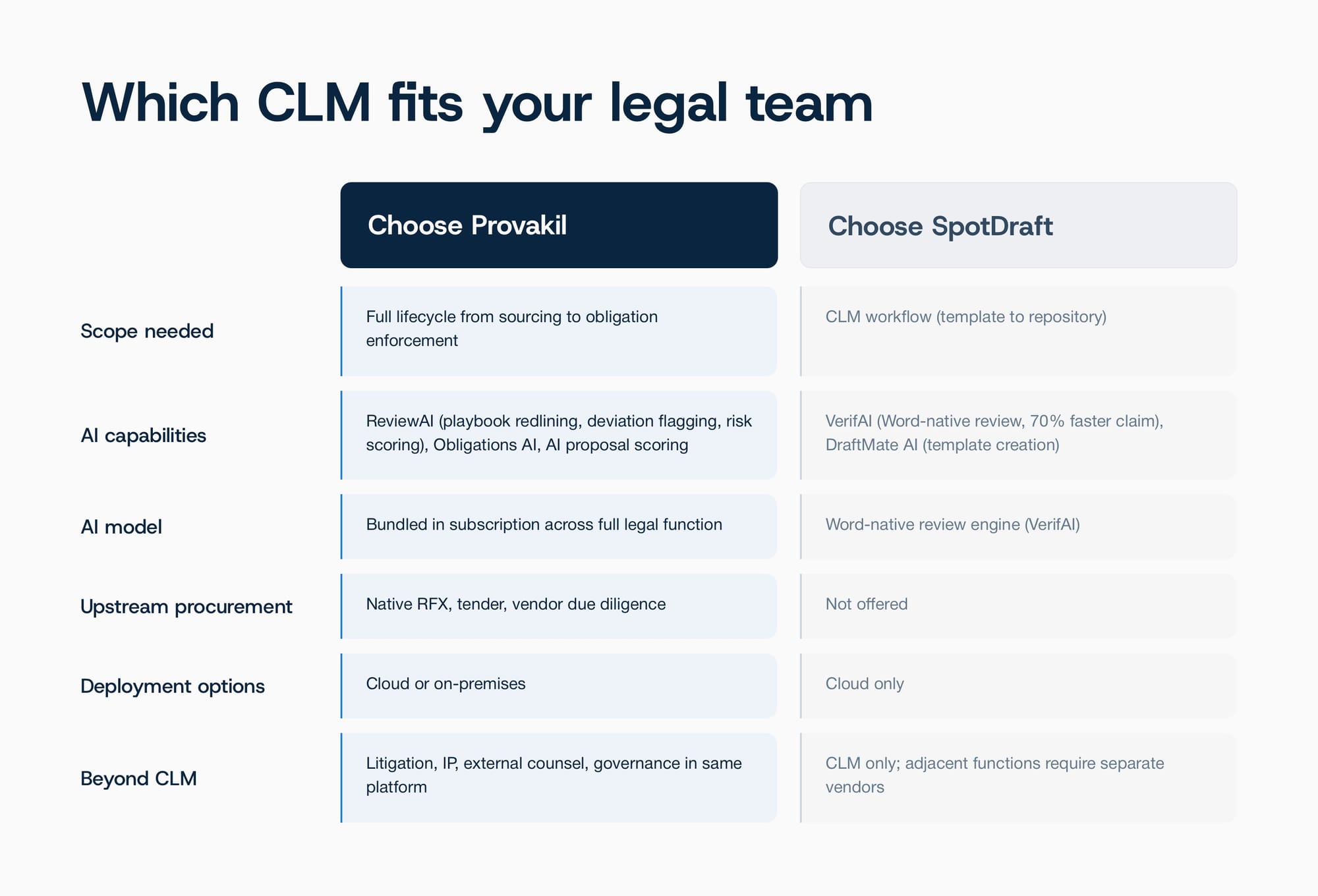
Choose Provakil when your legal team's requirements do not end where the contract does—sourcing through obligation enforcement in one CLM. On-premises deployment for regulated environments. Litigation, IP, counsel management, and governance inside the same platform whenever the team is ready to consolidate. None of that is a future roadmap item on Provakil; it is the architecture the platform was built around from day one, funded by the enterprises already running on it.
Choose SpotDraft when the contract is genuinely the entire scope and nothing adjacent is on the horizon, if litigation and IP are handled elsewhere with no consolidation planned. If India-specific compliance is not a factor in your evaluation criteria, and if your legal team is building a multi-vendor stack where the CLM is just one tool among several.
SpotDraft's CLM-only architecture covers that narrower mandate without the broader platform.

The CLM market is not short on platforms, and two India-born competitors targeting the same in-house legal buyers is a sign the category has matured well past the point where shared geography alone was a differentiator.
What actually separates Provakil and SpotDraft is not where they were built but how much of the legal function they were designed to cover and how seriously they treat the jurisdictions in which they operate.
For legal teams whose operations extend beyond contracting into litigation, IP, external counsel, and governance, and whose compliance requirements are tied to Indian or Gulf jurisdictions, that scope difference is not a feature gap you work around later. It is the architectural decision that determines whether your legal technology consolidates over the next three years or fragments further with every new requirement your team inherits.
If you are also evaluating global enterprise CLM incumbents alongside these two, our comparisons of Provakil vs. Icertis and Provakil vs. Ironclad cover those matchups with the same level of depth.

For organizations whose requirements extend beyond contracting into litigation, IP, external counsel management, and entity governance, Provakil is designed as a full replacement that eliminates the need for separate tools around the CLM. It covers what SpotDraft offers, as well as the legal functions that SpotDraft's CLM-only architecture does not address, with native depth in India and GCC compliance.
Both platforms use quote-based pricing and are positioned below global enterprise incumbents like Icertis and Ironclad. The meaningful cost difference lies in scope: a SpotDraft quote covers CLM only, while a Provakil quote covers CLM plus litigation, IP, counsel management, and governance in the same platform.
Provakil's typical implementation is completed within weeks, covering platform configuration, legacy contract migration with OCR-based import, and workflow setup across CLM and any additional modules the organization enables. SpotDraft positions itself for fast onboarding as a CLM-pure platform, though no specific implementation timeline is published in its public materials.
Provakil integrates with Microsoft 365, Salesforce, SAP, Oracle, Zoho, Google Workspace, Okta, Dropbox, DocuSign, and Leegality. SpotDraft integrates with Salesforce, Slack, HubSpot, and standard enterprise tools. Both support API-based connectivity, but Provakil's integration layer spans the full legal function beyond CLM, connecting contract data with litigation, IP, and compliance workflows in the same environment rather than routing it through a separate middleware layer.ors in migration planning, so your team is not rebuilding from scratch.
SpotDraft operates from New York and Bengaluru with growing commercial presence across the Americas and EMEA. For buyers whose global footprint centers on India, the Gulf, or Southeast Asia, Provakil's compliance depth through local data residency and e-stamping addresses jurisdiction-specific requirements that a globally architected CLM does not cover.

Dive deep into Provakil's numerous blog posts & discover how legal tech can streamline your litigation, contracts, IP, and notice management processes.