Provakil vs. Ironclad: A Head-to-Head AI CLM Comparison
6 min read



If your CLM platform charges separately for AI-powered contract review in 2026, the Gartner badge on its homepage is doing a lot of the heavy lifting. Ironclad holds three consecutive Gartner Magic Quadrant Leader placements and a Forrester Wave Leader badge. Yet, its AI assistant is a separately billed add-on that its own CEO says roughly one in three new customers adopt, which tells you something about either the pricing or the value proposition, possibly both.
The AI pricing is not the only gap. The contract lifecycle starts at the request stage with nothing before it, and users who praised the workflow engine on G2 also flagged clunky document editing, weak repository search, and a setup process, one reviewer called a "choose your own adventure," that still needs a dedicated admin months later.
This Provakil vs Ironclad evaluation comes down to one question: do you want contract lifecycle management software that sells the workflow engine and the intelligence layer as separate invoices, or one that covers pre-contracting through post-signature governance on a single platform at a single price? Provakil is the latter, and this blog breaks down the four criteria that separate the two.
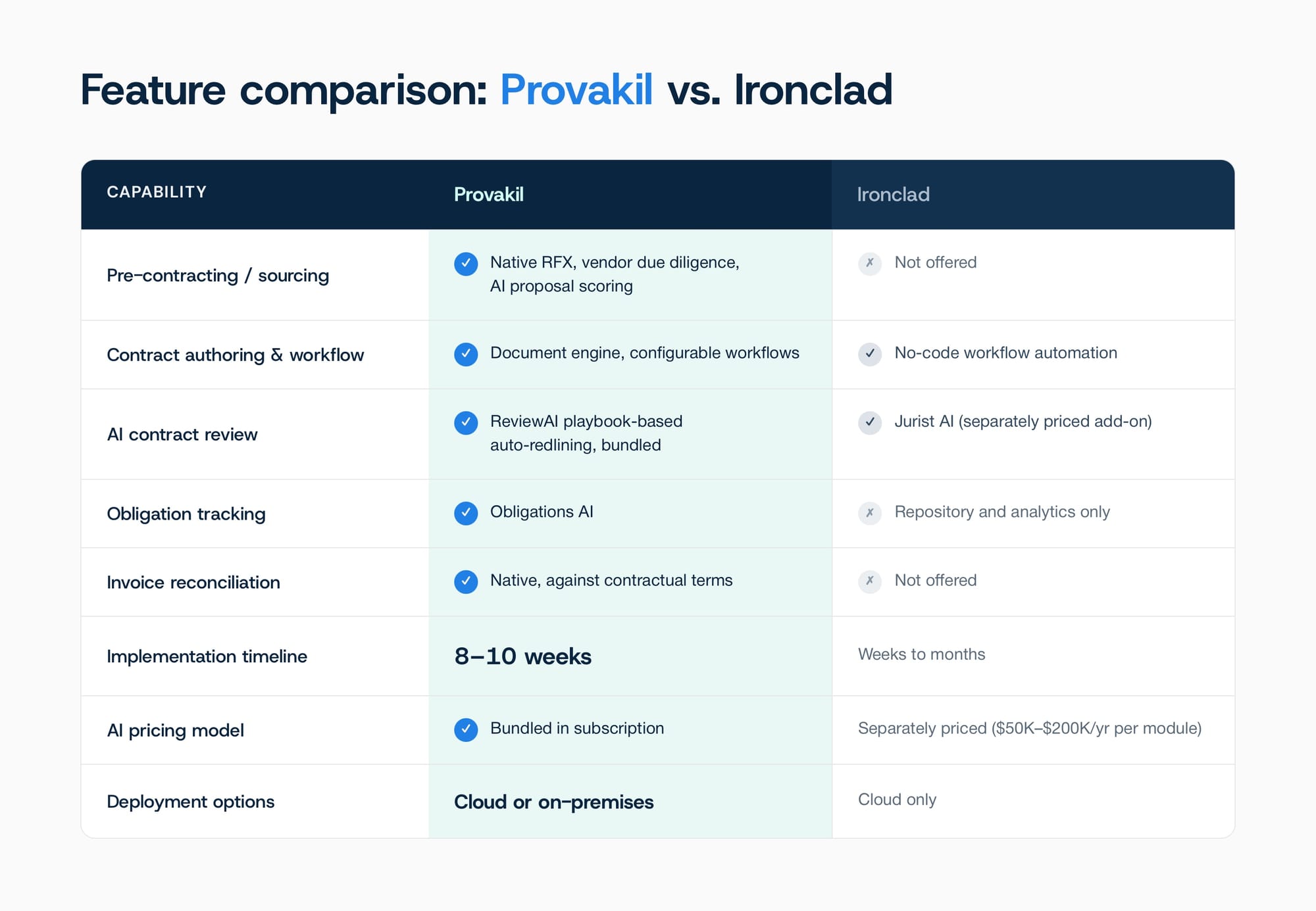
Ironclad's contract lifecycle begins when a business user submits a request, moves through templating, negotiation, and workflow-routed approvals, and ends when the signed contract lands in a repository with reporting and analytics.
The gap sits on either side of it. Before the contract request, your procurement team is managing RFPs, running vendor due diligence, and scoring proposals, none of which Ironclad covers natively. After the signature, your team needs to track obligations, validate invoices against contract terms, and monitor warranties, renewals, and milestones.
While Ironclad offers a repository and basic analytics for post-signature visibility, active obligation governance and invoice reconciliation are handled entirely outside the platform.
Provakil handles pre-contracting, execution, and post-award governance in a single workspace, which is a fundamentally different proposition from a workflow engine that covers the middle and leaves both ends to someone else.
Flyadeal, a leading Middle Eastern airline, deployed Provakil's AI CLM software to cover exactly that process end-to-end.
Ironclad splits its AI into two separately priced modules: Jurist, the AI assistant for drafting, redlining, and review, built on OpenAI via a Rivet abstraction layer and estimated at $50,000 to $200,000 per year on top of the base platform, and AI Contract Analysis, a clause analysis and risk identification module estimated at another $50,000 to $100,000 annually.
Their own CEO noted that roughly one in three new customers adopt Jurist, which means the majority of buyers are paying enterprise rates for a CLM and then not using the intelligence that is supposed to make it intelligent. The reason is not hard to guess when the base platform already runs $60,000 to $300,000 annually for enterprise deployments, and the AI modules stack another six figures on top.
Provakil bundles its entire AI layer into the standard subscription, with ReviewAI handling playbook-based auto-redlining and clause deviation flagging; Obligations AI extracting and tracking obligations, renewals, and milestones; AI proposal scoring evaluating vendor bids during pre-contracting; and risk scoring by severity flagging exposure before the contract is signed.
Marico, one of India's largest FMCG enterprises operating across 25+ countries, is already expanding into AI-assisted clause comparison and deviation flagging as the next phase of its Provakil rollout, building on a centralized repository of 1,500+ contracts and 50+ standardized templates that serve legal, commercial, procurement, and international teams.
That expansion does not require a separate procurement cycle or a new line item, because the AI was always part of the platform.
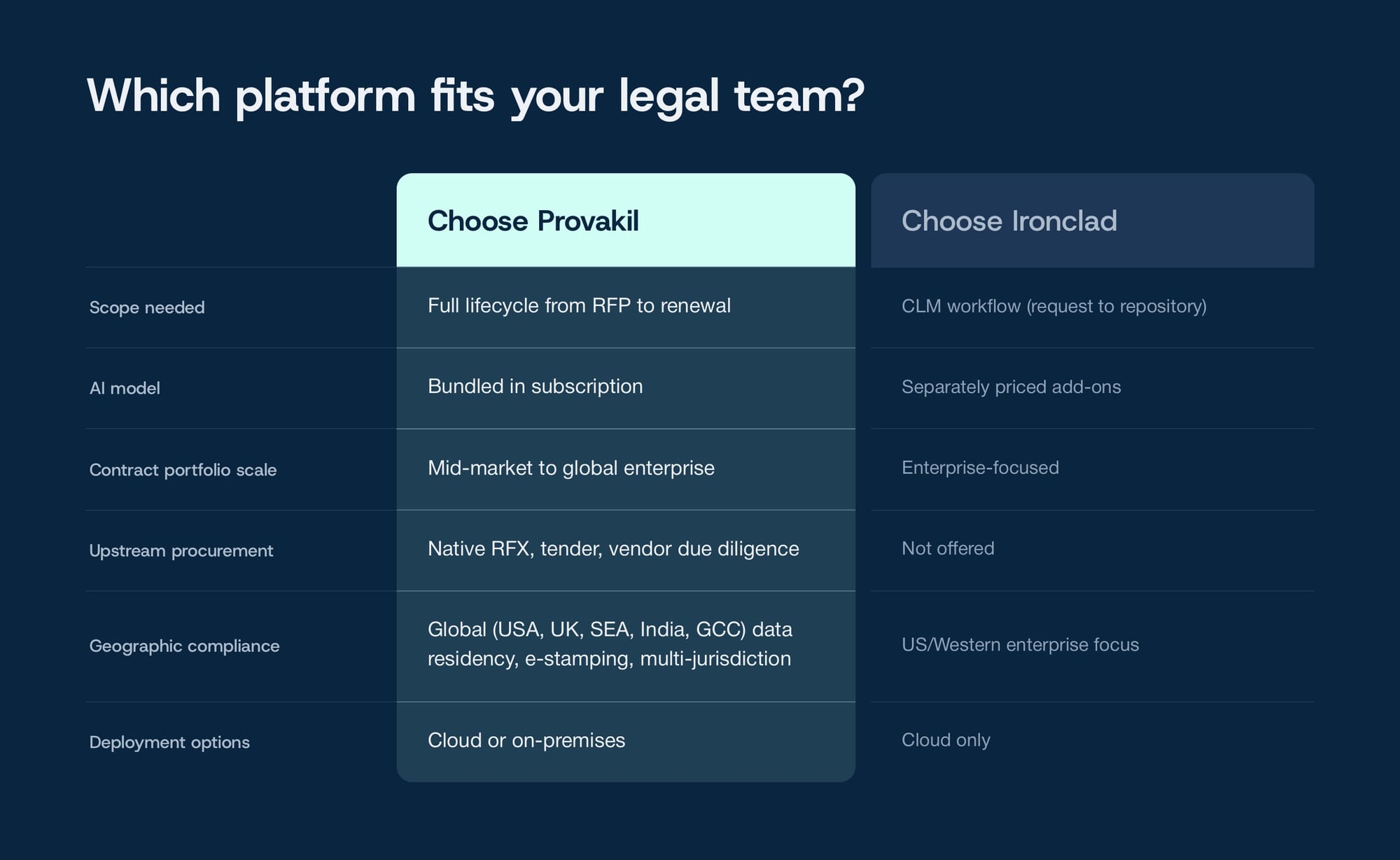
Choose Provakil when your team needs CLM coverage from pre-contracting through post-signature governance with AI included in the platform, not invoiced separately.
Provakil deploys in approximately 8 to 10 weeks, offers cloud or on-premises deployment for regulated organizations, supports local data residency globally, and scales from mid-market teams to global enterprises like Marico without an enterprise-only budget floor.
Marico onboarded 20+ new distributors onto the same structured contracting process and scaled the platform to its Bangladesh entity within months, the kind of cross-geography expansion that a CLM should make routine rather than require a re-platforming conversation.
Choose Ironclad when your legal team's primary requirement is a CLM workflow engine, and Gartner and Forrester recognition carries weight in your procurement committee.
Ironclad fits if your organization has the enterprise budget for the base platform plus separately priced AI modules, pre-contracting and post-award obligation management are handled by other systems you plan to keep, and your team has the admin resources for an implementation that reviewers consistently describe as more configuration-intensive than standard CLM rollouts.

The real question in this Provakil vs Ironclad comparison has nothing to do with which platform collected more analyst badges and everything to do with what your legal and procurement teams need the CLM to do tactically once the daily work starts, and the badges become wall art.
Upstream coverage, bundled intelligence, post-signature obligation governance, and a deployment timeline measured in weeks are either built into the platform or not. Provakil has them in one platform, at one price, live in weeks.
If you are also exploring Icertis, our Provakil vs. Icertis comparison breaks down how the same criteria apply to a five-time Gartner MQ Leader with a very different cost and deployment profile.

Yes, for organizations that need contract lifecycle management plus pre-contracting coverage (RFPs, vendor due diligence, AI proposal scoring) and post-signature governance (obligation tracking, invoice reconciliation, renewal monitoring) in one system. Provakil covers the full span that Ironclad addresses only from request through signature, and bundles AI natively rather than pricing it as a separate add-on.
Ironclad sells its AI capabilities as separately priced modules. Jurist, the AI assistant for review and drafting, is estimated at $50,000 to $200,000 per year, and AI Contract Analysis adds another $50,000 to $100,000 annually, both on top of the base platform subscription.
Provakil scales from mid-market to enterprise without an enterprise-only budget floor, with AI included in the standard subscription. Ironclad's entry pricing starts at approximately $60,000 per year before AI add-ons, making Provakil the more accessible option for teams that need AI-powered contract review without a separate procurement cycle for the intelligence layer.
Provakil offers both cloud and on-premises deployments with local data residency in India, the UAE, KSA, and SEA, which matters for regulated industries and organizations with jurisdiction-specific data sovereignty requirements, while Ironclad is cloud-only.
Provakil integrates e-signing and e-stamping with locally compliant digital signature workflows across multiple jurisdictions. Ironclad offers native e-signature but does not emphasize multi-jurisdiction e-stamping or locally compliant signing outside the US.

Dive deep into Provakil's numerous blog posts & discover how legal tech can streamline your litigation, contracts, IP, and notice management processes.