AI Governance for In-House Legal Teams: Building a Board-Ready Framework
7 min read



Eighty-five percent of legal departments now have dedicated AI oversight or resources, according to the CLOC 2026 State of the Industry Report. Yet when the board asks a direct question about who owns AI risk across the organization, most general counsel do not have a structured answer ready. AI governance for legal teams has moved from a "next quarter" agenda item to an immediate operational requirement, and the legal function is the only one positioned to own it.
AI governance is the set of policies, review checkpoints, and cross-functional oversight structures that let an organization adopt AI responsibly. It covers model selection, vendor due diligence, human-in-the-loop review, data-handling standards, shadow-AI risk, and the buy-versus-build decision. For legal departments, it also means translating regulatory obligations into enforceable internal standards and proving to the board that those standards hold up.
Regulatory compliance has become the top workload driver for 63% of departments, while budgets remain flat. The legal team is expected to govern more with the same headcount.
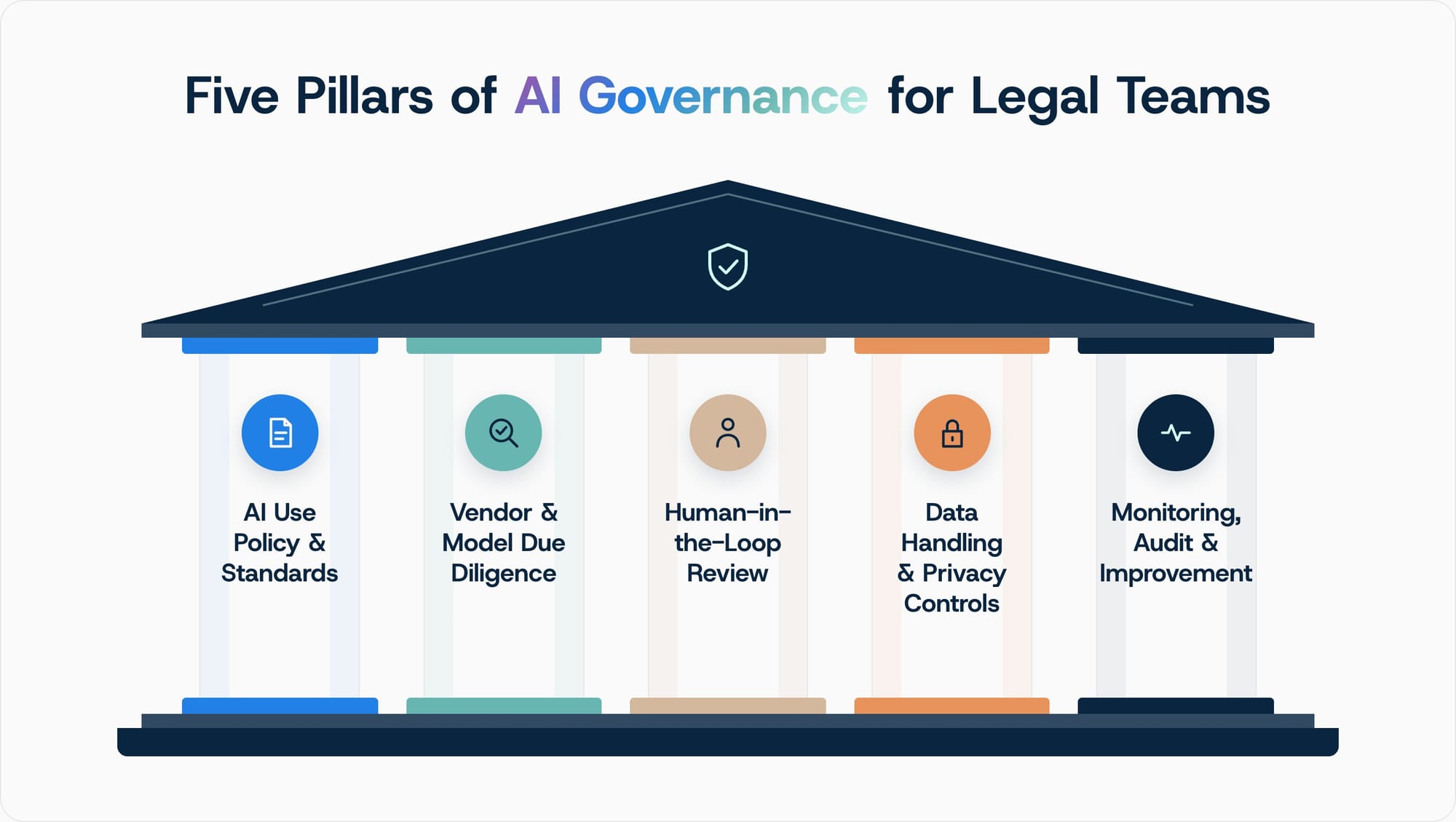
AI governance is not a single policy document. It is a set of interconnected controls spanning the organization. Legal does not own all of it, but it owns the parts that matter most to the board.
Which tools are approved, which uses are permitted, where human review is mandatory, and how to handle shadow AI.
Training data provenance, model transparency, data residency, and the vendor's own governance posture. The EU AI Act raises this bar for high-risk systems.
High-stakes outputs (regulatory filings, board materials, client communications) get defined checkpoints, escalation paths, and documented overrides.
What data flows into which tools, how outputs are stored, and how the organization meets DPDP, GDPR, and sector-specific obligations.
Ongoing tracking of tool performance, periodic compliance audits, incident logging, and a feedback loop that updates the framework as regulations evolve.
The ACC/Everlaw 2025 survey found 82% of large enterprises still cite reliability concerns even as 61% report workflow gains. That tension defines the legal team's role: draft the AI use policy, run vendor due diligence, map regulatory obligations, set human-review thresholds, and report to the board on governance posture.
The Thomson Reuters 2026 AI in Professional Services Report found enterprise-wide GenAI adoption rose from 14% in early 2024 to 43% two years later, with large firms and departments "approaching 100%." Another ACC survey found active GenAI use jumped from 23% to 52% the prior year. When half the department uses a tool daily, the board needs to know what guardrails exist.
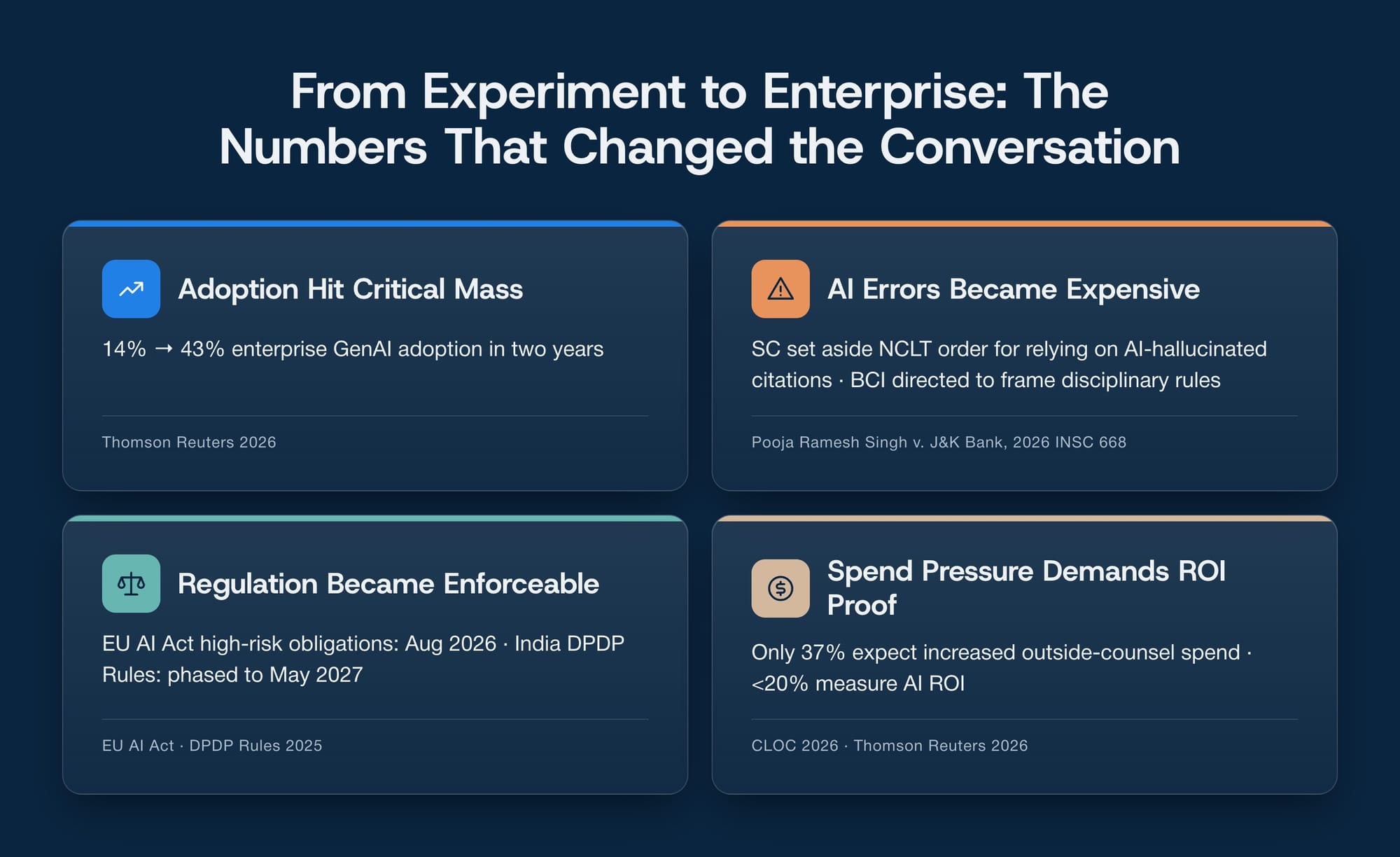
AI errors have become expensive. The Charlotin AI Hallucination Cases database logged roughly 200 cases in mid-2025 and reached 1,598 by June 2026. US courts moved from warnings to sanctions: $15,000 per attorney in Whiting v. City of Athens (Sixth Circuit, March 2026) and roughly $109,700 in Couvrette v. Wisnovsky (D. Oregon).
In July 2026, the Supreme Court of India set aside NCLT and NCLAT orders in Pooja Ramesh Singh v. J&K Bank (2026 INSC 668) after finding the tribunal had relied on AI-generated, non-existent judgments. The Court held that citing fabricated citations amounts to professional misconduct and directed the Bar Council of India to frame disciplinary guidelines for AI use by advocates.
For Indian enterprises, the message is clear: one hallucinated clause in a regulatory filing or board submission now exposes the lawyer to misconduct and the company to reputational risk.
The EU AI Act's full high-risk obligations take effect 2 August 2026. India's DPDP Rules 2025 phase in through May 2027. Sector regulators are layering AI-adjacent requirements onto existing frameworks. Only Legal can map these overlapping obligations to the company's actual AI usage.
The CLOC 2026 report found only 37% of departments expect increased outside-counsel spend, down from 58% the prior year. Thomson Reuters notes fewer than 20% of lawyers say their organizations measure AI ROI. The board wants evidence the investment is paying off, and risks are managed.
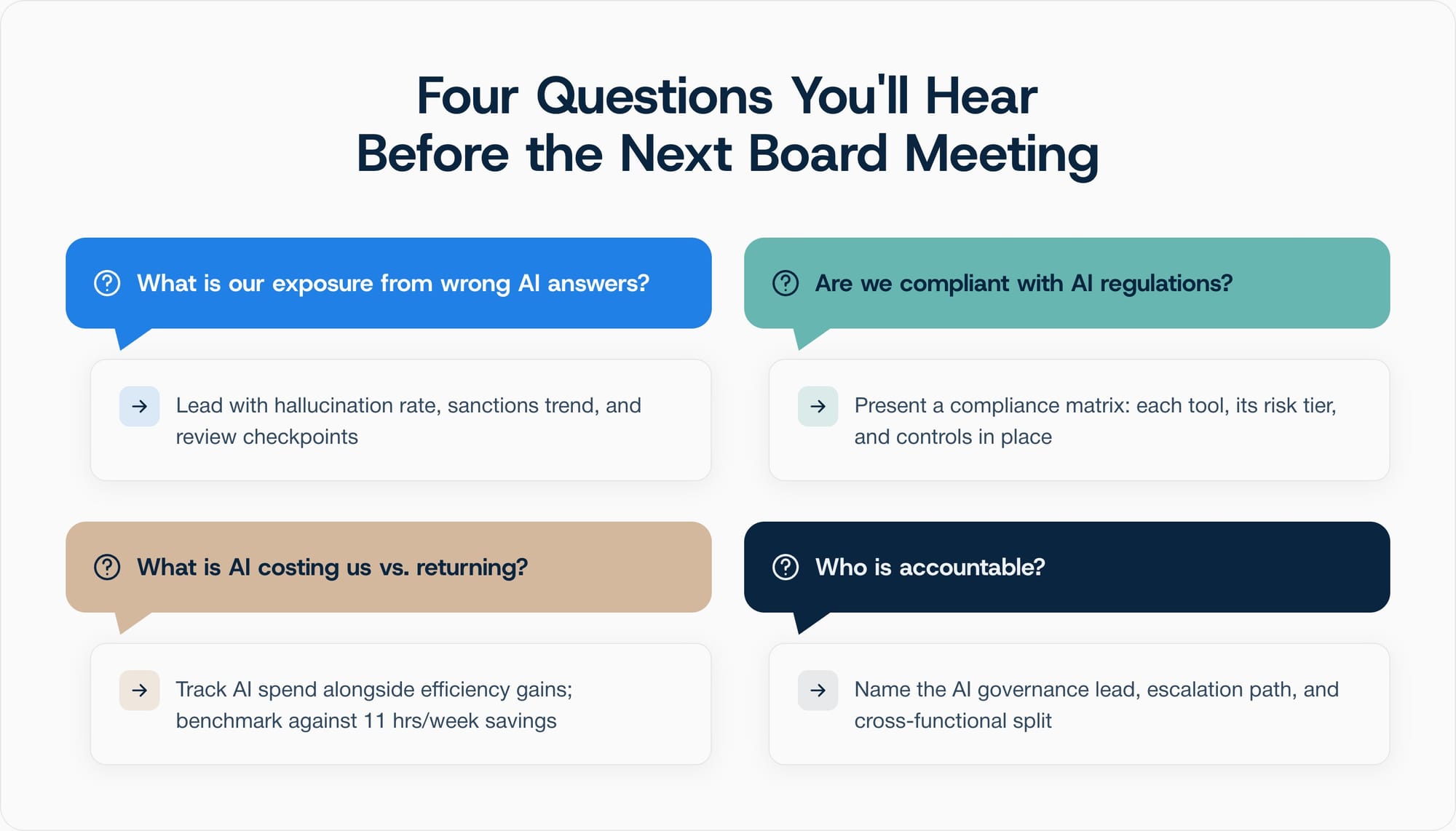
When the board asks about AI, they want to know about risk, liability, and return. Here are the questions GCs hear most often.
"What is our exposure if AI produces a wrong answer?"
Lead with facts: the hallucination rate, the sanctions trend, your specific review checkpoints. Show which outputs receive human review and how that is tracked.
"Are we compliant with AI regulations?"
Present a compliance matrix: each AI tool, its risk classification under the EU AI Act, and the controls in place. Most enterprise legal-AI tools fall outside the high-risk tier, but transparency and documentation obligations still apply. Layer in DPDP and sector-specific requirements.
"How much are we spending, and what are we getting back?"
Track AI-related spend alongside efficiency gains. The RSGI Harvey as Foundational report (June 2026) found power users save an average of 11 hours per week. Translate that benchmark into your team's numbers.
"Who is accountable?"
Name the AI governance lead, the escalation path, and how accountability is split between legal, IT, compliance, and business units.
A governance framework that lives in a policy document and a shared drive will not survive the first board question about specifics. It needs to sit inside the system your legal team already works in every day.
Provakil's Enterprise Legal Management platform gives you the operational infrastructure to run AI governance without bolting on a separate tool. Here is how.
Provakil's Legal Spend Management module already tracks your relationships with external counsel, spend, and performance. Extend the same structure to AI tool vendors: record contract terms, data-processing agreements, renewal dates, and spend in one place. When the board asks how much you are spending on AI tools, the answer comes from the same system that tracks your legal budget.
If an AI tool produces an error that triggers a regulatory inquiry or a client complaint, it becomes a matter. Provakil's Global Matter Management lets you track these alongside litigation and regulatory matters with defined workflows, task assignments, and documented outcomes. You do not need a separate incident-management system.
Provakil's MIS dashboards and reporting pull from your matter, spend, and task data. Use them to build quarterly governance reports that show the board how many AI-related matters were opened, what AI tool spend looks like against the legal budget, and which vendors are up for review. The data is already in the platform; the governance lens is a reporting configuration.
Your AI vendor contracts, data-processing agreements, and acceptable-use policies are contracts. Provakil's CLM handles drafting, playbook-based review, approval workflows, obligation tracking, and renewal alerts. When an AI vendor agreement is up for renewal, or a DPDP-driven clause needs updating, the obligation tracker flags it before it matures.

AI governance is not a one-time project. It is an ongoing program that grows alongside your organization's AI adoption. The legal team doesn't need to become a technology function, but it does need to own the risk, compliance, and accountability layer the board cares about.
Start with the inventory. Draft the policy. Operationalize it through your ELM. Report quarterly. The teams that build this discipline now will adopt AI faster and with more confidence than those still improvising when the board asks its next round of questions.

Yes, if your organization processes data of EU residents or deploys AI systems in the EU market. The Act applies based on where the AI system's output has effect, not where the company is headquartered. Multinational companies' legal departments should assess their AI tools against the Act's risk tiers regardless of home jurisdiction.
Shadow AI refers to AI tools employees use without formal approval from IT or legal. Unapproved tools may lack enterprise-grade security, create compliance gaps under DPDP and GDPR, and expose confidential matter data. A governance framework with an approved-tools list and a clear procurement process reduces this risk.
At minimum, quarterly. The EU AI Act's high-risk obligations take effect in August 2026, India's DPDP obligations phase in through May 2027, and new AI tools enter the market constantly. A quarterly cycle aligned with board reporting keeps the framework current and the board satisfied.
An ELM platform that already tracks compliance obligations, manages vendors, monitors spend, and generates reports is the most natural home. Provakil's ELM absorbs AI governance as a new compliance domain, keeping everything in one system instead of adding a standalone tool that duplicates your records.

Dive deep into Provakil's numerous blog posts & discover how legal tech can streamline your litigation, contracts, IP, and notice management processes.