Provakil vs. LawVu & Onit: A Workspace, A Portfolio, and A Litigation Management Software Built for Indian Courts
7 min read



The trouble with ELM comparison matrices is that they reward breadth without asking where it ends. LawVu, a workspace designed in New Zealand, checks the boxes for matter management, contract management, and spend with a clean interface and quick adoption.
Onit, a modular suite assembled through acquisitions in Houston, checks even more: enterprise ELM, mid-market e-billing, CLM, AI contract review, and low-code workflow automation.
Provakil checks the same boxes and then moves into the ones neither platform offers: litigation management, connected to 19,000+ Indian courts, daily causelist tracking, AI order summaries, vernacular translation of court documents, and IP portfolio tracking.
For enterprises evaluating litigation management software, the comparison that matters is not which platform fills the most cells on a vendor scorecard. It is which platform covers what your legal team actually does between courtrooms, compliance deadlines, and board meetings.
LawVu is a legal workspace built around a single premise: give in-house teams one place for matters, contracts, and spend, wrapped in an interface that promises quick adoption and minimal training. The CLM arrived through the acquisition of Belgian automation specialist ClauseBase, now rebranded as LawVu Draft, and LawVu Lens handles AI-driven contract analysis on top of that.
Onit arrived at its current shape through a very different strategy. Rather than building one product, Onit acquired its way to breadth: SimpleLegal for mid-market e-billing, ContractWorks for CLM, ReviewAI for contract review, BusyLamp for European spend management. Apptitude, a low-code workflow engine, holds the pieces together and lets legal departments build custom applications without writing code.
Both platforms were built for global legal departments. "Global" in this context carries a quiet qualification: global in the sense of working across geographies, but not in the sense of connecting to 19,000+ Indian courts and tribunals where your matters actually move.
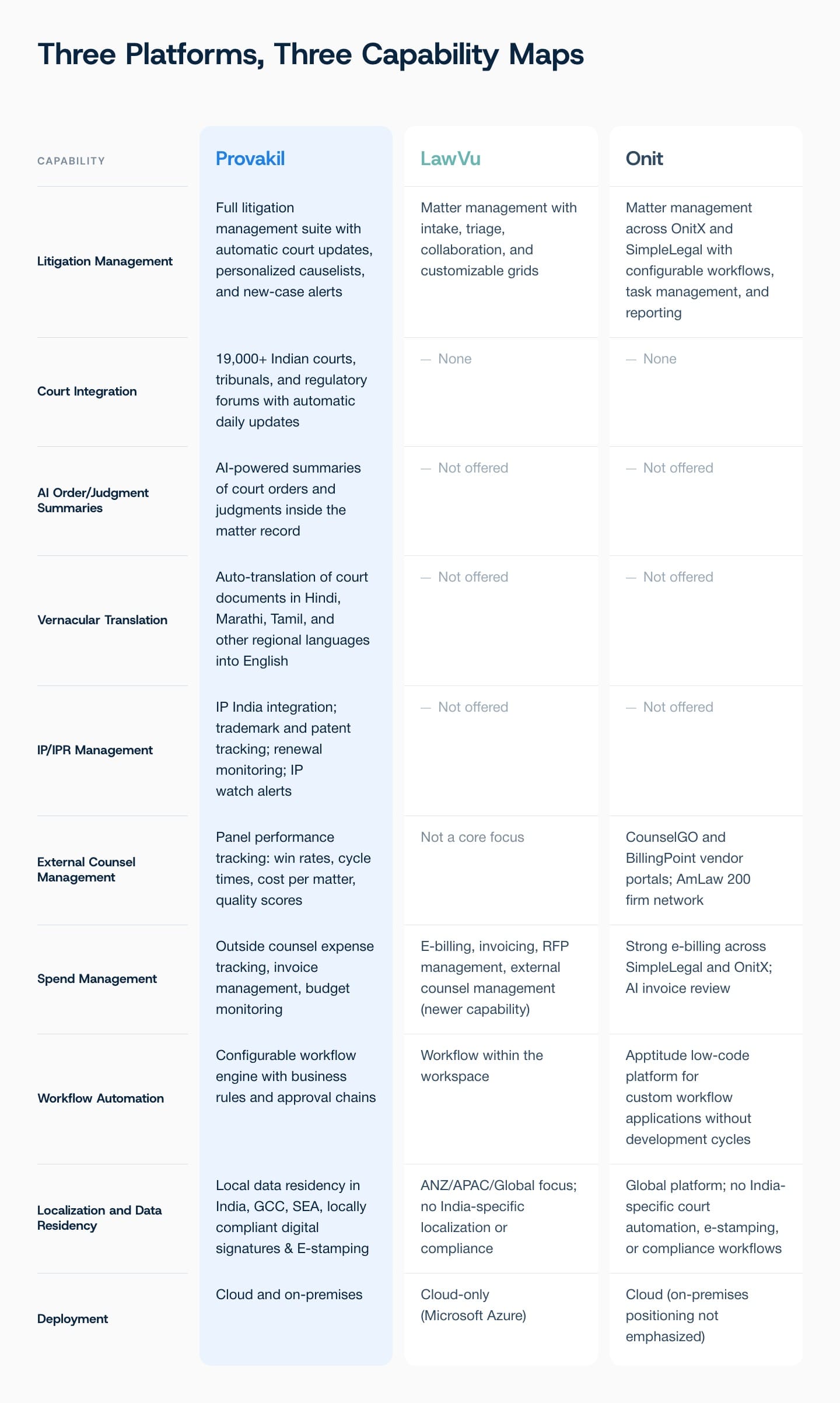
Provakil integrates directly with 19,000+ Indian courts, tribunals, and regulatory forums. The platform pulls automatic updates, tracks approximately 80,000 to 90,000 causelists daily, generates personalized hearing alerts, and monitors new case filings against tracked entities in real time.
LawVu does not offer litigation management as a capability. Onit's own materials, it describes litigation as "not a core offering" across its portfolio.
Both platforms can manage matters on a dashboard, but neither tracks what happens to those matters once they reach a courtroom.
The gap runs deeper than just court connectivity. Provakil's litigation management module generates AI-powered summaries of court orders and judgments, translates vernacular court documents issued in Hindi, Marathi, Tamil, and other regional languages into English, and automatically flags new cases filed against tracked entities.
These are not just supplementary features; these are what make litigation management software functional inside India's judicial infrastructure, where 5.64 crore cases remain pending across district courts, High Courts, and the Supreme Court.
Additionally, Provakil integrates with IP India for trademark and patent tracking, renewal monitoring, and IP watch alerts. Neither LawVu nor Onit offers IP management at any level, which means enterprises running both litigation and intellectual property portfolios would need a separate system stacked on top of whichever ELM platform they choose.
For buyers evaluating India-native litigation platforms alongside global ones, our Provakil vs. Legistify comparison shows how this depth of court integration holds up in the closest domestic head-to-head comparison.
LawVu started as a matter-management workspace and has since layered capabilities on top of it. CLM was acquired via the ClauseBase acquisition in late 2025 and rebranded as LawVu Draft. LawVu Lens added AI contract analysis separately. The workspace holds it together, and the experience is cohesive for what it covers, but the coverage boundary is visible: the moment your requirement crosses from "manage this matter" into "track what happened to this matter in court today," the workspace has no answer because that layer was never part of the original architecture.
Onit's story is different in method but similar in consequence. OnitX, SimpleLegal, ContractWorks, ReviewAI, BusyLamp, Legal Files, and SecureDocs all entered the portfolio through separate acquisitions. Apptitude, the low-code workflow engine, ties the pieces together and gives legal departments genuine flexibility to build custom applications. But flexibility through assembly also means configuration complexity, longer deployment timelines, and the practical reality that their codebases may span three different companies. Onit Unity is the stated answer to that fragmentation, though buyers should evaluate its current maturity directly.
We examined the limits of the spend-module-as-platform pattern in more detail in our Provakil vs. Brightflag comparison, and the architectural constraints are consistent here.
Provakil took a third path entirely. CLM, litigation management, IP tracking, external counsel management, entity and board governance, e-stamping and digital signature compliance, and legal collections were built on a single codebase from the start.
That has a practical consequence beyond marketing language: when a court order updates a tracked matter, the same system that received the update can flag an obligation in a related contract, notify the assigned outside counsel, and log the event against the entity's compliance calendar without moving data between products that were never designed to talk to each other.
Whether that architectural coherence matters to your team depends on how many of those layers your legal operations actually touch.
Choose Provakil when your legal operations span litigation tracking across Indian courts, IP portfolio management, external counsel oversight, entity governance, and regulatory compliance across India, the Gulf, or Southeast Asia, and your team needs one natively built platform that connects directly to the courts and tribunals where your matters are heard.
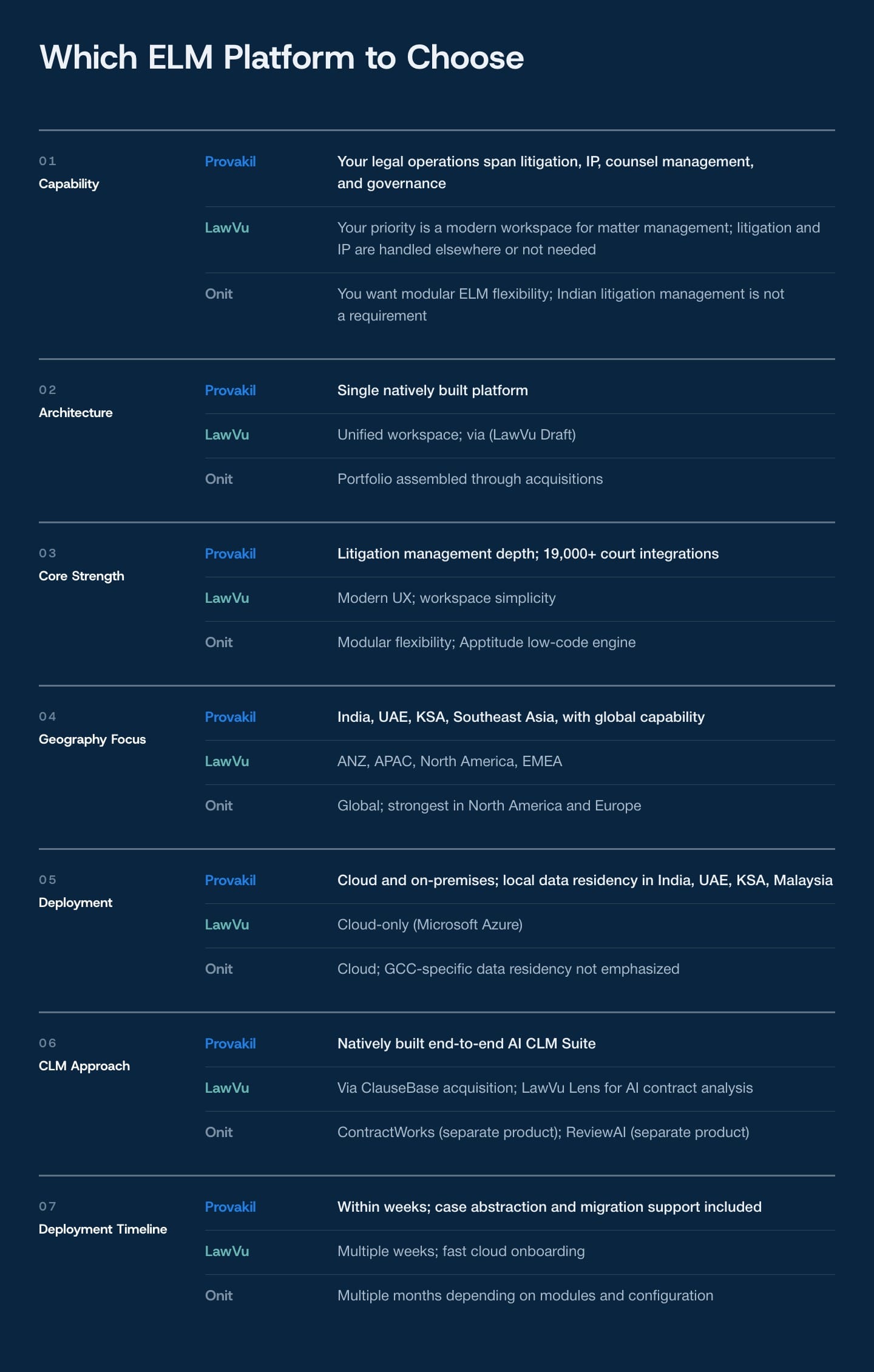
Choose LawVu when your priority is a modern workspace for matter management and contract handling in ANZ, APAC, or global markets; your legal operations do not require Indian court automation or litigation-specific intelligence; and cloud-only deployment aligns with your compliance posture.
Choose Onit when you want modular ELM flexibility, low-code workflow automation through Apptitude, and the ability to assemble a custom legal operations stack from enterprise and mid-market components, with Indian litigation management either handled by a separate system or falling entirely outside your team's operational scope.
The question is not which platform ranks highest on a feature list. It is which platform matches the jurisdiction, the regulatory environment, and the courtrooms where your legal team actually works.

The litigation management software market continues to branch into workspaces, portfolios, low-code engines, and AI layers. Every branch adds a new way to manage matters, review invoices, or automate a workflow. None of that branching changes the question Indian enterprise legal teams need answered first: does this platform connect to the courts, forums, and tribunals where our cases are listed, track the causelists that set our team's daily agenda, summarize the orders we receive in regional languages, and operate inside the regulatory environment we are accountable to?
Both platforms, LawVu and Onit, earned their respective markets through genuine product work. Neither market is India, the Gulf, or Southeast Asia, and neither platform was designed for the judicial infrastructure, regulatory frameworks, or litigation volumes that define daily legal operations in these regions.
Provakil was built for legal teams operating here, from the ground up, with 19,000+ court integrations, litigation intelligence, IP oversight, external counsel performance management, entity governance, and the deployment flexibility that Indian and GCC enterprises actually require.

For enterprises whose legal operations span litigation management, IP tracking, counsel oversight, and compliance across Indian courts and GCC jurisdictions, Provakil covers what both platforms offer individually plus the India-specific capabilities neither provides.
LawVu's workspace prioritizes simplicity and earns praise for adoption from teams focused on matter and contract management. Provakil covers a broader operational scope and greater configuration depth. The trade-off is breadth versus simplicity, and teams that need litigation, IP, and governance will find Provakil's depth more relevant.
Onit Unity combines OnitX and SimpleLegal into one architecture. Buyers should evaluate its current maturity directly with Onit. Even fully unified, court integration, causelist tracking, vernacular translation, e-stamping, and legal collections remain outside Onit's published roadmap as of 2026.
LawVu onboards in weeks through its cloud model. Onit's modular architecture can stretch deployment into multiple months depending on configuration. Provakil deploys within weeks, with contract abstraction and migration support for both cloud and on-premises environments.
SimpleLegal is a spend-first tool for mid-market legal departments with e-billing and CounselGO. For teams whose requirements extend beyond spend to include litigation tracking, IP management, or governance, Provakil covers a broader surface area on a single platform.

Dive deep into Provakil's numerous blog posts & discover how legal tech can streamline your litigation, contracts, IP, and notice management processes.