Provakil vs. Brightflag: Why One Spend Module Does Not Make a Litigation Management Platform
6 min read



Brightflag's entire product answers one question: what did your outside counsel bill you, and should you have paid it? Brightflag answers it well, with patented AI that reads invoice line items and a G2 profile that reflects genuine enterprise confidence.
But an enterprise legal management evaluation does not stop at invoices. It asks about litigation tracking, IP management, governance, compliance, court integration, and localization in the same conversation, and Brightflag has nothing for any of them.
Put Provakil vs Brightflag on the same ELM evaluation grid, and Brightflag fills one row while Provakil fills every row on the sheet. This comparison walks through exactly where those gaps sit and what they mean for your legal team.
Brightflag is a legal spend management and e-billing platform. Its AI reads narrative invoice line items to flag billing-guideline violations, enforces billing guidelines against outside counsel, benchmarks vendors, and manages budgets and accruals. A matter management module tracks tasks on outside counsel work, though it is not a system-of-record litigation platform with court integration or case tracking at portfolio scale.
Strip Provakil's Litigation Management Software down to what it covers on an ELM evaluation grid, and the picture is clear: spend management occupies one row, while litigation and matter management, IP, governance and compliance, and India and GCC localization sit on the other four rows with nothing from Brightflag on any of them.
The invoice AI is strong within its lane, but an ELM evaluation grades on five lanes, not one.
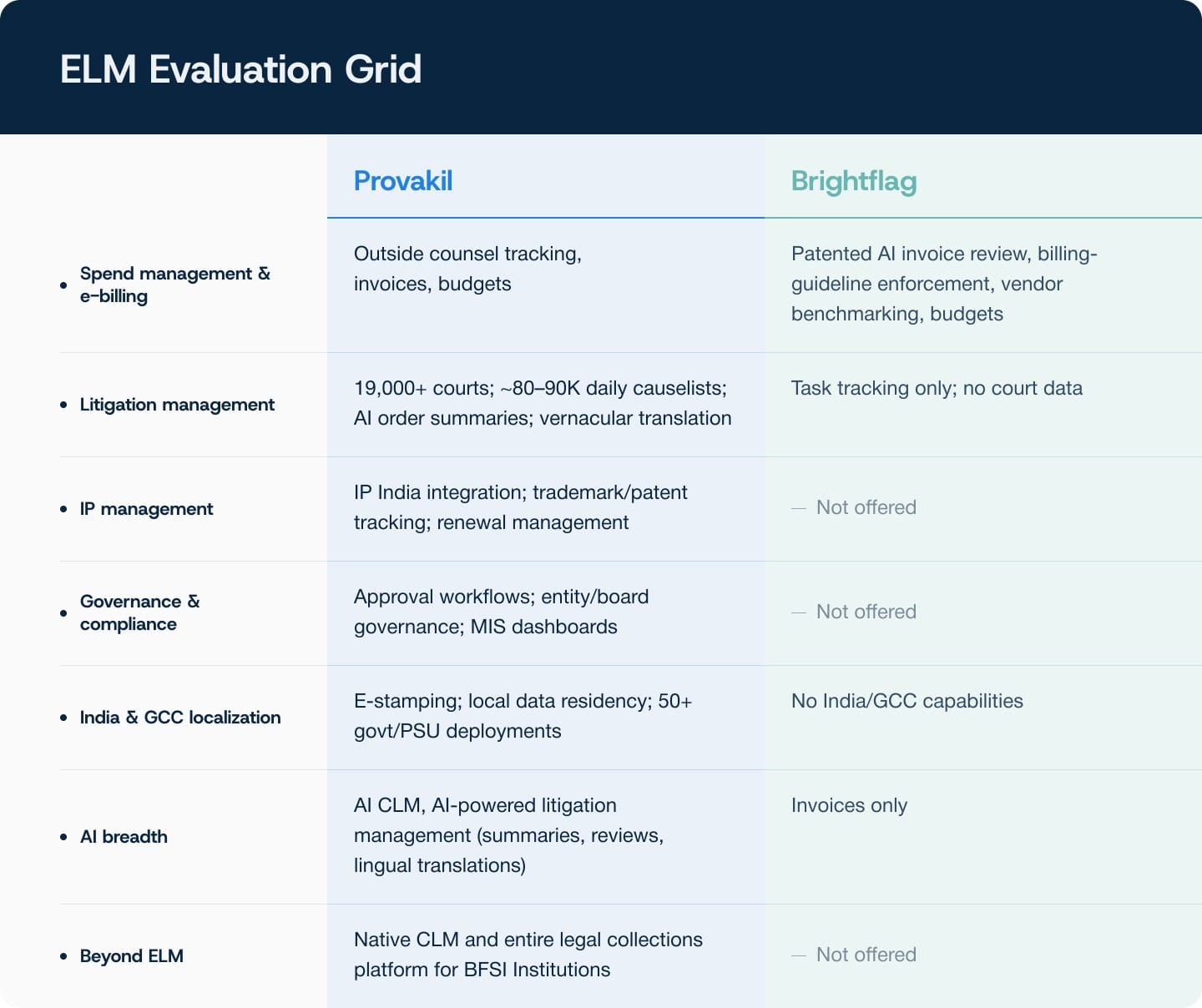
Provakil integrates with 19,000+ Indian courts and forums and tracks approximately 80,000 to 90,000 causelists every day. When a court passes an order, Provakil generates an AI summary and a vernacular translation and pushes both to the legal team handling that matter, the same day.
Brightflag's matter management tracks tasks for outside counsel work. It does not connect to courts, does not automate causelists, and does not summarize or translate judicial orders.
The gap between those two operating models lies in the shift from tracking administrative work to tracking litigation outcomes, and it is the largest distance between these two platforms on the evaluation grid.
Even against India-native platforms like Legistify that compete directly in litigation management, Provakil's court-integration depth and causelist automation set it apart; our comparison, the Provakil vs. Legistify head-to-head, covers it in detail.
Provakil also covers contract lifecycle management and legal collections on the same platform, both of which are entirely outside Brightflag's product scope.
Pick Brightflag for spend management, and you still need to source litigation management with court integration, IP tracking, governance, and localization from other vendors. Each carries its own licensing cost, implementation timeline, integration surface, and annual renewal conversation.
You end up managing four or five vendor relationships to assemble what a single ELM platform should cover natively.
Provakil covers spend management, litigation management, IP, governance, localization, CLM, and legal collections in a single contract with a unified integration surface.
For most buying organizations, the total cost of assembling a multi-vendor stack around Brightflag exceeds the cost of a single Provakil deployment that covers the full ELM scope, before you factor in the operational drag of managing that many vendor relationships year over year.
For legal teams operating in India, the Gulf, or Southeast Asia, the cost argument is secondary. The localization gap is the one that entirely removes Brightflag from the evaluation.
Brightflag offers no integration with Indian courts, no causelist automation, no local data residency for Indian or GCC jurisdictions, and no on-premises deployment for regulated industries. For a legal team headquartered in Malaysia, Singapore, Riyadh, or Dubai, these are not optional line items on a feature comparison. They are operational prerequisites that determine whether the platform can function in your environment at all.
Provakil offers cloud and on-premises hosting with local data residency across India, the GCC, and Southeast Asia. More than 50 Government entities and PSUs are already running on the platform, including IOCL, Govt. of Tamil Nadu, UGC, CRPF, DDA, and the Election Commission of India.
Brightflag asks you to solve every one of these requirements with additional vendors. Provakil ships them as defaults.
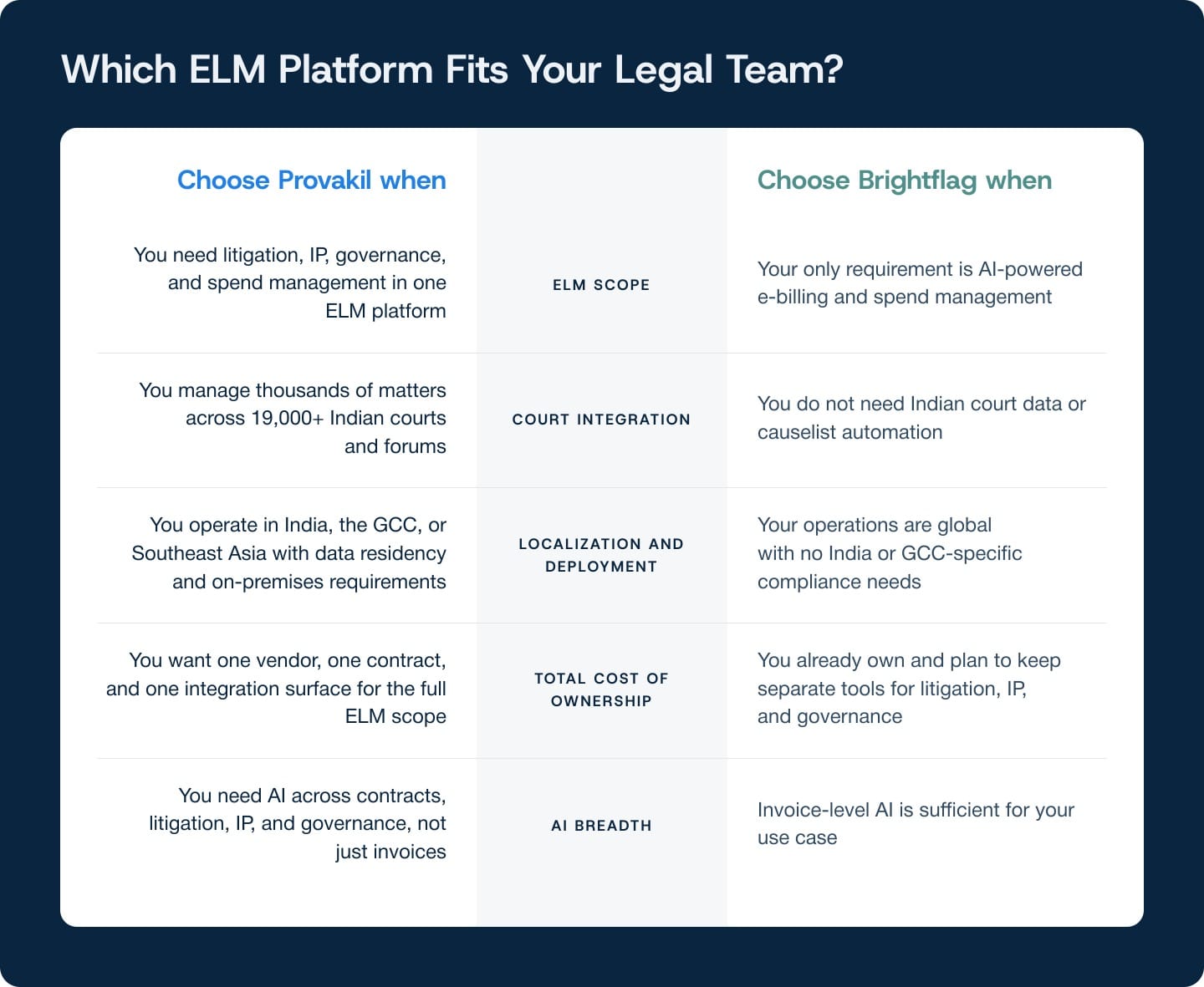
If your requirements extend beyond e-billing into any combination of litigation management, IP, governance, or India and GCC localization, Provakil covers them from a single platform with a single contract.
The only evaluation in which Brightflag is the right answer is one where the requirement begins and ends with AI-powered e-billing and outside counsel spend management. The team already owns and plans to keep separate platforms for everything Brightflag does not touch.

Sign with Brightflag, and your invoice review is handled on day one. But the questions that follow do not stop. Your GC will still ask who is tracking litigation outcomes across Indian courts. Compliance will still need governance workflows that report to the board. Your India or GCC office will still need court automation, e-stamping, and data residency from someone, and that someone will not be Brightflag.
Every one of those conversations either leads to another vendor, another contract, and another integration project, or it leads to one conversation with Provakil. That pattern holds whether you are comparing Provakil against a spend-management specialist like Brightflag or against global ELM incumbents like Mitratech TeamConnect.

Provakil holds ISO 27001 and SOC 2 certifications with cloud and on-premises deployment. Brightflag, now under Wolters Kluwer, carries enterprise-grade security. The differentiator between the two platforms is product scope, not security posture.
Provakil is positioned for deployment in weeks with contract abstraction and migration support. Brightflag's timeline depends on spend volume and the configuration of billing guidelines. Ask both vendors for scoped timelines against your specific requirements.
Technically, a team could run Brightflag for e-billing and Provakil for everything else. In practice, this creates two vendor relationships, two integration surfaces, and overlapping spend management functionality. Most teams evaluating both platforms are better served by consolidating onto Provakil, which natively covers spend management alongside the full ELM stack.
Yes. Provakil supports integrations with ERP systems, LMS, CRM, and IAM platforms. Brightflag also integrates with enterprise systems within its spend scope. Evaluate both against your existing tech stack during demos.
Provakil provides native iOS and Android apps with offline access for teams managing matters and causelists across courts. Brightflag is web-based. Mobile access to matters for teams operating across jurisdictions daily.

Dive deep into Provakil's numerous blog posts & discover how legal tech can streamline your litigation, contracts, IP, and notice management processes.