Provakil Among MGI's Top 15 CLM Vendors: What's Next for AI CLM Software in 2027?
7 min read



For most of the past decade, enterprises judged contract lifecycle management by how quickly a contract moved from request to signature. That yardstick is losing its hold, because AI now handles first-pass review in most platforms, and the contracts that cost companies money are usually the ones already signed.
MGI Research's CLM Top 35 Buyer's Guide 2026, published on October 23, ranks Provakil among the top 15 CLM vendors it rates globally and names Provakil as one of two suppliers whose rating improved meaningfully this year. Provakil is one of only 18 vendors in the guide to receive a full MGI 360 Rating.
For us, the recognition reflects a decade of building AI CLM software and legal operations technology for enterprises whose contracts span India, the Gulf, and a growing set of international markets. It also raises a more useful question for anyone planning a contract strategy for 2027: once AI is standard in every CLM platform, what separates the platforms that deliver value from the ones that only demonstrate it?
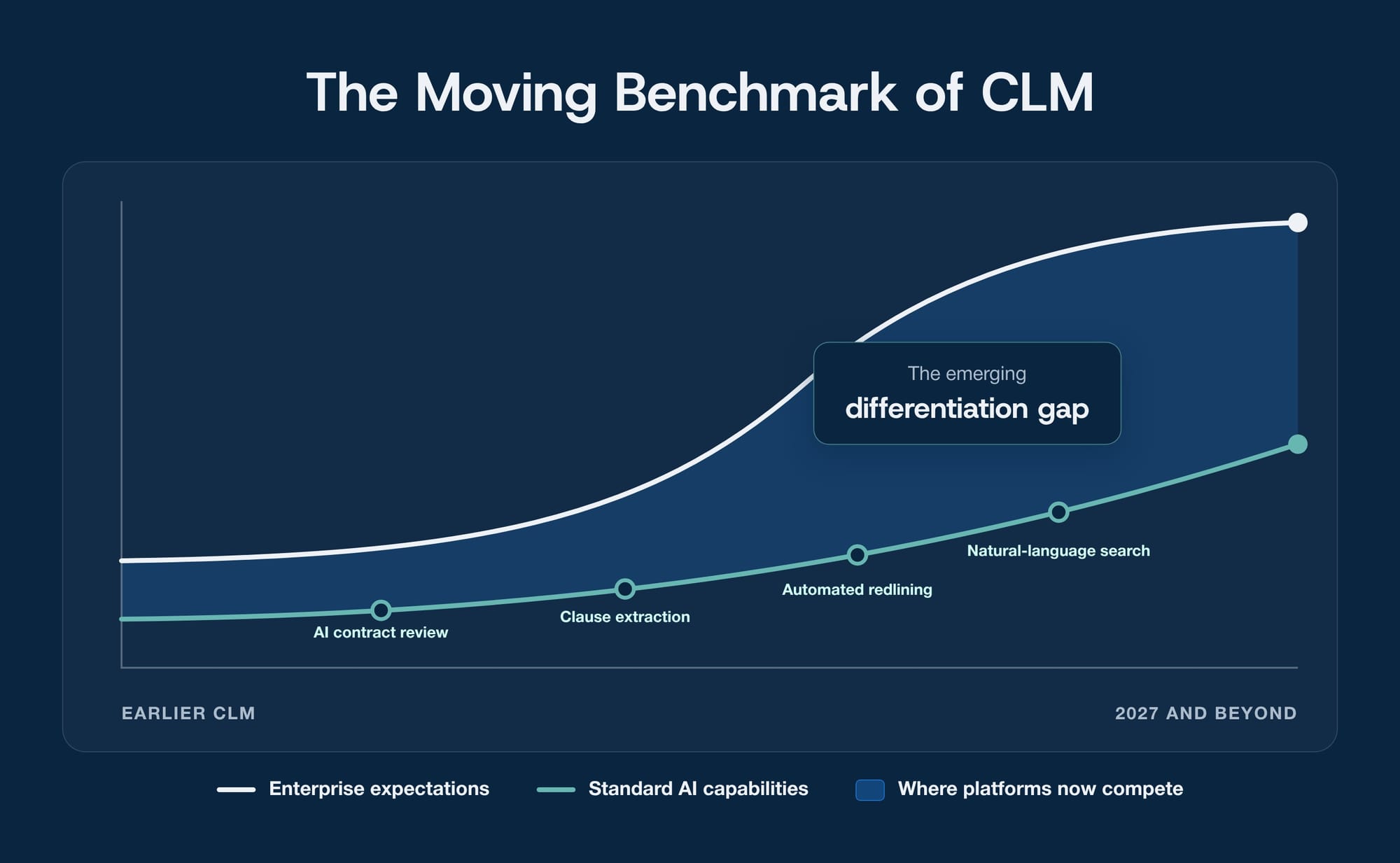
MGI estimates the CLM market is growing at roughly 15 to 20% a year, two to three times the rate of enterprise software overall. Growth tells only part of the story, though, because the capabilities that once set platforms apart have spread across almost all of them.
AI contract review, clause extraction, automated redlining, and natural-language search were advanced features a few years ago, and MGI now finds them in virtually every product it evaluates. AI presence therefore tells a buyer little about how a platform will perform on that buyer's own contracts, with their scanned legacy agreements and long amendment histories.
Implementation remains the other weak point. Nearly 40% of first-time CLM buyers replace their initial selection within 36 months, according to MGI, which suggests many enterprises bought features before they understood the work the system had to do. In 2027, the focus is likely to shift from acquiring more AI capabilities to finding platforms that deliver reliable intelligence, lasting adoption, and measurable business outcomes, and we see five developments driving that shift.
Drawing on MGI's findings and on what our enterprise customers now ask of their contracts, we expect these five developments to shape the next phase of CLM.
Most of the conversation about AI in contract management has centered on helping legal professionals draft, review, and summarize agreements faster. The next phase connects contract intelligence to business workflows, so AI CLM software identifies exceptions, surfaces risks, and starts the right action inside approval processes the enterprise already controls. Human oversight stays essential wherever legal judgment, commercial commitments, or sensitive decisions are involved, and the opportunity lies in removing needless manual steps without weakening accountability.
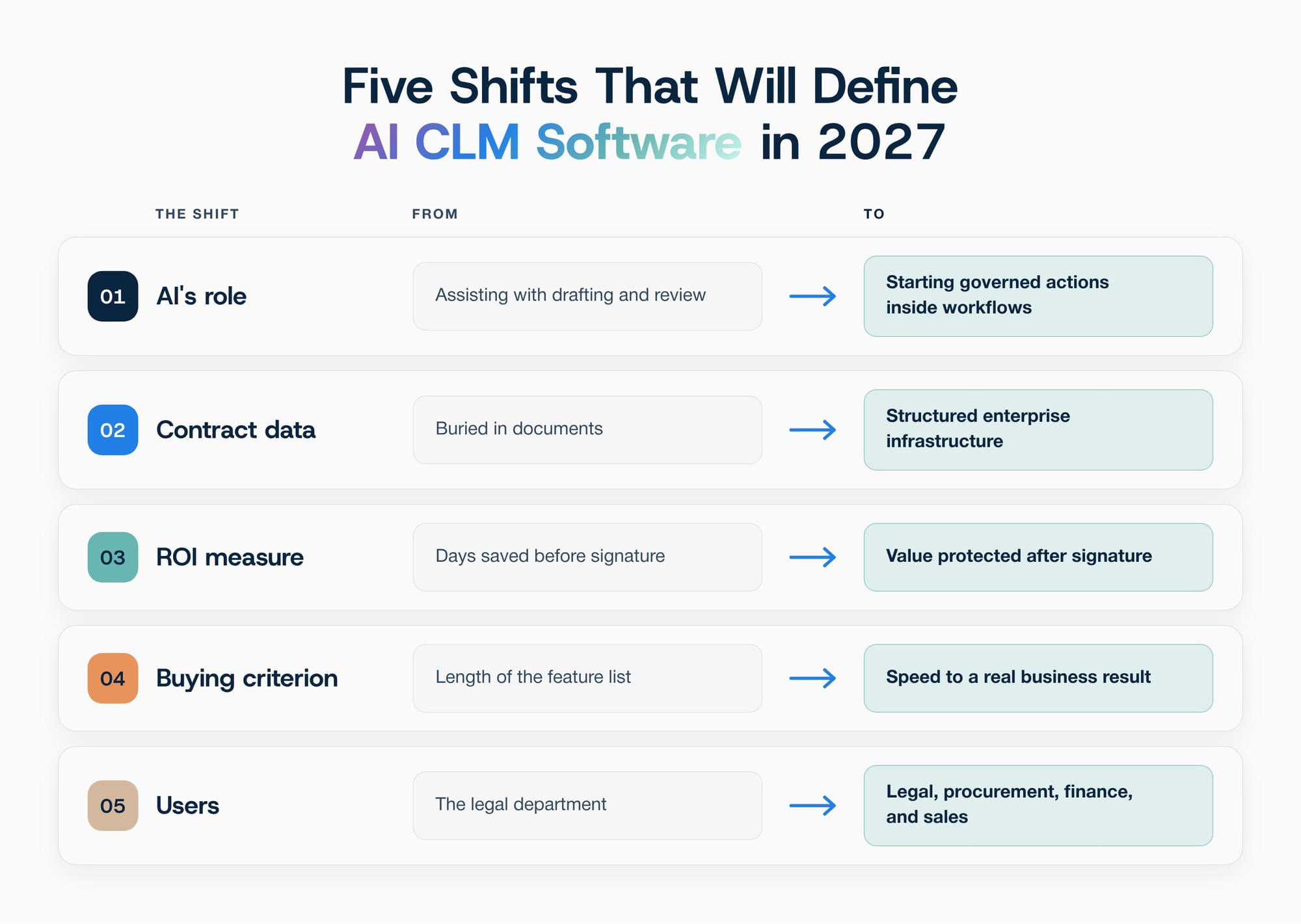
Every contract shapes how a business operates: pricing terms drive revenue, supplier commitments steer procurement, and service obligations set customer expectations. Much of that information still sits in unstructured documents, and as enterprises roll AI out across functions, contract data quality starts to determine answer quality. An AI system reading incomplete agreements or outdated amendments amplifies errors rather than resolving them. Centralized repositories, accurate metadata, linked amendments, and governed access will become the foundation for serious AI adoption in 2027, which is why Provakil extracts metadata at execution into a single contract record.
A faster signature does not make a contract more profitable. MGI estimates revenue leakage at a minimum of 3% of contracted revenue in organizations that cannot monitor and enforce their own terms, through missed renewals, unclaimed discounts, overlooked price adjustments, and unfulfilled obligations. Enterprises will expect post-signature contract management to keep those commitments visible for the whole contract term, and they will measure success by revenue protected, costs avoided, and value realized rather than days saved in negotiation.
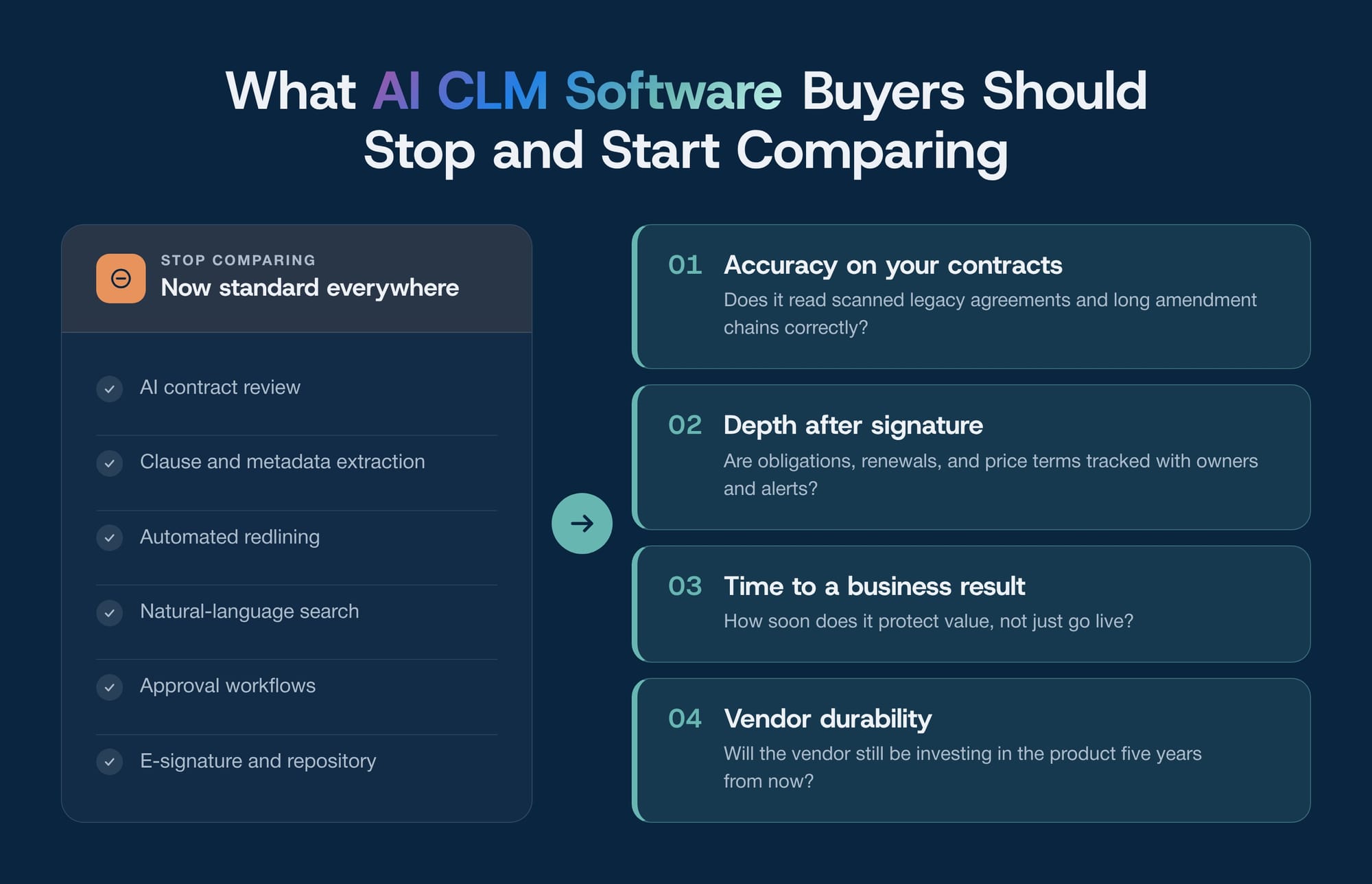
Enterprise software should solve operational problems without taking years to implement. AI-assisted extraction, faster legacy migration, configurable workflows, and automated document processing all shorten the path from purchase to use, provided they come with reliable data, sensible configuration, and real user adoption. In 2027, buyers will weigh how quickly a CLM platform delivers a practical business result more than the length of its feature list.
Legal teams oversee contracts, but the commercial consequences run across the organization. Procurement manages supplier commitments, finance watches payment terms and exposure, sales negotiates customer relationships, and operating teams deliver the promises. AI CLM software will increasingly serve all of them as a shared source of contract intelligence through governed access and integrated workflows, positioning CLM as an enterprise investment rather than a departmental productivity tool. For enterprises in India, that reach extends to litigation as well, since a contract that turns into a dispute should not lose its history on the way to court.
Provakil's contract lifecycle management software starts from a simple position: contract information should stay accessible, actionable, and relevant from the first draft to the final renewal.
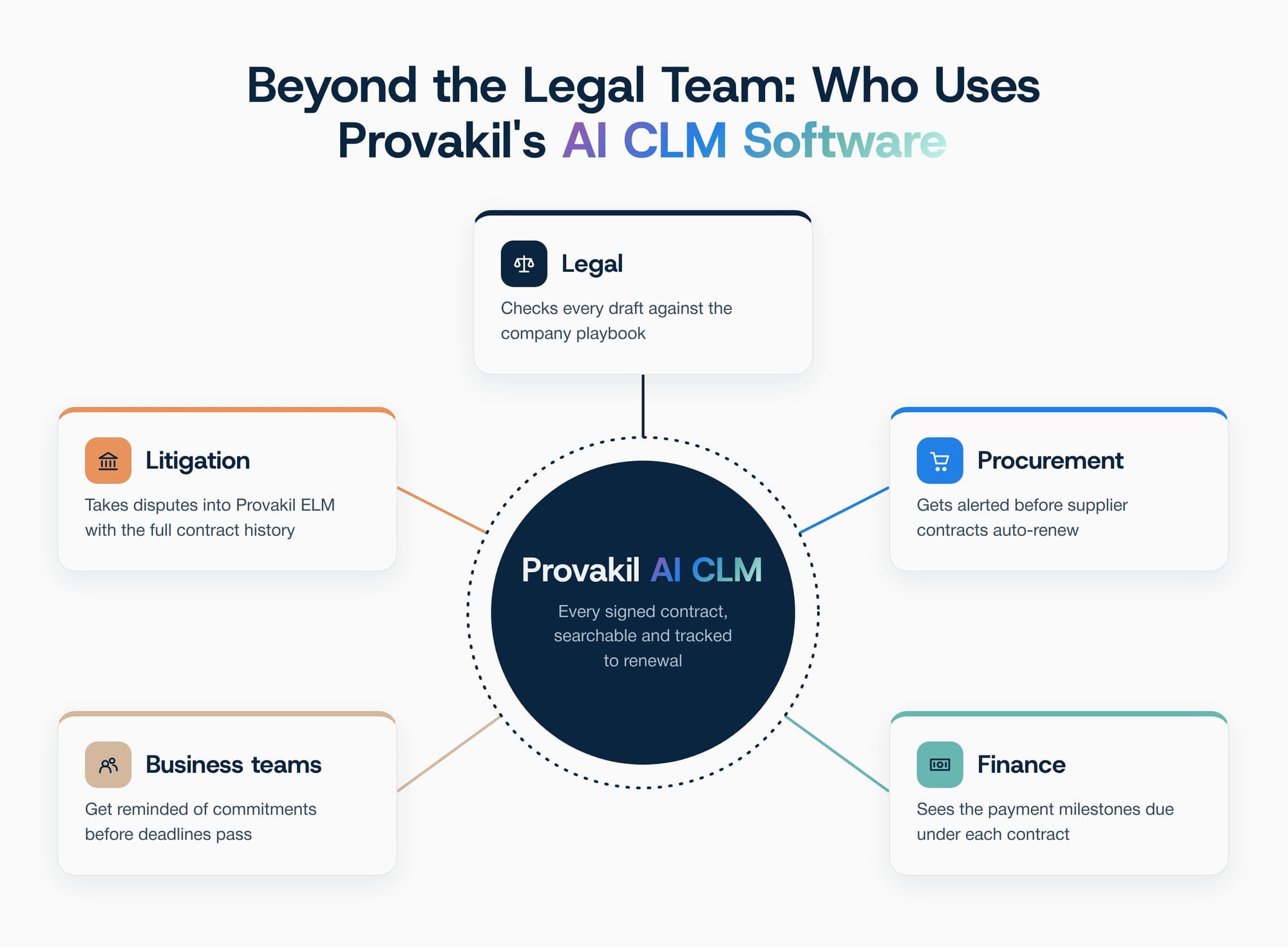
Provakil's AI CLM software:
MGI's assessment also points to the company behind the platform. Provakil is founder-led and bootstrapped, profitable without outside capital, and retains more than 90% of its enterprise CLM customers, which matters in a market where five of the 18 rated vendors have changed ownership since mid-2024. Enterprises can run Provakil on-premises, in the cloud, or as a managed service, depending on their data-hosting requirements.

The next chapter of AI Contract Lifecycle Management will be defined by what enterprises accomplish with their contracts, not how efficiently they file them. AI will play a central role, but its value will depend on reliable data, disciplined implementation, and a clear link to real business needs.
Through 2027, our focus at Provakil stays on helping enterprises contract with confidence, manage commitments before they become surprises, and realize more value from every agreement. A practical first step is to list the obligations your team still tracks from memory, then see how many a structured contract record would catch; teams weighing global platforms can start with our comparison of Provakil and Icertis.

Traditional contract management software mainly stores agreements and runs predefined processes. AI CLM software can read contract language, extract key data, flag risky or non-standard clauses, and track obligations, so teams act on contract terms instead of only filing the documents that contain them.
Provakil supports contracting for enterprises in India, the UAE, KSA, and Malaysia, with India as its primary market. Provakil ELM provides automated court and forum updates for Indian forums only; outside India, it manages disputes in a structured matter workspace rather than through a court-data feed.
Enterprises can build proprietary CLM systems on AI models and internal engineering resources. The full cost includes ongoing maintenance, security, system integrations, model performance monitoring, and regulatory change, all of which should be weighed against a vendor subscription over a multi-year horizon before deciding to build.
Check how a vendor handles encryption, data residency, model training on customer data, retention, access permissions, and security certifications. Then include those commitments in the vendor agreement, with a clear statement on how the vendor processes, stores, and returns contract data at the end of the term.
Full-lifecycle AI CLM software supports buy-side agreements, such as procurement and supplier contracts, alongside sell-side agreements, such as customer and service contracts. Assess whether a platform handles the distinct approval paths, templates, and commercial terms of each category rather than forcing both through one workflow.

Dive deep into Provakil's numerous blog posts & discover how legal tech can streamline your litigation, contracts, IP, and notice management processes.