Evaluating Litigation Management Software: How Provakil Compares to the World's Biggest ELM Platforms
6 min read



Most platforms that surface in enterprise evaluations for litigation management software are not, strictly speaking, litigation management software. Thomson Reuters Legal Tracker, LexisNexis CounselLink+, and Wolters Kluwer Passport are e-billing and spend-analytics platforms with attached matter-management modules.
They are very good at tracking invoices, benchmarking counsel rates, and telling you where your legal budget went last quarter. What they do not do is track litigation: no court integrations, no automated causelists, no hearing-date alerts, no AI-generated order summaries.
Provakil does all of that across 19,000+ Indian courts and forums, with AI-powered case tracking, vernacular order summaries, and IP management built into a single platform.
Thomson Reuters Legal Tracker has been in the category for over fifteen years, and its core function is AI-powered invoice auditing and spend benchmarking against one of the industry's larger datasets.
If your legal operations question is "are we paying outside counsel the right amount," Legal Tracker has been answering that specific question for a while now. It also offers matter management with intake workflows, but the platform's center of gravity remains firmly on the billing side of the house.
LexisNexis CounselLink+ wires e-billing and matter management into the LexisNexis research ecosystem. The positioning is operations plus legal research, though "operations" here still means invoices and matters. Its Protégé AI assistant handles summaries and recommendations across the platform, and SmartReview automates invoice compliance checks.
Wolters Kluwer Passport is the most configurable of the three, with a modular architecture that extends into insurance claims defense and competitive bidding through LegalCollaborator. It covers a wide scope, provided you measure it by variations in spend management.
All three orbit around the same center of gravity: outside counsel billing.
That is the category they built, and they built it well. The question is whether the category they built is the same thing as the category your legal team actually needs.
The table below covers what each platform offers natively. The section that follows explains only what the table cannot.
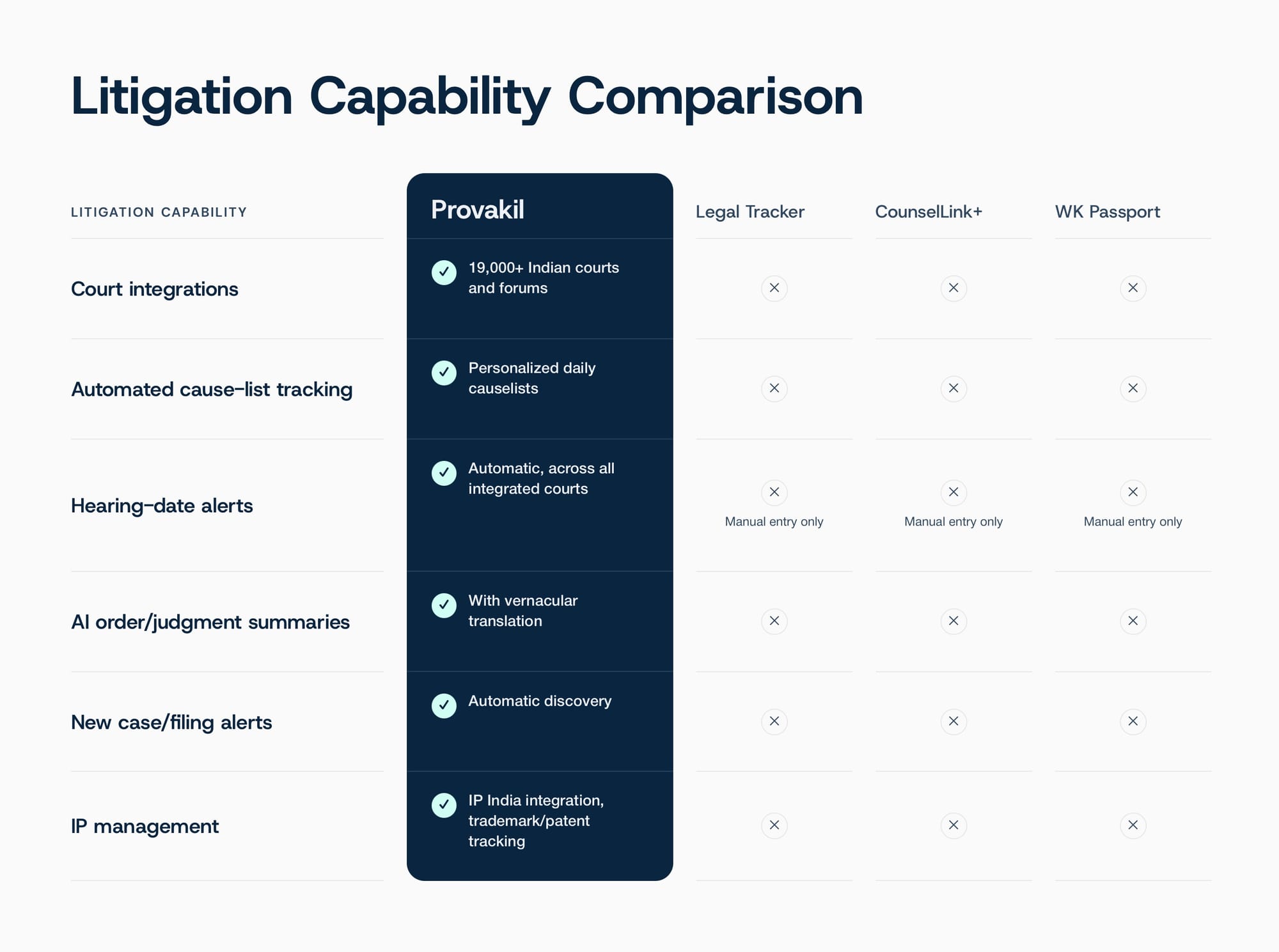
The difference between Provakil and these three platforms on litigation management is not a feature gap that a future update will close. It is architectural.
Matter management is not litigation management. All three global ELMs offer matter management, and they do it competently. However, they fail to tell you that your case was listed on tomorrow's supplementary causelist, or that an order was passed yesterday in a matter you are tracking at NCLT. Those are litigation management functions.
None of these platforms perform them because they were never architected to connect with courts.
Provakil's litigation module does not just store case metadata; it pulls live data from 19,000+ courts and forums, generates personalized causelists daily, sends hearing-date alerts automatically, and produces AI summaries of orders and judgments, including translations of vernacular court documents into English.
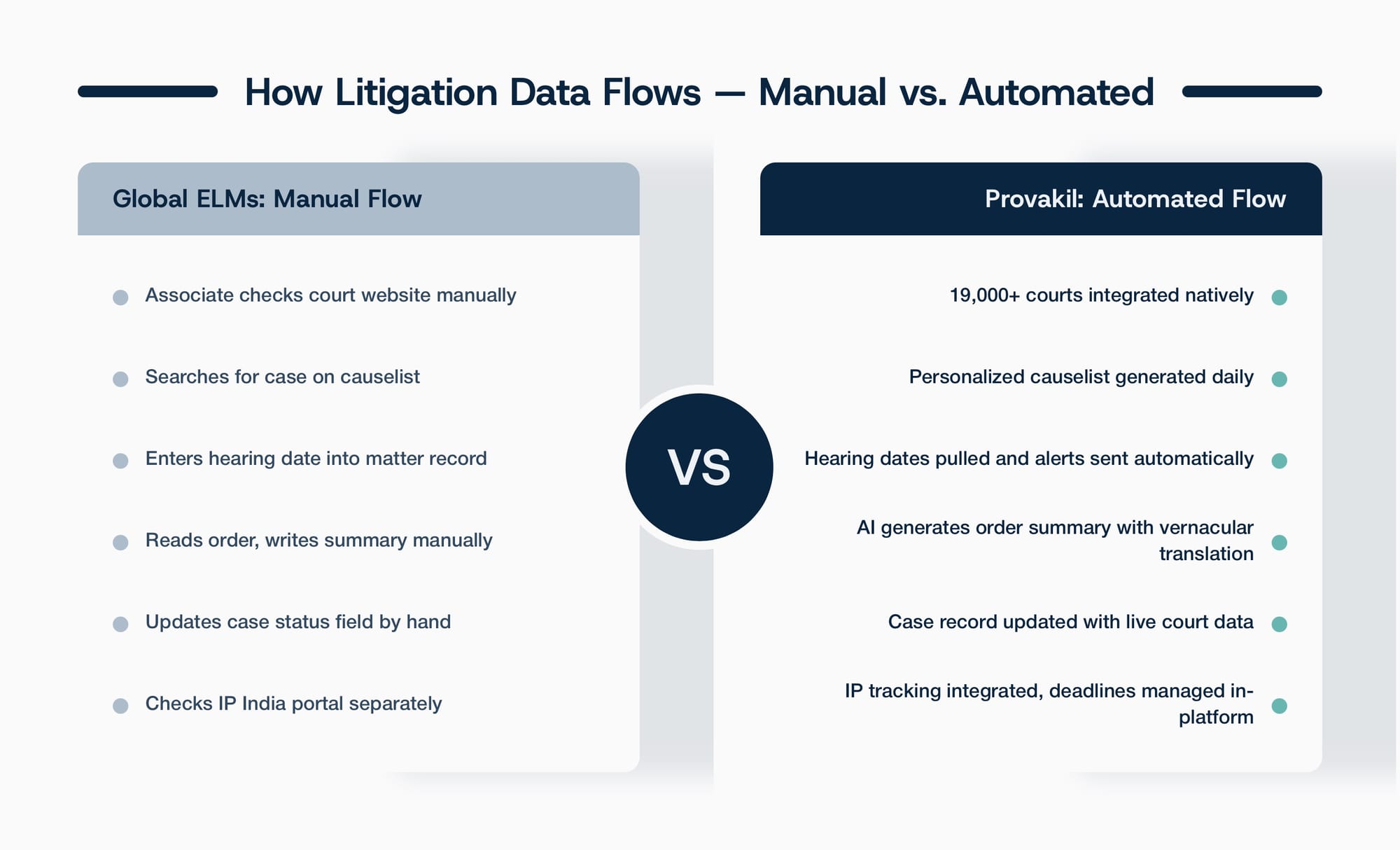
IP management is absent across the board. If your legal team manages trademarks, patents, or design registrations, none of the three global ELMs offer IP tracking or integration with IP India.
Provakil handles IPR management natively, including trademark watch, patent tracking, and deadline management, within the same platform where your litigation and matters already live. When a trademark opposition deadline coincides with a hearing at NCLT, your team sees both in the same system instead of toggling between an IP spreadsheet and a matter tracker that has no awareness of the other.
Global ELM implementations are not quick. Passport's deep configurability, Legal Tracker's enterprise onboarding, and CounselLink+'s integration with the broader LexisNexis ecosystem all have timelines that typically span quarters.
For large enterprises with dedicated IT teams and no urgency, that may be acceptable. For legal departments that need court tracking live before the next hearing cycle, it is a problem.
Provakil deploys in weeks, with cloud or on-premises options and migration support included. Every week your litigation tracker is not live is a week your team is manually refreshing court websites and reconciling causelists by hand.
The answer depends on what "legal operations" actually means in your organization.
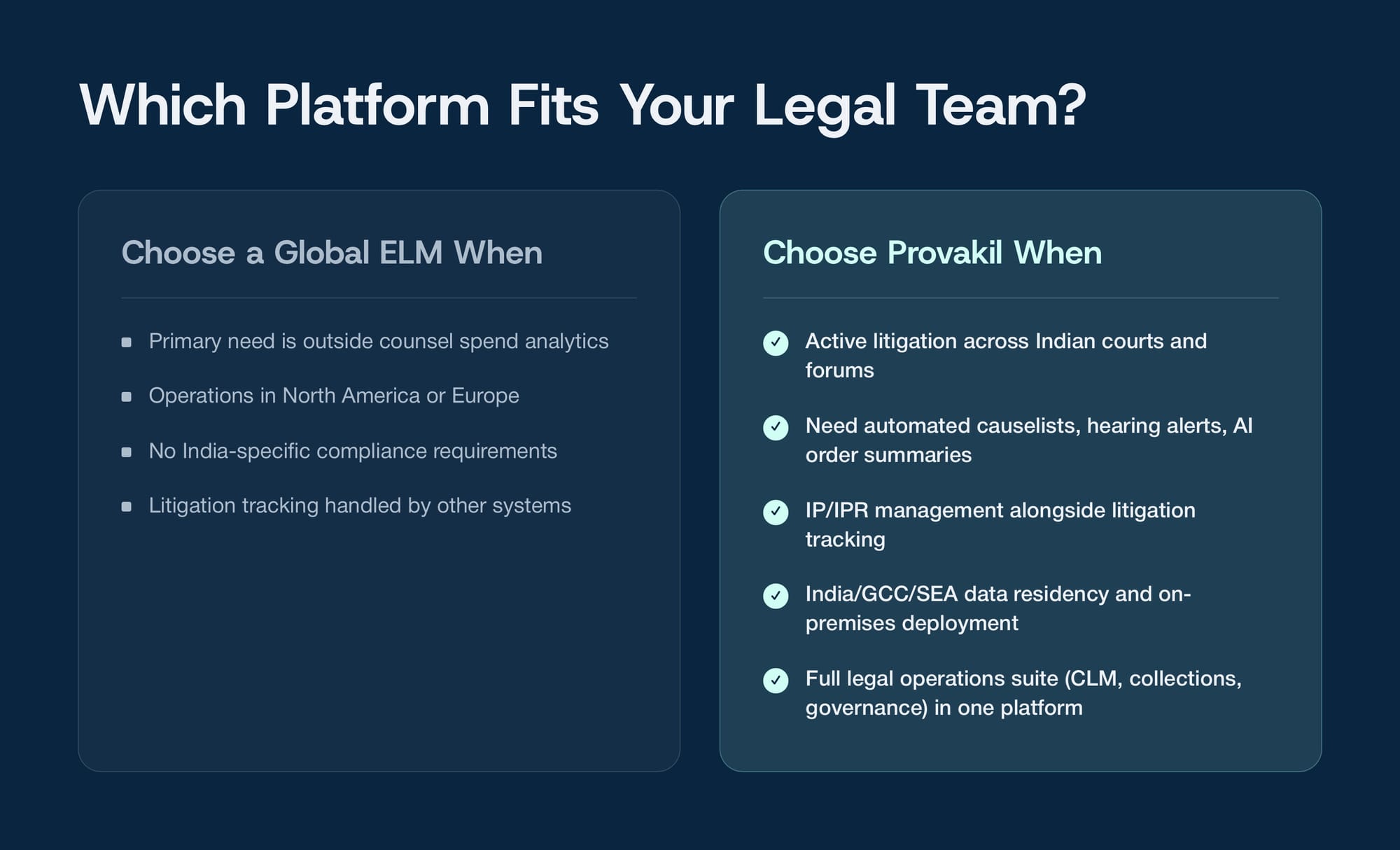
If your department's primary workflow is tracking outside counsel spend across a global firm network, and your operations sit in North America or Europe without India-specific compliance requirements, the global ELMs have been doing that for a long time.
However, if your legal operations involve litigation management across Indian courts or compliance workflows for India and the Gulf, you need a platform that was designed for that scope from the start.
Acquiring or bolting on capabilities after the fact does not yield the same result as building them natively, and no amount of configurability can compensate for functionality that simply is not there.

Thomson Reuters Legal Tracker, LexisNexis CounselLink+, and Wolters Kluwer Passport earned their place in the enterprise legal technology landscape by solving a real problem: outside counsel spend was opaque, and legal departments needed visibility into where the money was going.
But the category started calling itself "enterprise legal management" while continuing to manage mostly invoices. Litigation management, the part where cases are actually won or lost, stayed a manual process of court-website refreshes and spreadsheet trackers. That is not a product limitation; a future update will close it. It is a consequence of building for a market where courts were never part of the workflow.
Provakil was built for the market it serves. The architecture starts from the courtroom outward, not from the invoice inward.

For legal teams that need active litigation tracking across Indian courts alongside matter management and spend oversight, Provakil is designed as a full-scope replacement. For departments whose workflow centers entirely on global outside counsel spend analytics with no India-specific or litigation-specific requirements, the incumbents serve that narrower function.
No. None of the three offer Indian court integrations, automated causelist updates, hearing date alerts, or AI-generated order summaries for Indian tribunals and forums. Provakil natively integrates with 19,000+ Indian courts and forums.
Matter management tracks case metadata your team enters manually: documents, tasks, budgets, status fields. Provakil's litigation management pulls live data from courts, automatically generates daily cause lists, sends hearing alerts, produces AI-generated order summaries in vernacular languages, and tracks IP registrations. The court data feeds into the system without your team serving as the data-entry layer.
Global ELM implementations typically run on enterprise timelines measured in quarters. Provakil deploys in weeks, with cloud or on-premises options and migration support included.
Yes. Provakil covers AI-powered CLM, BFSI legal collections, entity and board governance, and compliance workflows for India and the Gulf on a single platform. This series will compare those capabilities against global ELMs in upcoming posts.

Dive deep into Provakil's numerous blog posts & discover how legal tech can streamline your litigation, contracts, IP, and notice management processes.