How to Calculate the ROI of AI Contract Management Software
6 min read



Most contract management platforms lead with eye-catching ROI figures, and the numbers vary wildly depending on who commissioned the study. A leading CLM software provider claims 324% return on its CLM platform, while a Forrester TEI study puts the figure at 449%. Those percentages work well in board decks, but they fall apart when a CFO asks how they map to your contract volumes, your team's loaded costs, and your actual turnaround times.
Contract management ROI measures the financial return from automating and standardizing your contract processes. It breaks into four categories: direct cost savings, cycle time reduction, leakage prevention, and risk mitigation. A credible model accounts for all four using your organization's real numbers.
A defensible calculation separates hard-dollar savings from soft-dollar value. Hard-dollar savings include FTE hours recaptured, reduced outside counsel spend, and eliminated printing and courier costs. Soft-dollar value translates to faster deal velocity and a better compliance posture.
Where your organization falls on the leakage spectrum matters more than most teams realize. World Commerce & Contracting puts average contract value leakage at 8.6%, with top performers at 3% and underperformers above 20%. The distance between your current leakage rate and best-in-class is the single biggest variable in your ROI model.
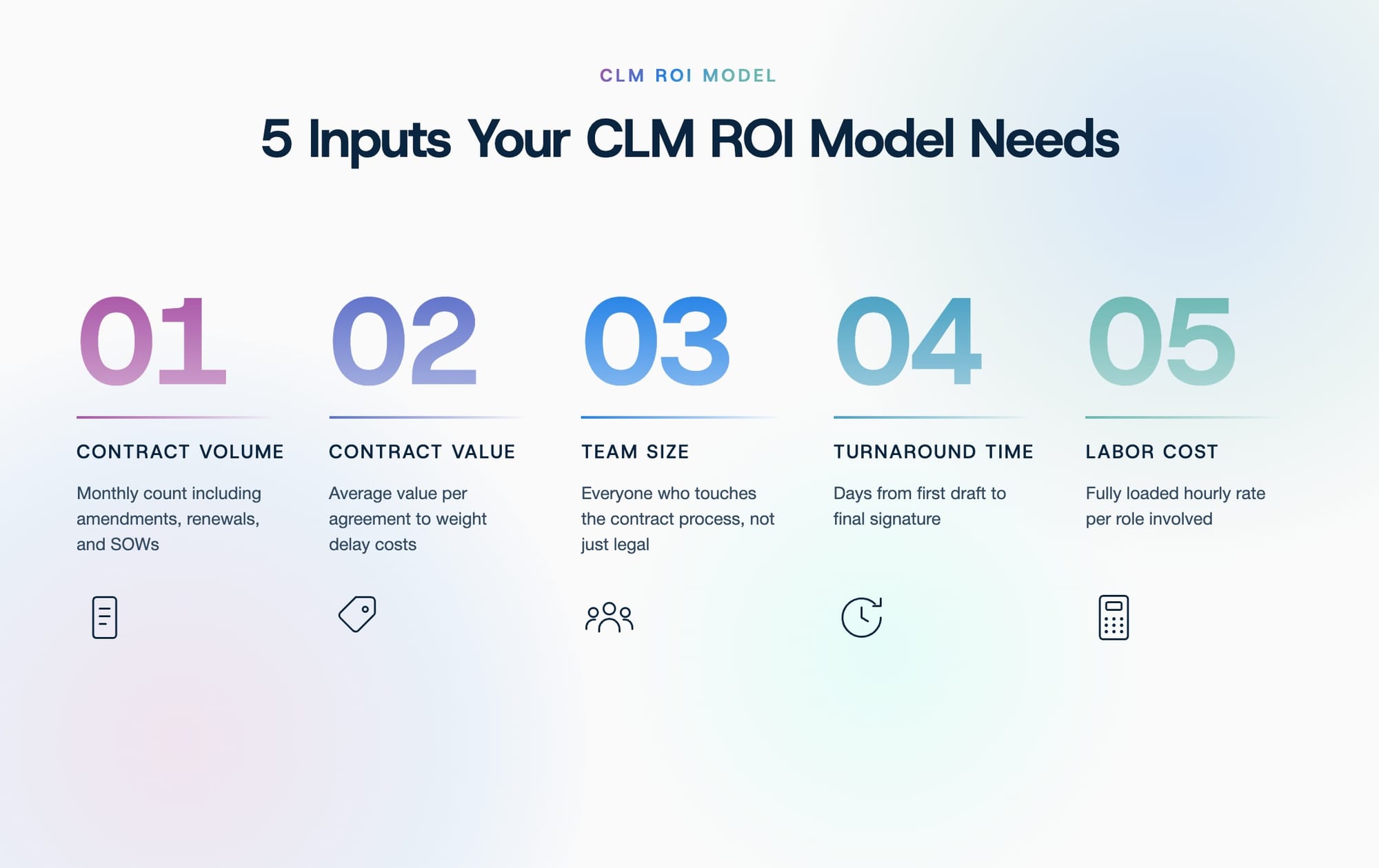
Before you open any calculator, your team needs five baseline numbers.
Count every agreement your team touches: amendments, renewals, SOWs, not just net-new contracts. Most organizations undercount by 30-40% because they miss agreements that flow through procurement or sales without legal review.
A 10-day delay on a $5,000 NDA is annoying. A 10-day delay on a $500,000 vendor agreement has a quantifiable revenue impact. This number weights the financial cost of every bottleneck in your process.
Everyone who touches the contract process, not just legal. Procurement, contract administrators, approving business stakeholders, and post-signature finance staff all count. Provakil's ROI Calculator uses this input, along with volume, to estimate the FTE capacity freed by automation.
Days from first draft to final signature. ACC and CLOC benchmarks indicate that the average B2B contract lasts 3-4 weeks. A longer TAT means greater cycle-time savings in your model.
Fully burdened cost (salary, benefits, overhead) for each role involved in contracting. At a $200/hour loaded rate, 10 hours of legal review per contract across 1,000 annual contracts represents $2 million in review capacity.
AI removes the hours spent on work that requires no judgment: template-based drafting, approval routing, signature chasing, filing, and renewal reminders. Provakil's AI CLM software handles these end-to-end, from standardized templates through approval workflows and integrated e-signing.
Provakil's model applies a standard TAT reduction benchmark. An organization averaging a 30-day turnaround can expect contracts closing 12 days faster. World Commerce & Contracting research shows that up to 9% of contracts are affected by delays significant enough to change deal outcomes.
Missed auto-renewals, unenforced obligations, and overlooked payment terms are real dollars your current process leaves on the table. Provakil's Contract Intelligence scans your portfolio to flag unfavorable clause patterns and predict renewal risk before obligations become liabilities.
The hard part is the data underneath it, because you can't claim hours saved or renewals captured when contracts sit scattered across drives and inboxes. Provakil AI CLM Software is built to close that gap. It reads agreements you already hold and automatically extracts key terms, dates, and obligations, so the data behind your ROI is captured automatically rather than keyed in by hand.
Renewal and obligation tracking surfaces deadlines well before they lapse, and that early warning is where most recovered revenue comes from. Because the platform plugs into the tools your contracts already pass through, those numbers stay up to date without anyone having to export a spreadsheet. Reporting then pulls all of it into dashboards that hand finance the hours saved and the value protected as figures rather than anecdotes.
AI-native CLM reduces the per-contract cost of review and risk assessment. Provakil's Contract Intelligence Software scans agreements, flags risky clauses, suggests playbook-based rewrites, and extracts metadata in seconds. Industry benchmarks show an average time savings of 63% compared to manual review.
AI also compounds returns over time. The models improve as they process more of your contracts, surfacing sharper risk signals with each cycle. Year-two ROI grows as the system expands across contract types and departments. The AI CLM Handbook breaks down how these capabilities translate to financial outcomes across the contract lifecycle.

Contract management ROI is a framework built on your baseline data, not a vendor's headline number. Start with honest inputs, separate hard-dollar savings from narrative value, and present conservative models that finance can verify. Run your numbers through Provakil's CLM ROI Calculator before the budget conversation.

Payback depends on your contract volume and how much manual work the software lifts off your plate, though many teams recover their first-year cost within six to twelve months. Adoption is the real lever, because the faster your team moves contracts out of email and spreadsheets and into the system, the sooner saved hours and captured renewals cover the spend.
There isn't a single universal benchmark, but a healthy first-year return often ranges from 30% to 100% and tends to climb in later years as the one-time implementation cost fades. Rather than chase a headline figure, build the number up from your own costs and gains so it survives scrutiny, because a defensible 40% you can explain beats a 300% claim nobody in the room believes.
Value leakage is money you quietly lose to missed renewals, overlooked discounts, vendor contracts that auto-renew unnoticed, and obligations that slip through. To put a figure on it, audit a sample of your contracts for missed deadlines and unenforced terms over the past year, then annualize that cost across your portfolio.
CFOs should focus on four categories: contract cycle time, administrative cost per contract, leakage rate, and compliance incident frequency. Establish baseline measurements for each before implementation, then track quarterly post-deployment to validate the ROI projection.
A CFO-ready business case needs five components. Start with a current-state cost analysis that shows the organization's current contracting costs. Add projected savings broken out by time, cost, risk, and revenue. Include the total cost of ownership for the platform, covering licensing, implementation, and change management. Present an expected payback period with both conservative and optimistic scenarios. Close with a post-implementation measurement plan that specifies which metrics you will track to validate the projection.

Dive deep into Provakil's numerous blog posts & discover how legal tech can streamline your litigation, contracts, IP, and notice management processes.