The Invisible Crisis in Legal Collections Management and Its Impact on BFSI Recovery Performance
7 min read



Between 2000 and 2015, a US-based multinational energy company paid its external legal counsel over $4.4 million for legal services that were never performed.
An in-house tax lawyer created phony invoices for work purportedly completed by external counsel but actually done by the in-house lawyer himself. For fifteen years, nobody noticed.
Thousands of kilometers away, India's Comptroller and Auditor General has repeatedly flagged similar patterns across public-sector institutions: irregular payments of legal fees, inadequate verification of services rendered, and a lack of documentation linking costs to outcomes.
These are not just billing anomalies; they are structural signals. Similar patterns can emerge across any litigation-heavy environment where external counsel operates without structured oversight. But in collections, the impact is far more immediate and financially consequential; it directly impacts recoveries and resolutions, cash flow, and financial outcomes.
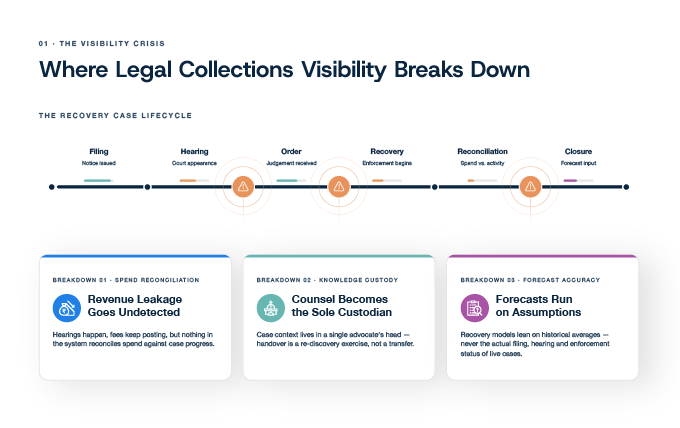
An advocate bills for eight court appearances across thirty SARFAESI cases in a single month. Without a centralized hearing log, there's no way to verify whether those appearances occurred, were adjourned, or were never scheduled. Each overbilled appearance might represent thousands in fees, which are trivial on their own. Multiply that across a panel of 20 advocates managing 500 active cases, and the unverified exposure runs into crores annually. It doesn't show up as fraud in any report. It simply disappears into the gap between what was claimed and what could be confirmed.
When advocates become the sole custodians of case knowledge, enterprises gradually lose operational control over legal recovery. Switching counsel mid-case becomes too risky because critical information, history, and case movement remain dependent on individuals rather than systems. Over time, this also makes it difficult to measure advocacy performance, since timelines, case progress, and recovery outcomes are not captured in a structured, comparable format.
Just like the examples discussed earlier, institutions often continue operating on reported progress without a structured way to verify how matters are actually moving. Finance and collections teams build recovery forecasts based on periodic updates, assumptions, and historical averages. At the same time, the actual status of filings, hearings, adjournments, and enforcement actions remains fragmented across emails and communications with external counsel.
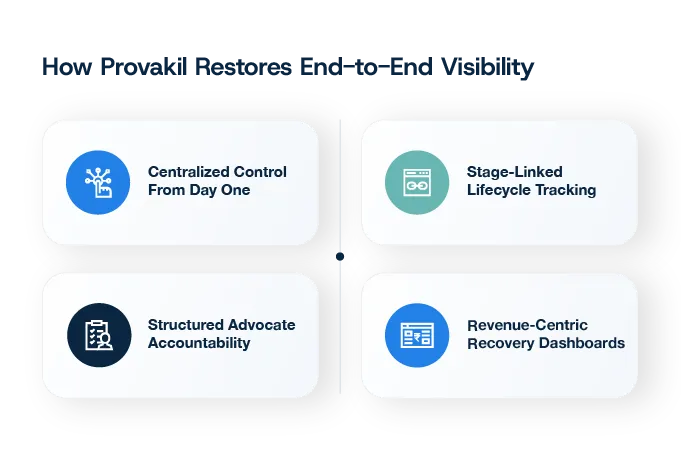
Provakil transforms legal collections from an advocate-dependent process into a system-led recovery engine. By structuring every stage, from data ingestion to enforcement, the platform restores visibility, accountability, and control across the legal collections lifecycle.
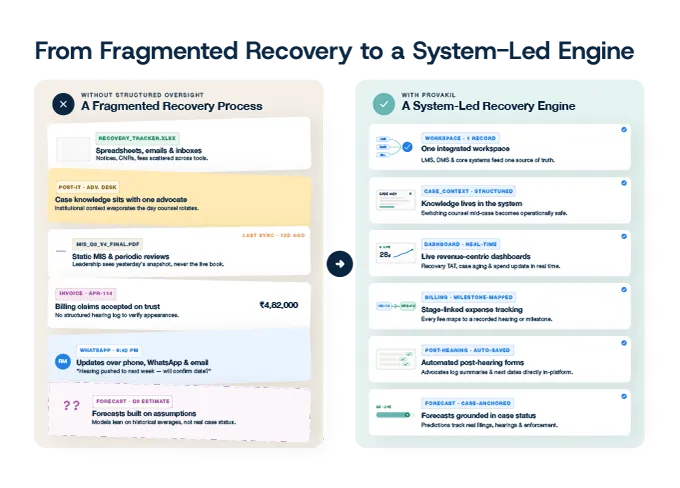
Provakil integrates directly with LMS and core systems to fetch delinquent account data into a unified workspace. All accounts, notices, filings, CNR numbers, and case statuses are captured in a single structured repository. No parallel spreadsheets or fragmented email trails. Collections and legal teams operate from a single source of truth.
Each legal action, from SARFAESI to arbitration to Section 138/25 proceedings, is mapped to predefined recovery stages within Provakil. Empaneled advocates receive controlled external access to update filings, hearing outcomes, compliance actions, expenses, and supporting documents directly within the system.
From case initiation to dismissal, settlement, win, or recovery closure, every movement is captured against structured milestones, creating a single source of truth for all legal recovery matters across courts and forums.
Provakil brings accountability into legal collections without disrupting advocate workflows. Legal managers can trigger automated emails requesting advocates to complete structured hearing update forms immediately after proceedings. Hearing summaries, next dates, documents, and case developments are recorded directly within the platform, ensuring institutional access to case knowledge at all times rather than relying on fragmented communication.
Provakil gives collections and legal leadership a real-time view of the entire recovery portfolio through centralized, revenue-focused dashboards. Teams can track recovery status, pending actions, stage-wise case distribution, hearing movement, bottlenecks, advocate responsiveness, and portfolio exposure across courts and forums from a single interface.
Instead of relying on static MIS reports and periodic review meetings, institutions gain live operational visibility into how legal recovery is actually progressing. Recovery TAT, escalation efficiency, case aging, legal spend, and cost-to-recovery ratios become instantly measurable, enabling faster intervention, sharper forecasting, and more informed recovery decisions at scale.
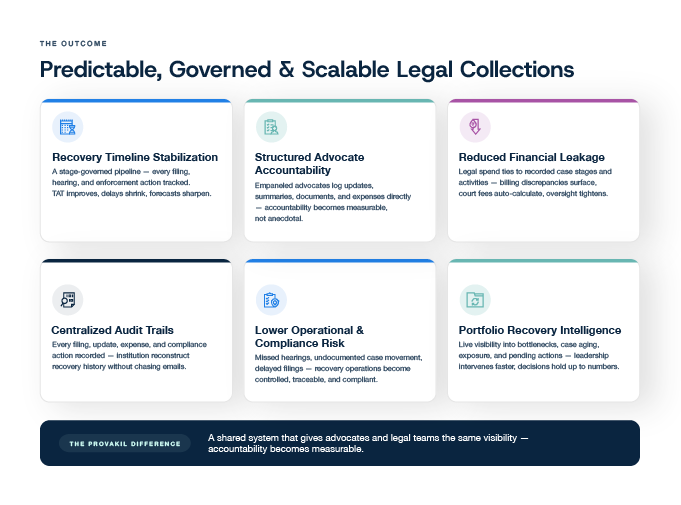
With Provakil, legal collections becomes a stage-governed recovery pipeline where every filing, hearing, adjournment, and enforcement action is tracked within a centralized system. Teams can see exactly where each matter stands, helping institutions improve recovery TAT, reduce delays, and forecast recoveries more accurately.
Provakil brings empaneled advocates into a controlled ecosystem where case updates, hearing summaries, documents, and expenses are recorded directly within the platform. This creates measurable accountability across timelines, responsiveness, and recovery, rather than relying on informal updates and fragmented communication.
By linking legal expenses to actual case stages and recorded activities, institutions gain better control over recovery-related spending. Automated court fee calculations and structured expense tracking help reduce billing discrepancies and improve financial oversight across large legal portfolios.
Every filing, hearing update, expense entry, document upload, and compliance action is recorded within the system, creating a complete audit trail across the legal collections lifecycle. Institutions no longer depend on scattered emails, spreadsheets, or individual case handlers to reconstruct recovery history.
Provakil helps institutions reduce risks arising from missed hearings, undocumented case movement, delayed filings, and dependency on external counsel for critical case information. With centralized visibility and stage-linked tracking, recovery operations become more controlled, traceable, and compliant.
Collections and legal leadership gain real-time visibility into portfolio-wide recovery movement, bottlenecks, case aging, pending actions, and exposure concentration. This enables faster intervention, sharper decision-making, and better alignment between legal recovery and financial strategy.

The examples at the beginning of this discussion were not extreme outliers; they were warnings of what happens when legal processes operate without structured oversight for long enough.
The solution, however, is not stricter monitoring or adversarial oversight of advocates. Banks and NBFCs depend heavily on external counsel, and strong recovery outcomes require strong collaboration.
What institutions need is a shared system that gives legal teams and advocates the same visibility into timelines and case data. When every stage, document, expense, and update is captured within a structured framework, trust improves because expectations become clearer, accountability becomes measurable, and recovery decisions become grounded in facts rather than fragmented communication.

The core challenge is the absence of structured oversight around external counsel. Hearing outcomes, filing statuses, and enforcement actions remain scattered across advocate communications and periodic MIS updates, making them difficult to verify independently. This makes it impossible to measure advocate performance and makes legal spend difficult to reconcile against the services actually rendered.
Most still rely on spreadsheets and advocate-reported updates, which means case knowledge stays with individuals rather than the institution. Provakil requires advocates to update hearing outcomes directly within the platform, making every case movement auditable without having to chase counsel for information.
When external counsel is the sole custodian of case knowledge, switching advocates becomes operationally risky. Provakil moves that knowledge into a system the institution controls, so continuity is never dependent on any single individual.
Without a structured record of hearings and filings, fee claims can only be verified on a trust basis. Provakil creates a time-stamped record of every case action, so billing can be reconciled against what actually happened rather than what was invoiced.
Because the data feeding into projections is not independently verifiable, forecasts are based on periodic advocate updates rather than real-time case status, so projections reflect what counsel has communicated rather than what is actually happening in court. Structured case tracking fixes this at the source.

Dive deep into Provakil's numerous blog posts & discover how legal tech can streamline your litigation, contracts, IP, and notice management processes.