10 Real-Life AI Use Cases of Contract Lifecycle Management
11 min read
Provakil named a G2 High Performer in Legal Case Management—Two times in a Row!



A recent study by World Contracting and Commerce (WCC) shows that companies lose up to 9.2% of their annual revenue due to poor contract practices. As contract volumes grow, manual CLM processes can’t simply keep up. Missed clauses, delayed reviews, and scattered obligations quietly erode value, long after the deal is signed.
This is where AI-powered contract lifecycle management software steps in. It automates repetitive tasks, flags risks early, and delivers real-time insights across the contract lifecycle. From smarter reviews to faster approvals using contract e-signature software, AI helps legal and business teams regain control.
In this blog, we explore real-life use cases of AI-enabled CLM software, offering a practical look at how technology is driving better outcomes across industries.
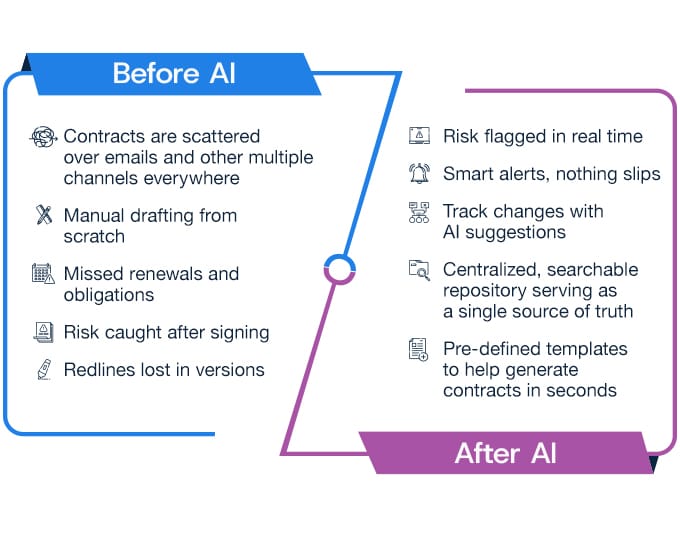
Drafting from scratch is time-consuming. AI-generated changes transform a few inputs into first drafts that are compliant, structured, and ready for review.
With AI-powered CLM, users can upload their specific pre-approved templates and select from a dropdown to generate contracts instantly. Whether it’s a Non-Disclosure Agreement (NDA),
Master Service Agreement (MSA), or vendor agreement, the structure is ready, and AI fills in the rest.
These templates reduce the time required for first drafts, enforce compliance, and expedite the approval process. AI builds on that by automatically filling in key details, inserting relevant clauses, and producing a clean draft, ready for review in seconds.
Based on the contract type and business context, AI generates a clause library that holds all relevant clauses. Commercial terms, boilerplate, and special conditions are all intelligently slotted in. The result is faster, more accurate first drafts.
Drafts generated by AI follow your internal templates and tone. This reduces review time and ensures brand and legal consistency across teams. Draft quality no longer varies by drafter.
Create a contract quickly with pre-defined templates on Provakil
Contracts are rich in information, but most of it sits buried in static PDFs. AI unlocks that value by extracting clauses, structuring metadata, and transforming documents into actionable data.
AI identifies key clauses such as indemnity, governing law, and payment terms, and labels them for quick access, eliminating the need to scroll through pages or rely on Ctrl+F. Every term is organized, searchable, and accessible in seconds.
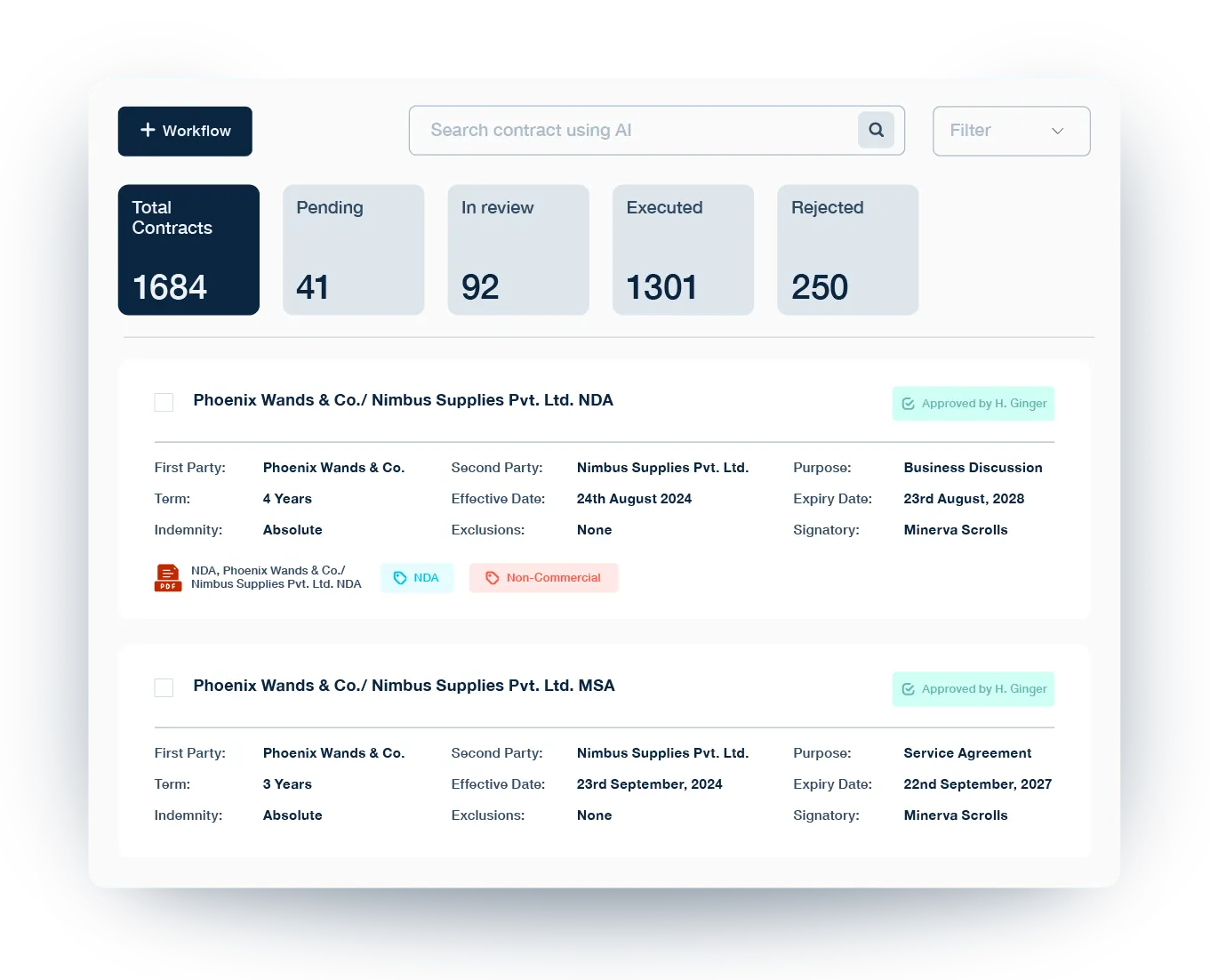
AI automatically generates metadata, including contract type, parties, start and end dates, renewal terms, and jurisdiction. This data fuels dashboards, filters, and triggers across the contract lifecycle. Legal teams no longer have to input details manually; they are done automatically at upload.
Structured metadata ensures no obligation, date, or renewal is missed due to oversight. It supports regulatory compliance by making every clause traceable and report-ready.
Extract key data from third-party contracts instantly
In current high contract-volume legal environments, every missed clause is a potential liability. AI brings precision to contract review, flagging risks, enforcing standards, and delivering consistency at scale. It’s how legal teams move from reactive to preventive, without stretching bandwidth.
AI reviews contracts by breaking them down into clause-level components and analyzing each using trained NLP models. These models detect deviations from standard language, flag risky patterns, and assign contextual risk scores, identifying issues like uncapped liabilities or vague termination clauses.
AI compares every incoming clause against your pre-approved legal playbook. It highlights deviations in real-time and recommends fallback language where necessary. This ensures consistent enforcement of legal policies across teams, functions, and geographies.
Risk isn’t one-size-fits-all. AI interprets contract type, governing law, and deal value, and adjusts its recommendations accordingly. That context sensitivity keeps recommendations relevant, not robotic.
When a clause raises a red flag, AI doesn’t just stop there; it offers refined, compliant alternatives based on your preferred language and past negotiations. That means fewer redlining incidents, fewer escalations, and faster alignment.
Accurately review contracts with pinpoint precision
In high-stakes contracting environments, not everyone needs to see everything, and not every clause should be open for edits. AI-powered CLM software brings structure to collaboration by defining who sees what, and who does what, right from initiation to execution.
Legal, sales, finance, and procurement are just a few examples; every function works differently. AI-powered CLM lets you assign precise access levels by department, user group, or geography. Sensitive terms stay protected, and teams only interact with what they’re meant to.
Key clauses, like indemnity or termination, can be locked to legal, while commercial terms remain editable by business stakeholders. It reduces back-and-forth and ensures compliance by design, not by follow-up.
Comments, approvals, and version edits happen in a centralized, controlled workspace. No side emails. No overwritten drafts. Everyone is on the same page, both literally and operationally.
Not all contracts carry the same level of risk, and AI is aware of this. It scores contracts dynamically, helping legal prioritize where to intervene.
AI assigns risk scores based on contract category, jurisdiction, party history, and deal value. A one-page NDA doesn’t require the same level of scrutiny as a three-year licensing agreement. The system adjusts automatically.
Specific clauses trigger higher risk scores, like unlimited liability, arbitration location, or penalty clauses. AI tallies these signals to create a composite risk profile. Teams know precisely where to look first.
High-risk scores can trigger workflow escalations to senior legal or leadership. Teams don’t have to monitor everything; they just need to focus on what matters. Less noise, more control.
Redlines are where deals slow down. AI helps legal teams track changes, suggest alternatives, and manage multiple versions more efficiently, eliminating the back-and-forth chaos.
Based on negotiation history and clause preferences, AI recommends a fallback language. It learns from accepted changes and offers innovative options right within the redline, reducing typing and increasing approvals.
Each change is time-stamped, attributed, and documented for audit-readiness. AI groups versions, flags key deviations, and ensures you're always working on the latest draft. No more "Which version is this?" headaches.
AI tracks what’s consistently being negotiated and helps revise templates accordingly. This shortens review cycles in the long run and aligns your terms with market realities. The more you negotiate, the smarter it gets.
Collaborate with multiple stakeholders to redline and suggest in one place
Executives don’t have time to read contracts. AI generates concise, digestible summaries that extract the key points and filter out the extraneous information.
AI extracts key points, such as commercial terms, obligations, and risks, and delivers a concise summary. These are readable and referenceable, just what decision-makers need.
AI explains complex legal clauses in plain, understandable language. It is helpful for non-legal stakeholders or business teams who need to act fast. It bridges the gap between legal review and business action.
Generate contract summaries with just a few clicks
The power of AI isn’t just in review; it’s in what happens next. Clause-level automation initiates workflows, tasks, and alerts without requiring manual input.
A clause stating "30-day notice period" triggers a reminder 25 days before the end date. No need to set up reminders manually, it’s built into the contract logic. Compliance becomes automatic.
Payment clauses trigger finance tasks, while renewal clauses notify business heads. AI routes obligations to the right owners without the need for chasing them via email, ensuring everyone stays informed.
Define triggers by clause type, value, or region, and AI handles the rest. For example, any indemnity exceeding ₹50 lakh can be routed to the General Counsel (GC).
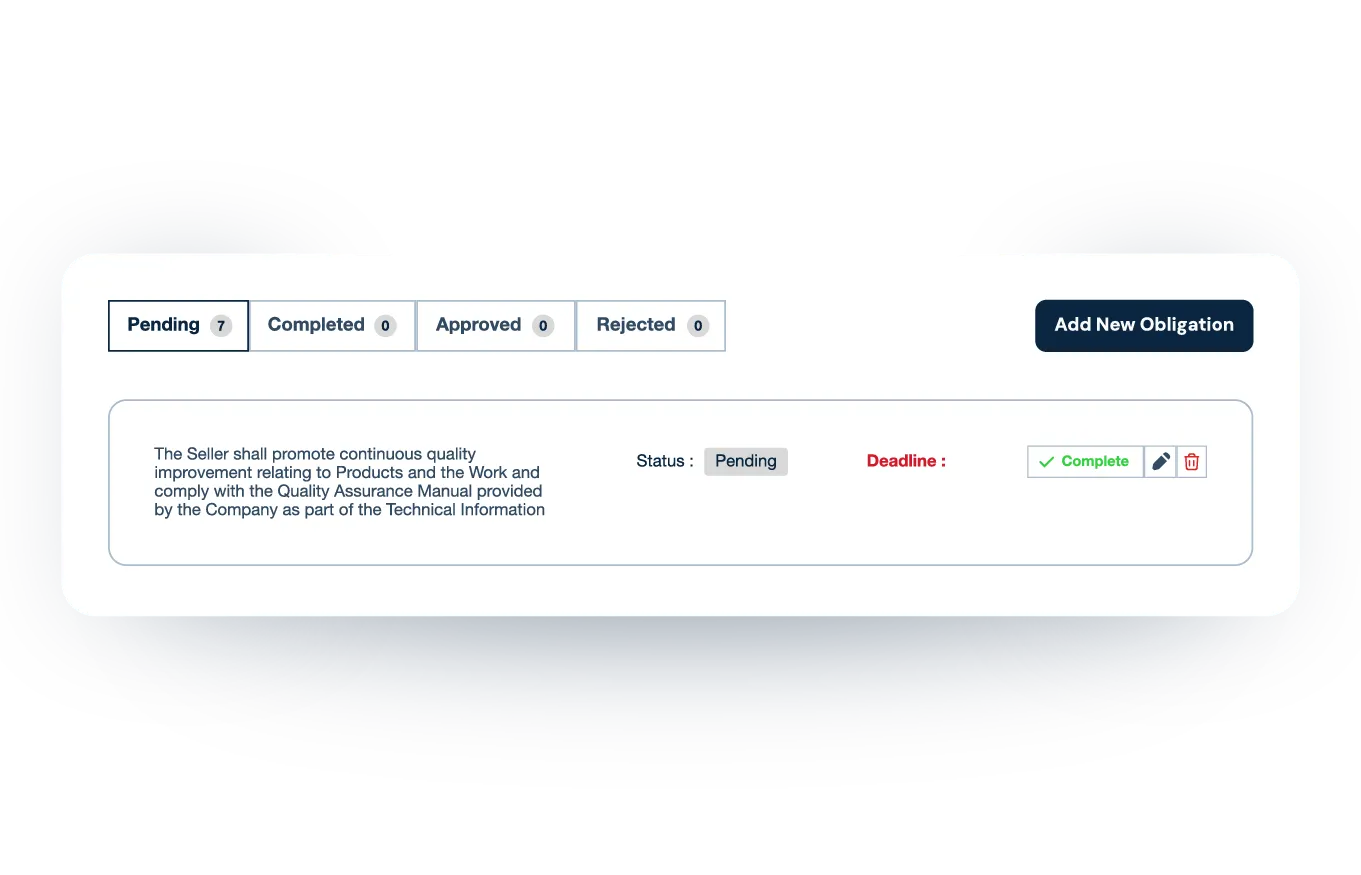
Missed renewals, forgotten obligations, and unnoticed escalations often stem from buried data. AI enables proactive tracking, ensuring that nothing slips through the cracks.
AI reads contract dates, terms, and auto-generates reminders before deadlines approach. Renewals, expirations, and price revisions are surfaced early, with no surprises. Business continuity gets protected without manual tracking.
Payment terms, service-level agreements (SLAs), and notice periods are automatically extracted and logged. Obligations are linked to responsible owners, and timelines are tracked automatically.
All upcoming renewals and obligations are visible on centralized dashboards. Teams can filter by urgency, contract type, or owner, making prioritization easy and efficient. It turns scattered reminders into unified insight.
A 2024 WCC study reveals that 71% of businesses can’t locate at least 10% of their contracts, resulting in missed obligations and costly gaps. AI helps bring archives into structured, searchable ecosystems.
AI reads scanned documents using optical character recognition (OCR) and extracts structured content using natural language processing (NLP). Even handwritten annotations or image-based PDFs become machine-readable.
Hundreds of legacy contracts can be uploaded, processed, and indexed simultaneously. No manual tagging or line-by-line review required. Within hours, your backlog becomes an asset. Additionally, access any clause of contracts through AI-powered Search.
AI ensures that metadata, such as party names, dates, and obligations, is captured accurately. Makes historical agreements searchable and audit-friendly. Helpful during due diligence or regulatory review.
In most organizations, contracts don’t live in isolation; they move across various departments, including legal, sales, procurement, finance, and leadership. That’s precisely why AI-powered CLM software isn’t just a legal tool; it’s a catalyst for operational efficiency. Here’s how different teams benefit when CLM becomes intelligent, connected, and automatic.
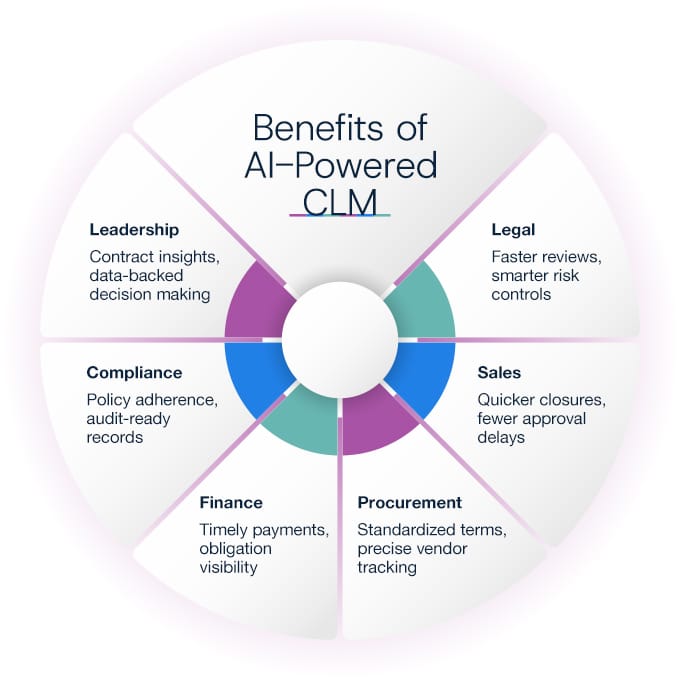
For legal teams, contract management has long been a balancing act between risk mitigation and turnaround time. With AI-powered CLM, that balance shifts in their favor. Instead of manually reviewing every clause or chasing redlines, they get real-time risk assessments, automated playbook enforcement, and contextual redlining, all in one place.
Legal teams stop being the bottleneck and start being the strategic enabler, armed with insights and time to focus on what truly matters.
Every deal delayed by contract review is a deal at risk. CLM software with AI streamlines contract drafting, embeds approvals into workflows, and offers pre-negotiated fallback clauses so sales doesn't have to wait for legal action on every request.
By removing friction from the closed process, AI-powered CLM helps revenue teams push deals across the finish line faster, without compromising on compliance or consistency.
Procurement operates on volume and urgency. AI-driven contract lifecycle management enables them to standardize vendor agreements, enforce commercial terms, and automatically track obligations, such as payment schedules and penalties. It flags deviations early, so contract value isn't eroded by overlooked terms or non-compliance.
With bulk digitization and metadata extraction, procurement finally gains complete visibility into what has been signed and what is at risk.
Finance isn’t in the weeds of contract clauses, but it feels the heat when renewals are missed, penalties are incurred, or liabilities surface unexpectedly. AI-powered CLM software links financial obligations directly to workflow triggers. It ensures payments, escalations, and revenue terms are always surfaced before deadlines.
Managing risk manually is like watching a storm with a blindfold. AI-infused CLM software provides clause-level risk scoring, deviation detection, and escalation logic, offering compliance teams a live dashboard of what is out of policy or non-standard.
For risk officers, contract lifecycle management shifts from being primarily about paperwork to being more about proactive governance and risk management.
For CXOs and decision-makers, clogged contract processes don’t just delay paperwork; they slow down the business. Missed renewals, buried risks, and approval bottlenecks quietly bleed time, revenue, and momentum.
AI-driven CLM software removes uncertainty by highlighting essential information, such as summaries, forecasts, and risk alerts, precisely when you need it. From vendor rationalization to Mergers and acquisitions (M&A) readiness, leadership gets a real-time, accurate view of contract portfolios and exposures without chasing teams or waiting on reports.

If there’s one thing the best teams have figured out, it’s this: the cost of doing nothing is no longer zero.
Contracts left unmanaged don’t just sit idle; they delay revenue, invite risk, and stretch already-thin teams even thinner.
This is where AI-powered CLM software has proven its worth. From clause intelligence to risk scoring, automated renewals to guided workflows, it enables legal and business teams to shift from reactive firefighting to proactive control.
Contract lifecycle management today is about managing outcomes with speed, clarity, and confidence. And in that equation, inaction has a cost. Progress, on the other hand, pays for itself.

Contract Lifecycle Management (CLM) is the process of managing contracts from initiation to execution, renewal, and expiry. When managed poorly, it leads to revenue leakage, compliance issues, and deal delays. Modern CLM tools bring structure, speed, and visibility to this critical business function.
A digital contract repository isn’t just storage; it’s searchable, structured, and designed for tracking key contract metadata, such as clauses, renewal dates, and obligations. Unlike simple folders, contract repository software gives legal teams structured information, auditability, and instant access to critical terms.
Look for CLM software that offers AI-powered review, clause-level risk detection, role-based access, digital contract templates, and integration with e-signature tools. The best contract management software is one that aligns with both compliance needs and cross-functional workflows.
Provakil offers AI-powered contract lifecycle management tools that go beyond storage and workflow. From automated drafting and clause suggestions to obligation tracking and real-time insights, it helps legal teams reduce turnaround time, minimize risk, and standardize contracts at scale.

Dive deep into Provakil's numerous blog posts & discover how legal tech can streamline your litigation, contracts, IP, and notice management processes.