The Cost of Not Investing in Enterprise Legal Management Software in 2026
8 min read
Provakil named a G2 High Performer in Legal Case Management—Two times in a Row!



Every enterprise legal team enters 2026 with the same underlying pressure: the business expects legal to operate at the speed, accuracy, and transparency of a modern operations function, yet most legal departments still run on infrastructure never designed for legal work at scale.
Case updates are scattered. Hearing reminders are manual. Invoices move through unstructured approvals. Compliance tasks sit in personal calendars. Documentation is scattered across multiple teams and varied sources.
In this environment, operating without Enterprise Legal Management (ELM) software isn’t just inefficient; it's a structural vulnerability.
Without modern ELM software, legal operations lose the structure required to maintain control. The absence of centralized matter data, audit-ready documentation, automated workflows, and real-time dashboards creates blind spots that expand quietly into financial, regulatory, and reputational consequences.
This blog breaks down precisely how delaying ELM Solution adoption is costing in-house legal teams, and why the organizations that modernize now will be the ones equipped to handle the speed, risk, and scrutiny that define 2026.
The legal landscape isn’t merely evolving, it’s accelerating; and 2026 marks the year when traditional, manual legal operations can no longer keep pace with the speed at which risk, regulation, and business decisions now move. This is the inflection point where enterprises relying on fragmented systems will find themselves structurally disadvantaged.
By 2026, AI will move from being an experimental add-on to the core operating layer of modern legal departments. Leadership expects automated insights, risk alerts, centralized dashboards, and real-time analytics across cases, contracts, and spend.
Enterprises running without AI in legal operations or integrated legal operations software will struggle to meet the speed and intelligence expected.
The new year comes with a compliance ecosystem marked by frequency, complexity, and zero tolerance for delays. Statutory filings, regulatory submissions, and ESG obligations must be executed precisely.
However, manual trackers and siloed workflows lead to missed deadlines and fragmented documentation, making Litigation Management Software crucial for maintaining consistency, accuracy, and audit-ready governance.
Litigation portfolios are expanding across industries, and the cost of managing them is rising just as quickly. Legal teams now juggle more cases, filings, and documentation than their existing systems can support.
Without a unified case management framework, operational risks escalate: missed updates, incomplete case records, a higher risk of ex parte orders, inconsistent documentation, and growing inaccuracies in measuring contingent liabilities.
As caseload increases, manual processes simply cannot keep pace, and the financial impact of delays, errors, and poor visibility becomes unavoidable.
Quarterly pull-out spreadsheets no longer suffice. Boards want dynamic dashboards that show exposure, timelines, spend, compliance status, and case outcomes in real time.
Organizations operating without modern ELM software lack the transparency, speed, and intelligence required to support data-driven governance in 2026.
Get Your Copy Now
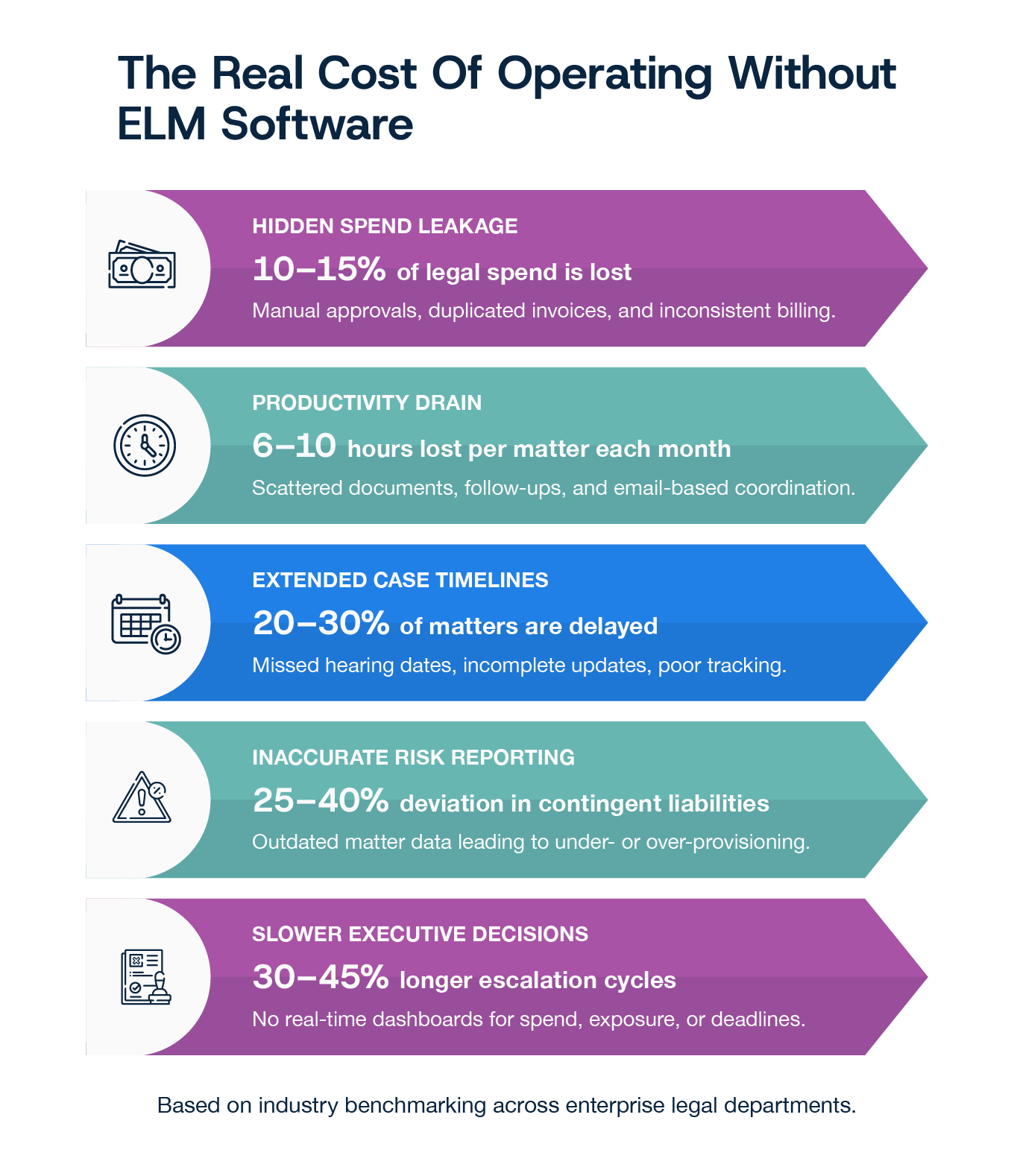
Unreported spending and legal costs leaking out are persistent issues that drain enterprise budgets. Errors in billing, rate cards, and invoices often go unnoticed due to unstructured processes like email approvals and scattered spreadsheets. This can lead to overpayments to external counsel, misallocated budgets, and failures to reconcile actual spending with forecasts.
Contingent liabilities pose real financial risks to enterprises, yet manual tracking often leaves them outdated. Incomplete documentation and outdated records obscure an organization’s true exposure. Without an integrated Enterprise Legal Management (ELM) solution, CFOs and boards lack an accurate view of pending risks, leading to under-provisioning and surprises during audits.
The most costly mistake in litigation is often missing a hearing. When details are spread across emails, WhatsApp, and personal trackers, the risk of oversight increases, especially as courts accelerate hearings and digitize lists. This can lead to ex parte orders, harm the case and reputation, and escalate costs. A unified case management system that centralizes updates, documents, and next steps is crucial to effectively managing litigation risk.
Legal teams are crucial to strategic decision-making across contracts, HR, and compliance. When legal operations are manual, it leads to slow approvals, conflicting contract versions, and poor collaboration. Without integrated legal management tools, companies face delays and complicated compliance reporting.
Boards and CXOs must operate on foresight, not hindsight. Yet enterprises without modern legal operations software lack the insights needed. Litigation exposure is unclear, spending is unexamined, compliance gaps arise during audits, and trends are reviewed retrospectively.
ELM consolidates every step of case initiation, approvals, document uploads, checklists, and filing data into a single workflow. This removes the common breakdowns legal teams face when case filing depends on scattered emails, manual coordination, or incomplete inputs.
Case files no longer live in personal drives or shared folders with ambiguous ownership. ELM software provides a secure, governed repository for storing, versioning, tagging, and easily retrieving petitions, orders, notices, affidavits, drafts, and evidence. Documentation stays audit-ready, complete, and protected.
The solution captures every hearing date, order, interim direction, next step, and forum movement in one place. Automated alerts and reminders ensure no hearing, filing, or deadline is missed, directly solving issues leading to missed hearings, ex parte risks, outdated cases, and incorrect contingent liability reporting.
Instead of invoices moving through email-based approvals or legal spend living in inaccurate spreadsheets, Provakil’s ELM software centralizes all spend data, budgets, invoices, court fees, stage-based fees, and external counsel payments. Every cost is tracked, verified, and matched against the matter and its progression.
Litigation management software brings external lawyers into a secure, role-based workspace. They can update case status, upload documents, submit invoices, and add hearing notes, without accessing internal data beyond their scope. This solves the coordination gaps legal teams face when counsel updates arrive late, inconsistently, or across fragmented channels.
Enterprise Litigation Management Software becomes the single source of truth for all case information: history, filings, orders, tasks, comments, spend, documents, and performance metrics. This solves the biggest structural issue legal ops teams face: fragmented data that never paints the full picture.

At its core, Enterprise Legal Management software solves a problem every organization feels but rarely names: the growing gap between what legal teams are responsible for and what their current systems can support.
ELM solution closes that gap with structure, visibility, automation, and intelligence, giving legal operations the foundation they need to function with accuracy and control.
The value of ELM is simple: it strengthens legal operations where manual processes consistently fail. And enterprises that adopt it build a legal function capable of meeting the speed, scrutiny, and complexity of today’s environment.
Those who delay inherit risks they no longer need to carry.

If your legal team relies on spreadsheets, email reminders, scattered documents, or manual follow-ups, you already feel the gaps. Missed deadlines, unclear ownership, slow escalations, and inconsistent updates are the strongest indicators that the organization needs ELM Software.
Common hidden costs include spend leakage, extended litigation cycles, inaccurate contingent liabilities, compliance lapses, and slower decision-making. These issues compound quietly and significantly impact financial accuracy and operational discipline.
Our ELM Software tracks cases across 19,000+ forums, automating workflows and tracking dates, filings, notices, approvals, and obligations. The system sends reminders, triggers escalations, and assigns ownership—removing dependency on manual calendars or inbox-driven tracking.
ELM ensures that case data is consistently updated and stored centrally. This allows finance and legal teams to access accurate exposure information, reducing provisioning errors and improving audit readiness.
Adoption is typically straightforward because modern ELM systems are built for business teams, not just lawyers. With guided onboarding, role-based access, and intuitive dashboards, enterprises see strong adoption across legal, business, and finance functions.
No. While large enterprises benefit most from scale, mid-size organizations are increasingly adopting ELM to build disciplined, data-driven legal operations that support growth and governance.

Dive deep into Provakil's numerous blog posts & discover how legal tech can streamline your litigation, contracts, IP, and notice management processes.