7 Legal Tech Trends To Watch Out For in 2026
10 min read
Provakil named a G2 High Performer in Legal Case Management—Two times in a Row!



There has been a considerable shift in how modern lawyers, law firms, and in-house legal teams see technology today. From digitizing case documents to using AI to draft contracts in minutes, the legal industry is leveraging new-age tech tools to automate routine tasks and prepare regulatory reports required for compliance.
As businesses shift to tighter budgets and leaner teams while still meeting stakeholders’ high expectations, legal firms will increasingly rely on technology to drive speed and efficiency. In this blog, we’ll explore the top legal tech trends defining 2026 and what they mean for legal teams aiming to stay agile, scalable, and future-ready.
Get Your Copy Now
Research remains one of the most time-consuming responsibilities in any law practice. Junior lawyers often spend countless hours combing through old judgments, trying to spot precedents, and preparing case briefs. The process is slow, repetitive, and error-prone.
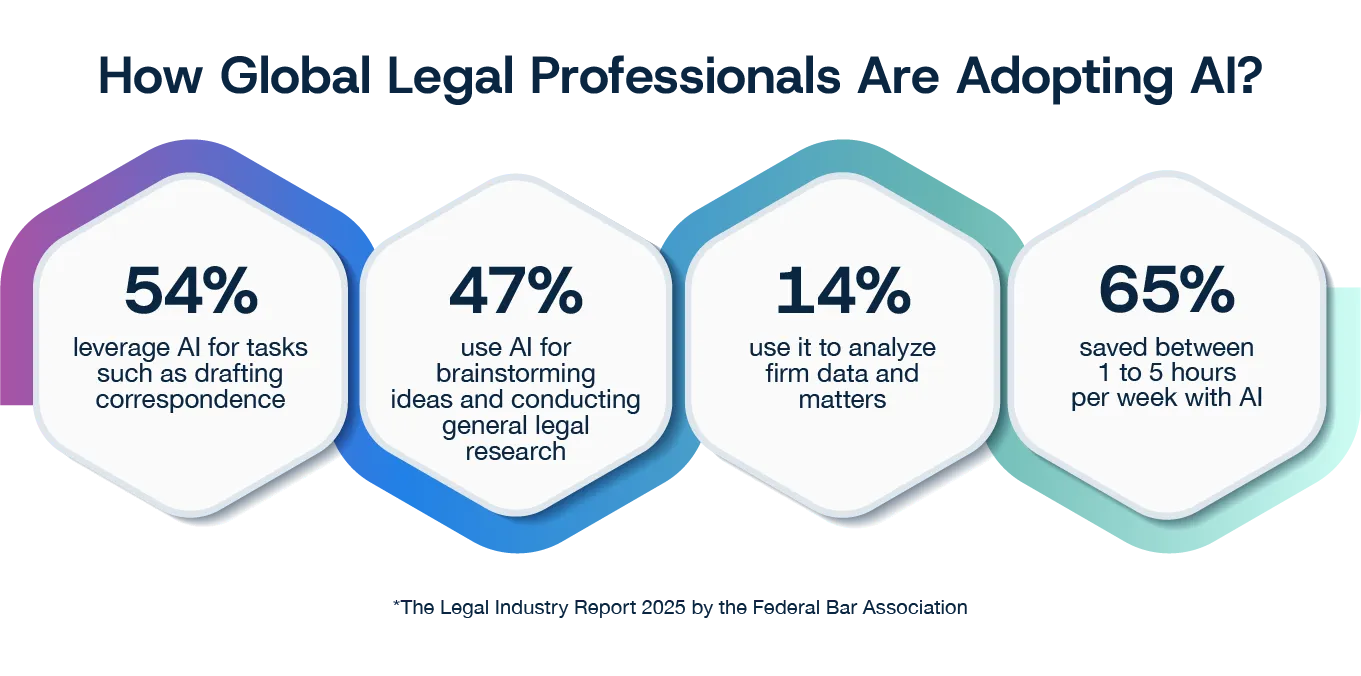
Legal teams aren't just looking to reduce time spent on research - they’re rethinking how legal knowledge itself gets stored and accessed. AI is prompting a shift from static libraries to dynamic, self-learning systems, transforming research into real-time intelligence.
AI-powered legal research tools use natural language processing (NLP) to understand the contextual nuances of information. It helps legal teams:
When ChatGPT, Claude, and Gemini arrived, lawyers were curious to see how these AI answer engines could help make their lives easier. They used them to prepare strategies and arguments for cases. What they didn’t know was that these tools might not always provide accurate information.
Morgan & Morgan, a well-known law firm in the US, was sanctioned by a district court for a motion that cited some cases, which were allegedly “hallucinated” by an internal AI platform and were not legitimate. This case is one of many instances where AI tools have led to drastic consequences for legal professionals.
AI chatbots hallucinated between 69% to 88% of the time on legal queries.
*Study by Stanford RegLab and Institute for Human-Centered AI researchers
Global researchers are developing a retrieval-augmented generation (RAG) system—an AI framework that enhances the capabilities of large language models (LLMs) by connecting them to external knowledge bases. This will help LLMs access real-time, domain-specific information, improving their accuracy and reliability.
Until then, legal professionals are using a human-in-the-loop approach, reviewing AI chatbot responses multiple times to ensure accuracy.
Legal documents are often dense, loaded with jargon, and complex in their structure. Hence, lawyers find it challenging to explain them to their clients. This leads to frequent follow-ups and inquiries about case updates.
Legal design combines human-centered thinking with the law to make legal documents more accessible to a layperson.
The approach blends rapid prototyping, user interviews, and iterative testing, ensuring that documents and workflows are not only visually appealing but also easier for people to interpret.

Legal teams are employing legal design in various ways:
Legal teams often get blindsided by disputes or compliance lapses. Contract reviews and risk assessments are typically reactive.
Predictive analytics combines historical case data, statistics, and machine learning to forecast outcomes, such as how a case will progress and compliance risks. It guides decisions with patterns and insights, helping firms choose the right cases, allocate resources, and manage risks more effectively.
Legal teams utilize these tools to anticipate litigation, flag potentially risky clauses, and integrate intelligence into their daily workflows.
Law firms and legal teams are most likely to be victims of cybercriminals because of the sensitive, high‑value data they manage.

These data breach incidents aren’t minor errors. They can lead to substantial monetary losses. Breaches often result from phishing, ransomware, or credential theft, but the deeper issue lies in legacy systems, limited incident response plans, and inadequate compliance frameworks.
Corporate clients and regulatory bodies now demand complete transparency around data handling. Legal service providers must demonstrate compliance with international standards. Tech tools that don’t offer encryption, audit trails, and compliance certifications are no longer acceptable and are increasingly subject to disqualification in the procurement phase.
Here’s why cybersecurity matters for legal firms:
Cyber resilience is no longer a backend concern - it’s a business differentiator. Firms that highlight certifications, audits, and secure portals can position cybersecurity as a competitive advantage.

Remote work has firmly cemented itself as a baseline expectation in the legal industry. It's not a temporary measure, but the new frontier of professional legal practice. However, success in this model depends not only on offering flexibility but on strategically deploying tools, policies, and cultural frameworks to maintain productivity, client service, and firm identity.

As remote tools mature, leaders find fewer distractions, greater control over their schedules, and more efficient workflows. Firms benefit too, by reducing office expenses and reallocating funds toward growth initiatives.
For a robust remote infrastructure, lawyers and law firms are investing in:
Manual client updates consume time and increase the likelihood of errors. Failing to share case updates, such as hearing dates and order summaries, with clients can damage trust. Hence, legal chatbots are increasingly taking the lead in managing routine client communications, from intake forms and FAQs to 24/7 status updates.
As per a Thomson Reuters Survey, around 26–37% of law firms are deploying generative AI tools (including chatbots) to streamline initial client communication, with adoption expected to rise as workflows evolve. These firms use chatbots for:
Regulatory requirements around the globe evolve rapidly. Manually tracking these requirements and ensuring compliance leads to errors and a tremendous amount of labour time. Regulatory technology, also known as RegTech, automates monitoring regulatory changes, extracting key clauses from contracts, and generating intelligent alerts. These systems dramatically reduce the risk of non-compliance by proactively flagging updates.
A Fortune Business Insights report shows that the global RegTech market is projected to reach $19.6 billion in 2025.
Here are some core capabilities that you should consider while investing in regulatory technology:

As we move into 2026, it's clear that legal tech is no longer a niche—it's a necessity. From AI-powered workflows to smarter contract management and human-centered legal design, the trends shaping the future are all about driving efficiency, accessibility, and strategic value. For legal teams and firms willing to embrace innovation, the opportunity isn't just to keep up, but to lead. The question isn't if your legal function will evolve—it’s how quickly you’re ready to adapt.

A legal workspace is a centralized platform that shows all matters, hearings, deadlines, and case updates in one place, helping lawyers save time and avoid missing critical tasks.
Firms utilize Provakil dashboards to track hearings, court orders, and case progress instantly. This helps them prepare more effective strategies and update clients without delay.
Yes. Provakil connects directly with Indian court databases, automatically pulling listings, orders, and case updates into your workspace.
Clear communication fosters trust, keeps clients informed, and reduces the need for repetitive queries about case status or documents.
Law software is used to manage cases, documents, deadlines, invoicing, teams, and client management. It centralizes everything lawyers need to run a practice efficiently.
Provakil automates repetitive tasks like case & task tracking, sends deadline reminders, and enables reporting, helping lawyers focus on research, client work, and case strategy.

Dive deep into Provakil's numerous blog posts & discover how legal tech can streamline your litigation, contracts, IP, and notice management processes.