Legal Notice Automation Transforming India’s Banks & NBFCs
8 min read
Provakil named a G2 High Performer in Legal Case Management—Two times in a Row!



A few months ago, during a client strategy call with one of India’s top-tier private banks, their General Counsel made a candid confession:
“Despite having everything else digitized, we still track legal notices in Excel sheets and print hundreds every week. We often miss timelines; not because we lack intent, but because the process itself is broken.”
This isn’t the only case.
Across the BFSI sector, from legacy banks to digital lenders, the manual process of sending legal notices is slowing down recovery, draining compliance teams, and delaying litigation.
That’s where legal notice automation steps in; not just as a productivity tool, but as a catalyst for transformation.
By leveraging automated legal notice software, institutions can digitize and streamline the entire debt recovery process, from pre-litigation to case filing and beyond, under the SARFAESI or Section 138 provisions. Whether you're managing high DPD accounts or early-stage soft dunning, the right legal collections management software integrates seamlessly with your LMS, DMS, and core banking systems to deliver compliant, timely, and trackable communications.
In this blog, we’ll unpack how legal notice automation is changing the game for banks and NBFCs, and why it’s quickly becoming a non-negotiable for future-ready legal teams.
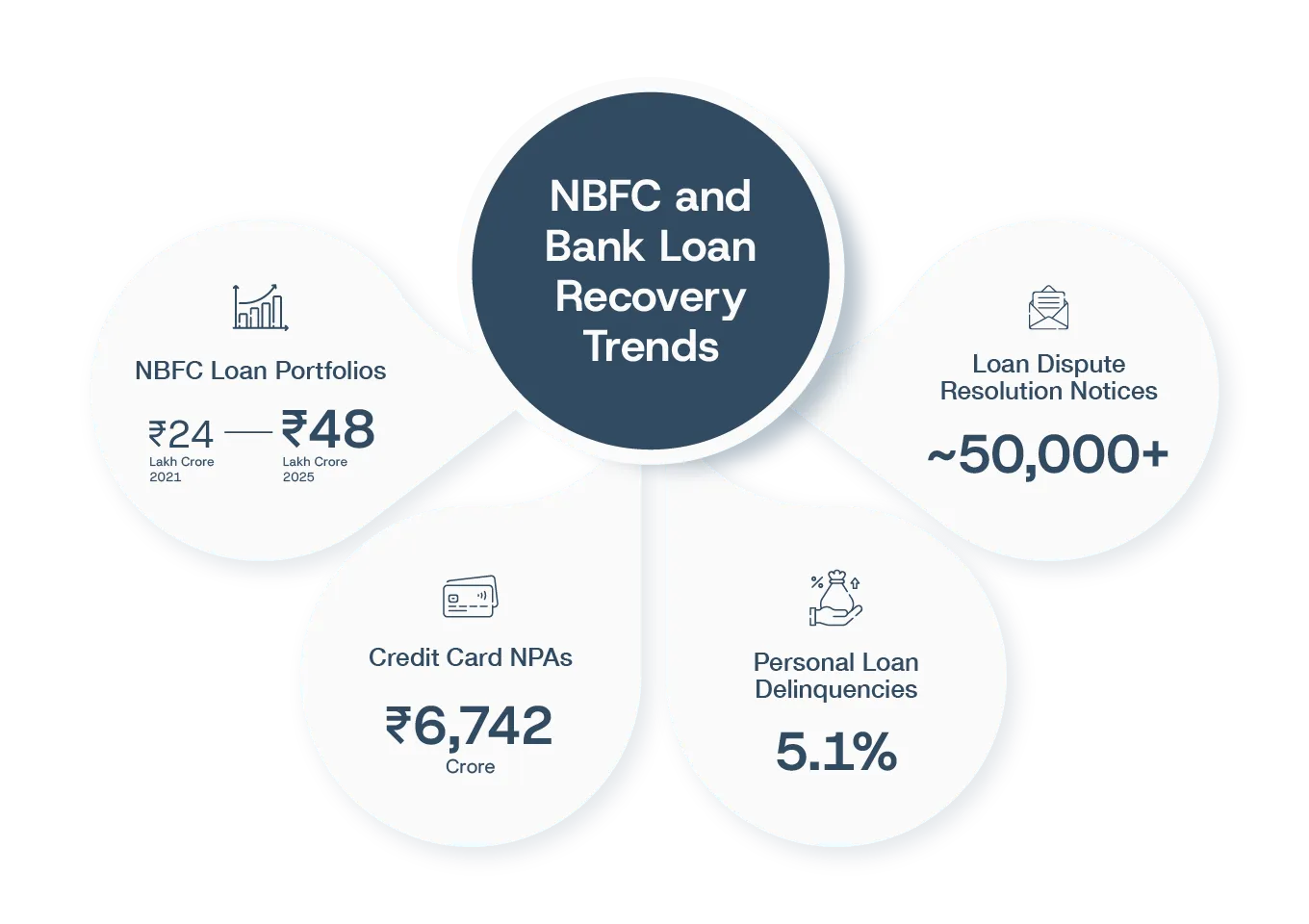
Most financial institutions still rely on manual tools, such as spreadsheet trackers, physical templates, and ad hoc email dispatches, for legal notice management. This process now operates at a staggering scale, with NBFCs' loan portfolios having grown from ₹24 lakh crore in 2021 to ₹48 lakh crore in 2025.
"According to the Financial Times, personal loan delinquencies (90+ DPD) now hover around 5.1%, up from 3.9% the previous year. Credit card NPAs alone have reached ₹6,742 crore, accounting for 2.3% of total balances."
According to a State‑Level Bankers’ Committee (SLBC) report, banks file over 48,000 DRT cases, issue 637 asset confiscation notices, and serve approximately 50,000 dispute resolution notices in a single year.
These require strict adherence to SARFAESI, RBI Fair Practices, or Section 138, where even one missed date or incorrect format can render recovery invalid.
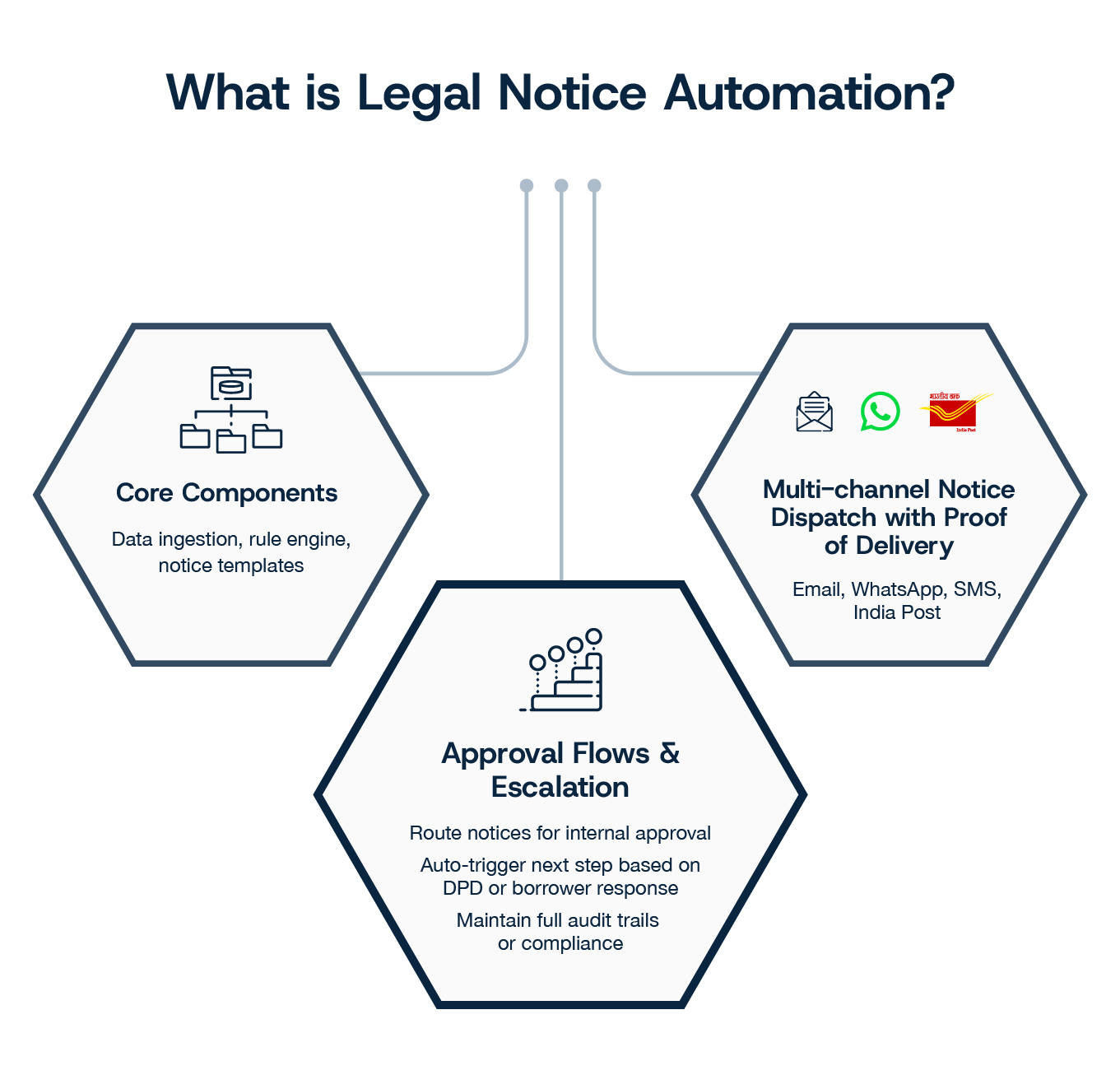
Legal notice automation refers to the digitized process of generating and dispatching legal notices using predefined rules and system integrations. It replaces the manual, error-prone workflows traditionally used by legal and collections teams to initiate recovery communication with borrowers.
The end-to-end automation encompasses logic-based decision-making, auto-creation of notices, multi-channel delivery (email, SMS, WhatsApp, India Post), and real-time tracking of dispatch and acknowledgment. By connecting directly to loan systems, it ensures notices are triggered using the right data, sent in the correct format, and tracked with audit-ready precision.
In most lending institutions today, sending a legal notice still begins with a manual request—an Excel sheet of defaulters, a paralegal drafting letters one by one, someone printing and signing documents, and another person coordinating dispatch. There’s little standardization, no real-time visibility, and minimal audit trails. It’s not just inefficient—it’s unsustainable at scale.
That’s where legal notice automation reshapes the equation. The biggest shift?
Legal managers often spend 2–3 days building a master spreadsheet of delinquent accounts, manually applying notice logic, and running mail merges to generate notices, only to risk rework if there's even a single formatting error or outdated data. Additionally, these spreadsheets don’t reflect real time borrower actions, meaning notices may still be sent even if a payment has already been made.
Provakil automates this end-to-end using live data from LMS and payment systems, ensuring notices are accurate, instant, and error-free, thereby freeing legal teams to focus on strategy rather than manual data entry.
Every notice generated through automated legal notice software is tracked, timestamped, and archived with delivery proofs. This creates a defensible paper trail essential for court proceedings under SARFAESI, Section 138, or Arbitration.
For NBFCs disbursing small-ticket unsecured loans, taking legal action for every default isn’t financially viable. Legal notice automation introduces a cost-effective middle layer, enabling early intervention and effective management. It reduces per-account recovery costs while maintaining legal pressure on borrowers.
Automation reduces turnaround time from days to hours, ensuring that loan recovery actions commence promptly after default triggers, such as DPD thresholds, are met. Instant, rule-based notice generation and multi-channel delivery improve borrower engagement and follow-through. The faster the notice reaches, the faster recovery conversations can begin.
With pre-approved notice templates, jurisdiction-specific clauses, and configurable approval flows, automation reduces human error. It ensures that every notice complies with regulatory requirements, including the RBI's fair practices and court mandates. This consistency protects lenders from compliance breaches and strengthens their position in any potential legal challenge.
With centralized dashboards, legal and collections teams gain instant insight into what’s working, and what isn’t, across regions, product types, and borrower segments.
This visibility allows for rapid course correction, A/B testing of recovery strategies, and informed adjustments without waiting for month-end reviews. Over time, lenders can fine-tune their legal notice approach using live performance data to drive smarter, more effective loan recovery.
Legal notice automation doesn’t only operate in isolation. It also thrives when embedded within a larger ecosystem, a unified legal collections management software that connects data, workflows, and compliance across the entire recovery lifecycle.
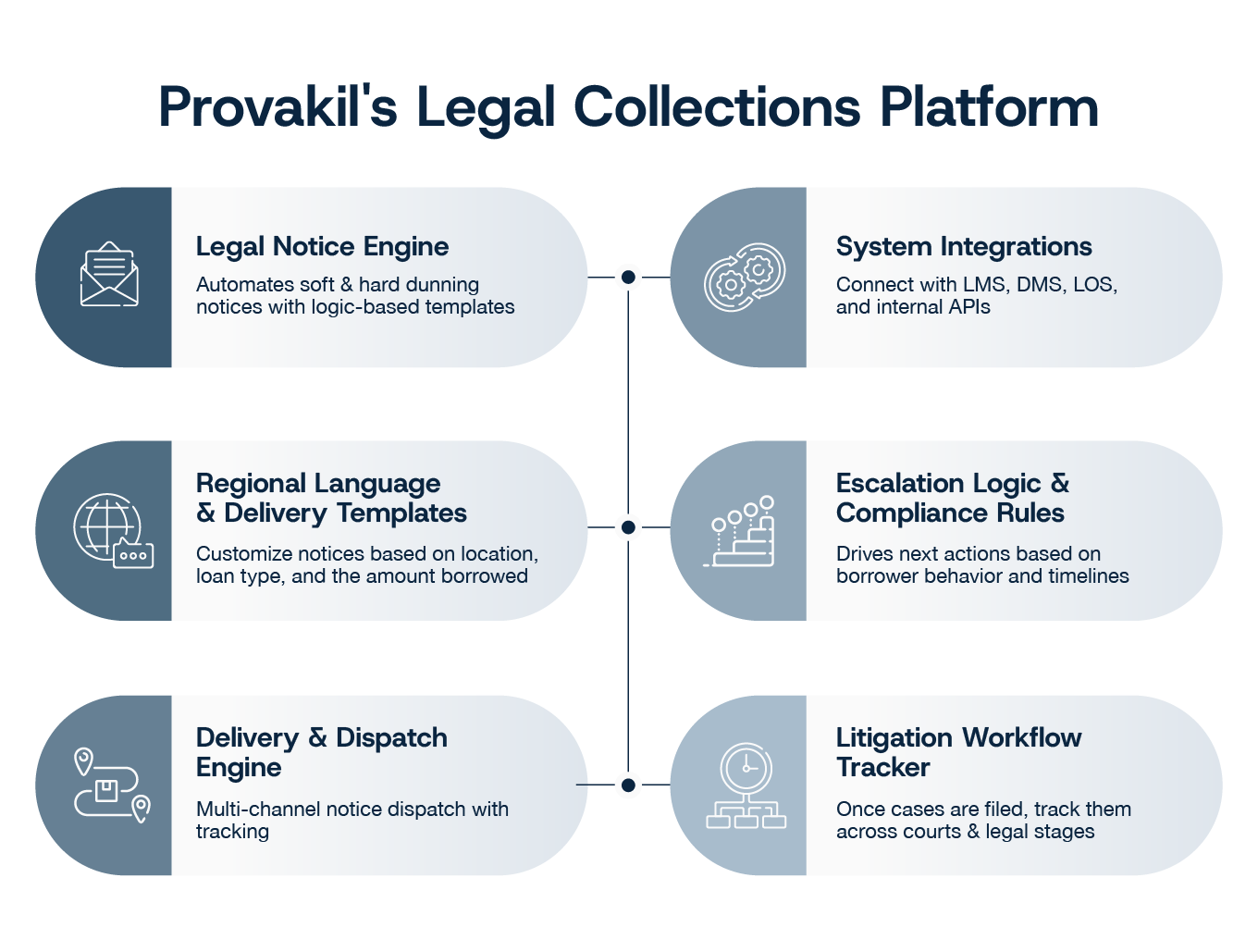
Provakil centralizes the entire legal notice lifecycle, from data ingestion to dispatch tracking, on a single, integrated platform. Built to handle massive operational scale, the system generates over 5.5 lakh notices in a single day, supporting even the most demanding recovery environments.
With standardized templates, delivery workflows, and robust audit trails, lenders can run compliant, large-scale automation without adding operational load.
Provakil integrates directly with your Loan Management System (LMS), Document Management System (DMS), Core Banking Systems (CBS), third-party payment systems, and collections platforms to ensure that borrower data flows seamlessly.
The system retrieves borrower details (name, address, contact), loan parameters (DPD, POS, product type, outstanding balance), account history, and document records, all without requiring manual input. This ensures that notices are accurate, compliant, and automatically triggered based on live borrower behavior, thereby improving precision and reducing administrative lag.
From urban metros to rural credit zones, Provakil adapts. Its dynamic notice engine supports regional templates, vernacular formats, and geo-specific compliance rules, making it easier for banks and NBFCs to communicate clearly and legally across diverse borrower segments.
Once generated, notices are automatically routed for multi-channel delivery. Digital options, such as email, SMS, and WhatsApp, enable instant dispatch with delivery tracking and read receipts.
For cases requiring physical service, integration with India Post or courier partners enables tracked delivery with acknowledgement reports. This ensures that every notice, whether dunning or LRNs, reaches the borrower via the most appropriate and compliant channel.
Provakil enables legal and collections teams to define smart escalation logic based on DPD buckets, product category, and outstanding amount. This allows lenders to automate notice generation using recovery strategies tailored to specific borrower segments.
Over time, teams can track which strategies drive better response rates, enabling data-backed adjustments and targeted loan recovery efforts.
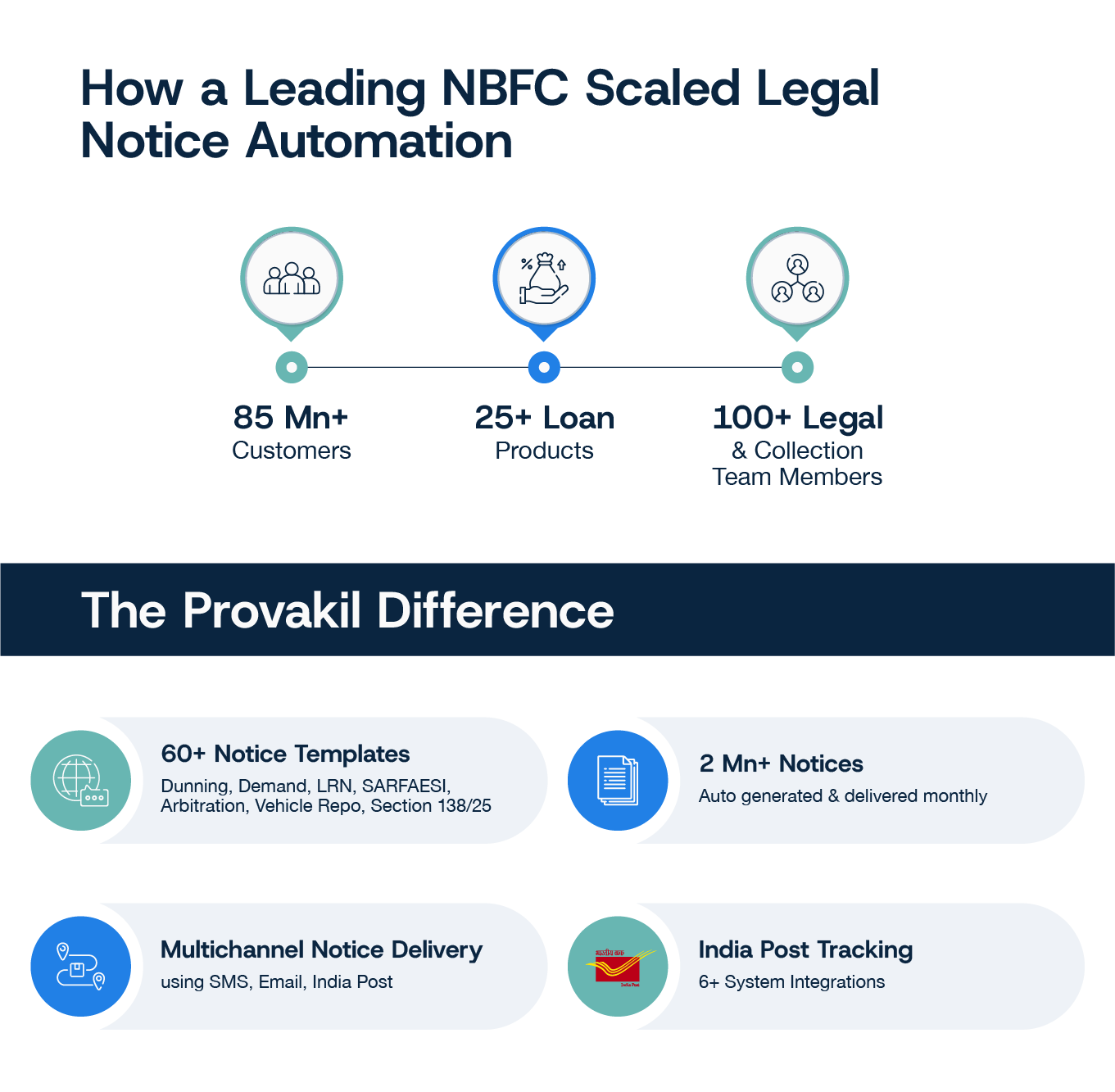
Managing over 85 million customers and a $41 billion loan book, one of India’s top NBFCs needed a reliable, scalable way to automate legal notice delivery across 25+ loan products. With complex bucketing logic, high-volume defaults, and a decentralized legal team, manual notice generation was no longer viable. Here’s the difference Provakil created:
Loan recovery isn’t just about collection; it’s about timing, compliance, and strategic execution. In a landscape where defaults are increasing and legal pressure is mounting, relying on manual processes for generating legal notices is no longer a sustainable approach.
Legal notice automation transforms this process from a reactive task into a structured, intelligent workflow, freeing up legal teams, reducing costs, and accelerating borrower response. When supported by robust legal collections management software, the benefits compound.
Whether you're an NBFC managing small-ticket loans or a bank scaling secured portfolios, automation isn’t just a tool: it’s a competitive edge. And the financial institutions that adopt it now will be better prepared for loan recovery, litigate more effectively, and stay compliant at every step.

Most debt collection systems focus solely on tracking repayment and sending reminder workflows. Provakil, however, is purpose-built for legal collections automation, combining notice generation, compliance-ready templates, multi-channel dispatch, escalation logic, and legal workflows into a single platform. This legal-first design enables banks and NBFCs to manage both early delinquency notices and post-default legal actions within the same system.
While many collection platforms focus on payment tracking and reminders, a legal-first debt collection system integrates SARFAESI, arbitration, Section 138, and DRT workflows. It offers document automation, compliance checklists, advocate assignment, court hearing updates, and integrates with legal spend systems. It’s built not just to collect — but to ensure total compliance throughout.
Yes. Provakil is built to scale and does that seamlessly. Leading platforms support bulk notice generation through automated logic buckets (based on DPD, POS, etc.), push thousands of notices via email, SMS, WhatsApp, and integrate with India Post for physical dispatch. Advanced systems process 50K+ legal notices/month and offer automated tracking dashboards.
Absolutely! Enterprise-grade legal collections platforms offer role-based access, end-to-end encryption, document audit trails, activity logs, and are hosted either on-prem or on dedicated cloud servers (including India and GCC data residency options) to meet jurisdictional and compliance requirements.

Dive deep into Provakil's numerous blog posts & discover how legal tech can streamline your litigation, contracts, IP, and notice management processes.